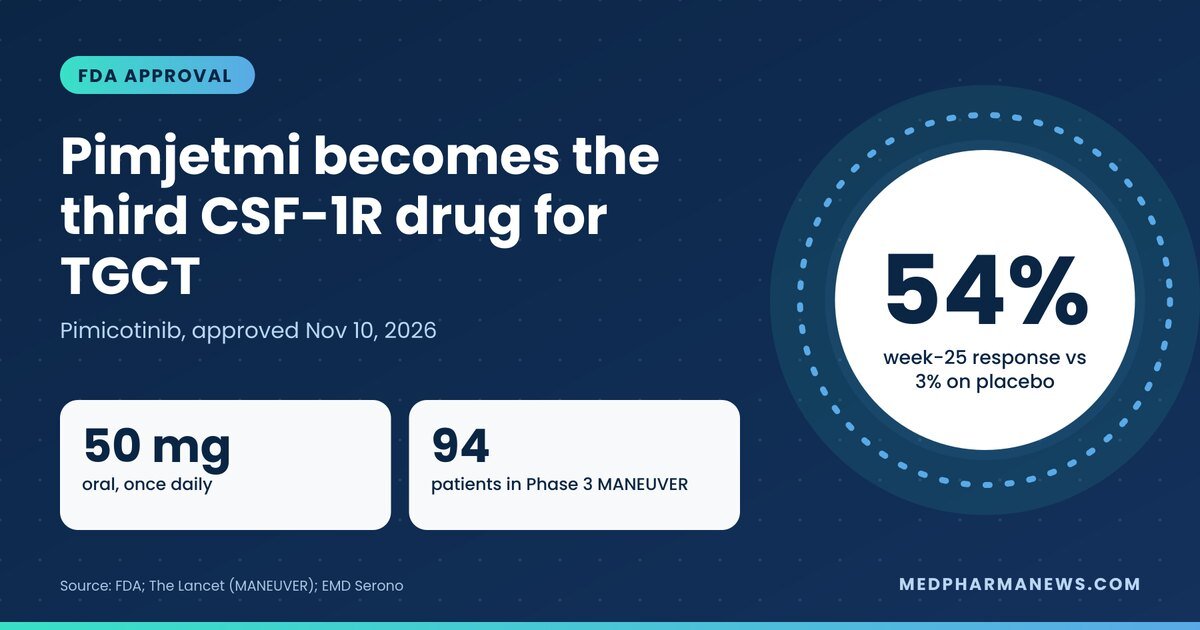
The Pimjetmi FDA approval came on November 10, 2026, when the U.S. Food and Drug Administration cleared pimicotinib (Pimjetmi), a once-daily 50 mg oral CSF-1R inhibitor from Abbisko Therapeutics licensed to Merck KGaA, Darmstadt, Germany (EMD Serono in the U.S.), for adults with symptomatic tenosynovial giant cell tumor (TGCT) when surgery could worsen function or cause severe morbidity. In the Phase 3 MANEUVER trial, 54% of treated patients responded at week 25 versus 3% on placebo.
Key takeaways on the Pimjetmi FDA approval
- Pimjetmi is the third CSF-1R inhibitor approved for TGCT in the U.S., after Turalio (pexidartinib) and Romvimza (vimseltinib).
- It is taken once daily, with or without food, a simpler schedule than the twice-daily pexidartinib.
- The label carries warnings for liver toxicity, embryo-fetal toxicity and raised serum creatinine without an effect on kidney function.
- The review ran under Project Orbis, alongside regulators in Australia, Canada, Israel, Switzerland and the UK.
- For Abbisko, U.S. approval triggers a milestone tied to the first commercial sale under a deal worth up to $605.5 million.
Who the approval is for
TGCT is a rare, usually non-malignant but locally aggressive tumor of the joint lining, tendon sheaths and bursae, most often around the knee. It is driven by overproduction of colony-stimulating factor 1 (CSF-1), which recruits inflammatory cells that make up most of the tumor mass. Patients typically report pain, swelling, stiffness and loss of movement. Surgery is the standard first option, but diffuse disease recurs often, and repeated operations can leave joints permanently damaged. The FDA indication is limited to those patients for whom resection risks worsening functional limitation or severe morbidity.
MANEUVER trial in numbers
MANEUVER (NCT05804045) was an international, double-blind Phase 3 study that randomised 94 patients 2:1 to pimicotinib or placebo. Part 1 results were published in The Lancet.
| Measure | Pimicotinib 50 mg daily | Placebo |
|---|---|---|
| Patients randomised | 63 | 31 |
| Objective response at week 25 (blinded central review, RECIST 1.1) | 54.0% (34/63) | 3.2% (1/31) |
| Difference | 51 percentage points (95% CI 33 to 63; P < .0001) | |
| Response with extended follow-up (median 14.3 months) | 76.2% | n/a |
| Discontinuation due to adverse events | 1.6% | n/a |
| Dose reduction due to adverse events | 7.9% | n/a |
Responses deepened with time: at a median of 14.3 months, the response rate among patients on pimicotinib from the start had risen to about three in four, and median duration of response had not been reached. The companies also report statistically significant gains in relative range of motion, physical function and pain, though numerical effect sizes have not been published in the announcement.
How Pimjetmi compares with Turalio and Romvimza
| Drug | U.S. approval | Dosing | Pivotal week-25 response vs placebo | Notable label feature |
|---|---|---|---|---|
| Turalio (pexidartinib) | 2019 | Oral, twice daily | 39% vs 0% (ENLIVEN) | Boxed warning for liver injury; restricted REMS program |
| Romvimza (vimseltinib) | 2025 | Oral, twice weekly | 40% vs 0% (MOTION) | No boxed warning |
| Pimjetmi (pimicotinib) | 2026 | Oral, once daily | 54% vs 3% (MANEUVER) | Hepatotoxicity warning; liver tests before and during treatment |
The numerically higher response rate is the obvious marketing point, but MANEUVER enrolled a large share of patients in China, and differences in baseline tumor size and prior treatment can shift response rates. Prescribers are likely to weigh liver safety and convenience at least as heavily as the headline percentage.
Safety signals to watch
Liver injury defined the first drug in this class, so it is the first thing clinicians will check. Pimjetmi’s label warns of hepatotoxicity and calls for liver blood tests before and periodically during treatment. EMD Serono says MANEUVER showed no cholestatic hepatotoxicity and no hair or skin hypopigmentation. Common side effects (above 20%) included itching, rash, facial and periorbital swelling, fatigue, nausea, headache and peripheral swelling. Laboratory rises in creatine phosphokinase, LDH, liver enzymes, lipase, amylase and cholesterol were frequent; grade 3 or 4 creatine phosphokinase elevation was seen in 13% of patients.
The business behind the molecule
Pimicotinib is a China-discovered asset that went global through licensing. Merck KGaA took Greater China rights in December 2023 with an option on worldwide rights, which it exercised in March 2025. Abbisko has disclosed $155 million received to date ($70 million upfront plus an $85 million option fee) out of total potential payments of up to $605.5 million, plus double-digit royalties. By our calculation, up to $450.5 million in milestones remains on the table. China approved the drug in December 2025, Canada in June 2026 and Switzerland in October 2026.
It is another example of the China-to-West licensing route reshaping oncology pipelines. For more U.S. oncology decisions this month, see our report on Rybrevant Faspro in head and neck cancer.
Still unknown
- U.S. launch date and list price have not been announced.
- The European Medicines Agency took part in Project Orbis only as an observer; EU timing is unclear.
- What happens after stopping treatment: TGCT can regrow, and long-term off-drug data are limited across the class.
FAQ
What is Pimjetmi used for?
Pimjetmi (pimicotinib) treats adults with symptomatic tenosynovial giant cell tumor when surgery could worsen function or cause severe morbidity.
When was pimicotinib approved by the FDA?
The FDA approved it on November 10, 2026, after granting breakthrough therapy and fast track designations.
Who makes Pimjetmi?
It was discovered by Abbisko Therapeutics in China and is licensed worldwide to Merck KGaA, Darmstadt, Germany, which operates as EMD Serono in the U.S. and Canada.
Is pimicotinib better than vimseltinib?
No head-to-head trial exists. Pimicotinib posted a higher week-25 response rate in its own trial, but study designs differ, and dosing schedule and liver monitoring also shape the choice.
More drug approval coverage: Pharmaceuticals.
Sources: FDA oncology approval notification (November 10, 2026); MANEUVER Part 1, The Lancet; ESMO 2025 follow-up; EMD Serono and Abbisko Therapeutics announcements. This article is for information only and is not medical or investment advice. Last updated November 11, 2026.