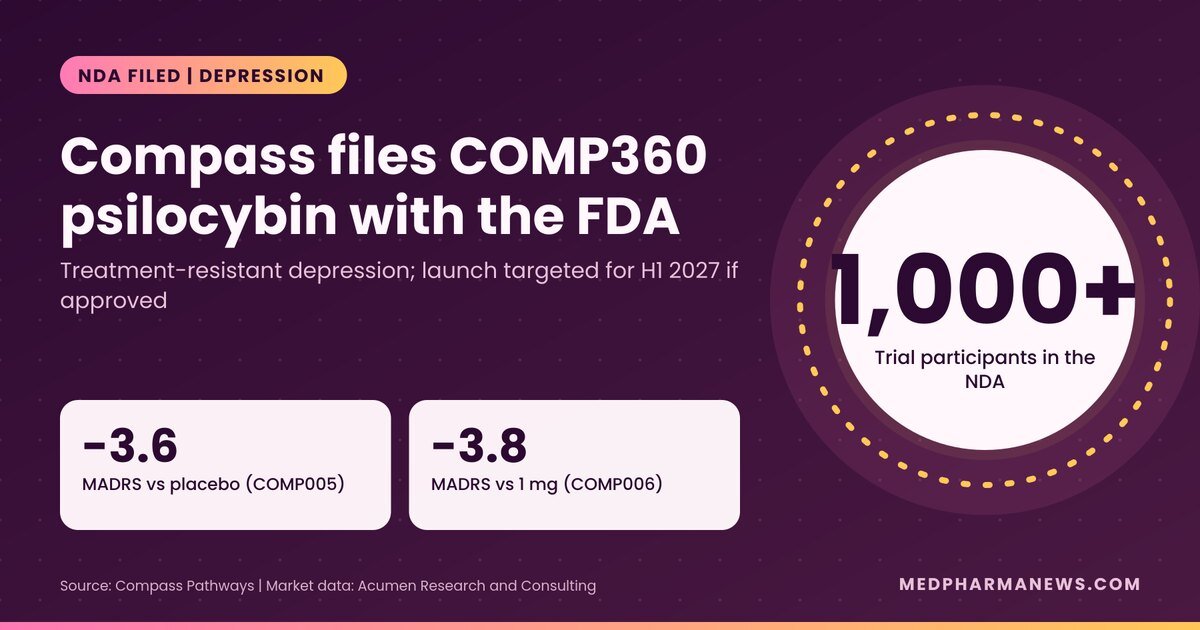
The COMP360 psilocybin NDA is now with the US Food and Drug Administration: Compass Pathways said on November 9, 2026 that it has completed its New Drug Application for COMP360, a synthetic psilocybin formulation, to treat treatment-resistant depression (TRD). The filing rests on two Phase 3 trials and a Phase 2b study covering more than 1,000 participants, and Compass is preparing for a possible US launch in the first half of 2027 if the FDA approves it and federal drug scheduling is changed.
That timeline is unusually short for a novel psychiatric drug, and it depends on three separate gates opening in sequence. This article explains what is in the application, how fast the FDA could act, and which hurdles remain before any patient receives a dose outside a trial.
Key takeaways on the COMP360 psilocybin NDA
- Compass completed a rolling NDA for COMP360 in TRD on November 9, 2026; the FDA had not publicly confirmed acceptance at the time of the announcement.
- Both Phase 3 trials met their primary endpoint, with MADRS depression-score advantages of 3.6 points (COMP005) and 3.8 points (COMP006) at week 6, each with p<0.001.
- COMP360 holds Breakthrough Therapy designation and a Commissioner’s National Priority Voucher, a program that aims to compress review to one or two months after a complete submission.
- Psilocybin is a Schedule I substance, so DEA rescheduling and state rules must follow any approval before commercial sales.
- Rivals are close behind: Usona Institute has reportedly filed its own psilocybin NDA in major depressive disorder, a report Usona has not confirmed.
What Compass submitted
COMP360 is given as a single supervised session in which the patient takes the drug in a clinic with psychological support before, during and after dosing. The application targets adults with TRD, usually defined as depression that has not responded adequately to at least two antidepressant treatments. Chief executive Kabir Nath said the company is “focused on delivering COMP360 to patients as quickly as possible, subject to FDA approval.”
The rolling submission let Compass send modules as they were ready rather than in a single package. Completing it is the step that starts the FDA clock, but formal acceptance (the agency’s decision that the file is complete enough to review) is a separate milestone investors are now watching.
The Phase 3 evidence behind the filing
| Trial | Design | Patients dosed | Week 6 MADRS difference |
|---|---|---|---|
| COMP005 | Single 25 mg dose vs placebo | 258 (171 COMP360, 87 placebo) | -3.6 points (95% CI -5.7 to -1.5), p<0.001 |
| COMP006 | Two doses three weeks apart: 25 mg vs 10 mg vs 1 mg control | 581 (296 on 25 mg) | -3.8 points for 25 mg vs 1 mg (95% CI -5.8 to -1.8), p<0.001 |
Compass reports that improvement appeared the day after dosing in both trials and persisted through week 26, and that COMP005 participants who received a further 25 mg dose in open-label follow-up showed additional benefit through week 52. A 3.6 to 3.8 point MADRS gap is modest in absolute terms, comparable to the drug-placebo differences many approved antidepressants achieve. The case for COMP360 rests less on effect size than on speed of onset and on the convenience of one or two sessions instead of daily pills, in a population that has already failed standard treatments.
Safety signals regulators will weigh
Most adverse events were mild or moderate and resolved within 24 hours; headache, nausea, visual hallucinations and anxiety were the most common. COMP005 recorded 11 serious adverse events in 8 participants (5%) of the 25 mg arm, and COMP006 recorded 6 serious events in 6 participants (2%) overall. Serious suicidal ideation occurred in under 1% of participants, and one case of suicidal behavior occurred in the 1 mg arm of COMP006. An independent data safety monitoring board found no clinically meaningful imbalance in suicidality between arms. Expect the FDA to focus on the monitoring setting, functional unblinding (patients can usually tell whether they received an active psychedelic dose) and a likely Risk Evaluation and Mitigation Strategy.
Three gates to a 2027 launch
- FDA review. The national priority voucher, awarded in April 2026, targets a one to two month review after final submission instead of the standard 10 to 12 months. The FDA has not published a decision date, and the voucher does not lower evidence standards.
- DEA rescheduling. Psilocybin is federally Schedule I. An approved product must be moved to a lower schedule before it can be sold, and Compass has said launch follows that step.
- State rules and delivery sites. State scheduling laws and the availability of clinics able to run supervised sessions will shape where and how fast COMP360 reaches patients.
The competitive race in psychedelic medicine
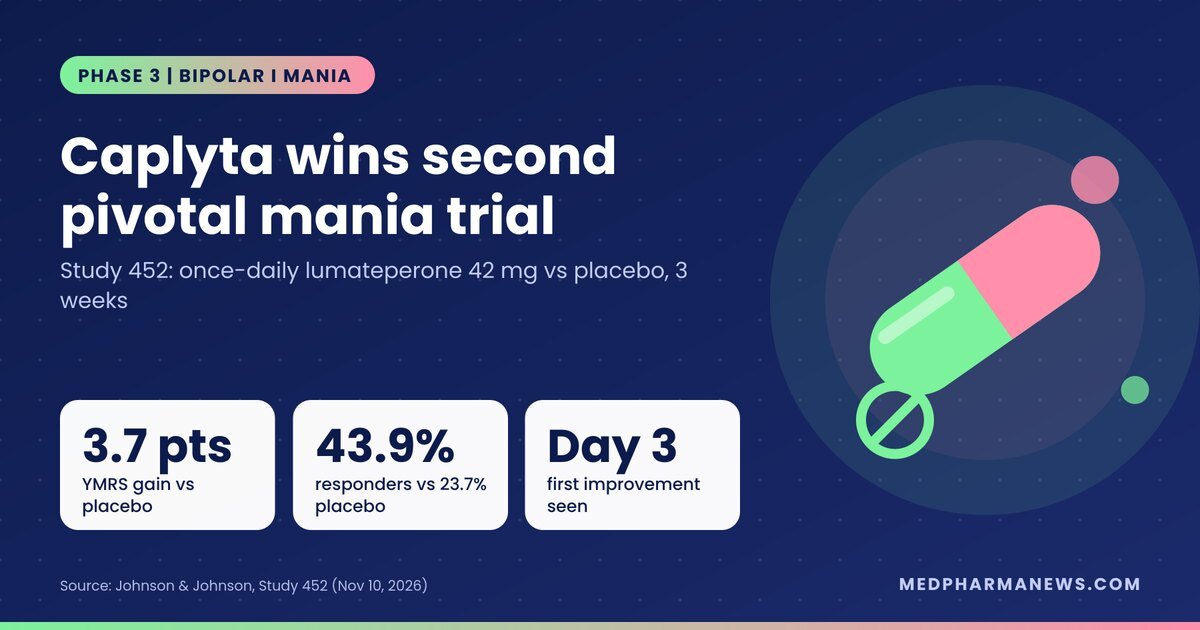
Compass is not alone. The nonprofit Usona Institute has reportedly completed an NDA for psilocybin in the broader major depressive disorder population and also holds a priority voucher, though Usona declined to comment. Definium Therapeutics (formerly MindMed) has reported positive Phase 3 data for its LSD tablet and plans a generalized anxiety filing in the first half of 2027, while Eli Lilly closed its acquisition of AtaiBeckley in September. Compass shares rose 6.6% to $9.18 on the filing news, recovering part of a 27.3% slide on November 2 when the Usona report surfaced. For more on recent psychiatry filings, see our report on the Caplyta bipolar mania Phase 3 win.
Market context
Acumen Research and Consulting estimates the global psychedelic drugs market at USD 2.6 billion in 2022 and projects USD 7.1 billion by 2032, a 10.9% compound annual growth rate, with North America the largest region. By our calculation, that implies the market growing to roughly 2.7 times its 2022 size over the decade. The forecast was last updated in April 2023, before any psilocybin product had been filed, so a first approval would be a key test of those assumptions. Our psychedelic drugs market overview has more detail.
Browse more approvals and filings in our Pharmaceuticals section.
FAQ
Is psilocybin FDA approved for depression?
No. Compass has submitted COMP360 for FDA review in treatment-resistant depression, but no psilocybin medicine is approved in the US as of November 11, 2026.
When could COMP360 be approved?
The FDA has not announced a date. The national priority voucher program aims for a decision within one to two months of a complete submission, and Compass is preparing for a potential launch in the first half of 2027, after DEA rescheduling.
How is COMP360 psilocybin given?
In trials it was taken as a 25 mg dose in a supervised clinical setting with psychological support; COMP006 tested two doses three weeks apart. It is not a take-home medicine.
What is the difference between Compass and Usona psilocybin?
Compass targets treatment-resistant depression with COMP360. Usona has reportedly filed its own synthetic psilocybin for major depressive disorder, a broader population, though Usona has not confirmed the filing.
Sources: Compass Pathways NDA announcement (November 9, 2026); Compass COMP006 results (February 17, 2026). Market data: Acumen Research and Consulting. Not medical or investment advice. Last updated November 11, 2026.