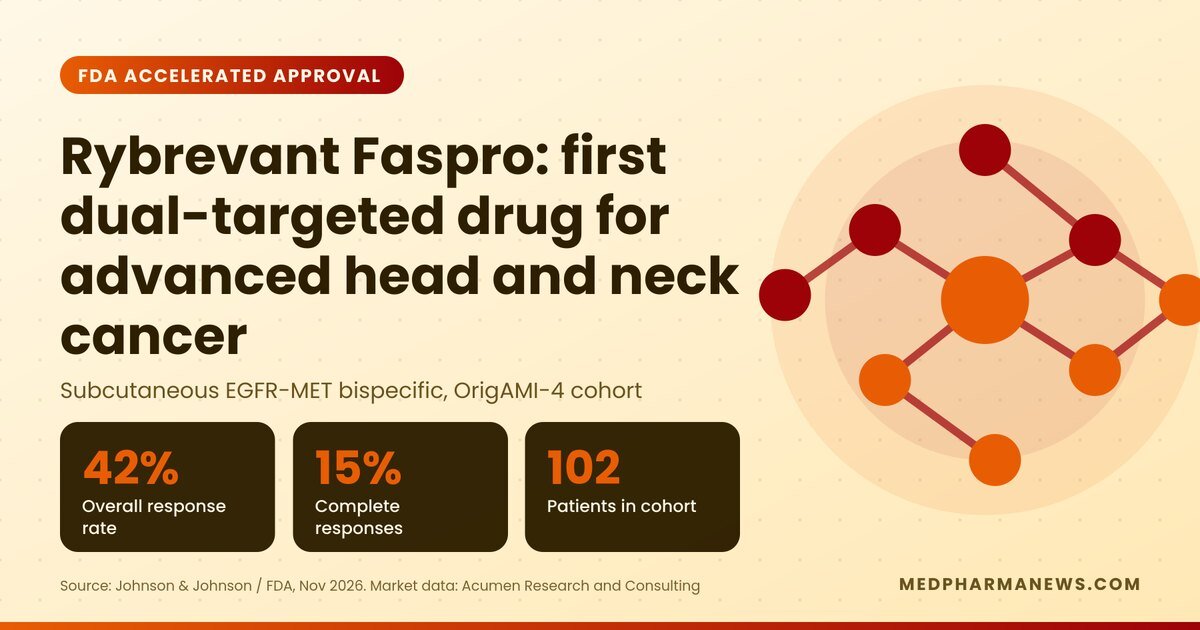
Johnson & Johnson’s Rybrevant Faspro head and neck cancer approval, announced on 5 November 2026, gives US oncologists the first new drug in about a decade for patients whose recurrent or metastatic head and neck squamous cell carcinoma (HNSCC) has progressed after platinum chemotherapy and a PD-1 or PD-L1 inhibitor. The FDA granted accelerated approval to the subcutaneous EGFR-MET bispecific antibody (amivantamab and hyaluronidase-lpuj) on the strength of a 42% response rate in 102 patients from the OrigAMI-4 study.
Key takeaways on Rybrevant Faspro head and neck cancer approval
- Indication: single-agent treatment of adults with recurrent or metastatic HNSCC after platinum chemotherapy and anti-PD-(L)1 therapy.
- Excluded: HPV-associated oropharyngeal cancer, defined by p16 testing.
- Efficacy: 42% overall response rate (95% CI 32% to 52%), including 15% complete responses; 56% of responders stayed in response for more than six months.
- Approval type: accelerated, so continued approval depends on confirmatory data, led by the Phase 3 OrigAMI-5 trial.
- Given as a roughly five-minute injection under the skin every three or four weeks.
- It is the first indication for Rybrevant Faspro outside EGFR-mutated lung cancer.
Which patients qualify, and which do not
The label targets a specific, hard-to-treat group: people whose head and neck cancer came back or spread and then kept growing after both standard platinum chemotherapy and immunotherapy. That setting has relied largely on older options such as cetuximab, methotrexate or taxanes, with response rates the FDA describes as around 20% or lower.
The HPV exclusion matters. HPV-driven oropharyngeal tumours behave differently and did not respond in the same way, so patients will need p16 status confirmed before treatment. According to J&J, about 80% of recurrent or metastatic HNSCC cases are not HPV-driven, which means most of the second-line population should be eligible.
OrigAMI-4 results at a glance
| Endpoint (cohort 1, n=102) | Result |
|---|---|
| Overall response rate (blinded central review) | 42% (95% CI 32 to 52%) |
| Complete response | 15% |
| Partial response | 28% |
| Responders still responding at 6+ months | 56% |
| Serious adverse reactions | 39% |
| Fatal adverse reactions | 6% |
By our calculation, that translates to roughly 43 responders among 102 patients, about 15 of them with no detectable disease on imaging. Complete responses are rare in this line of therapy, which helps explain the Breakthrough Therapy designation in February 2026 and Priority Review in July. The data were first presented at ASCO 2026 and published in the Journal of Clinical Oncology. The caveat is that this is a single-arm cohort without a comparator, so survival benefit has not been shown.
Why hitting EGFR and MET together makes sense here
EGFR has been a validated target in head and neck cancer since cetuximab, but tumours often escape single EGFR blockade, and MET signalling is one of the known escape routes. J&J says EGFR and MET are overexpressed in 80% to 90% of recurrent or metastatic tumours. Amivantamab binds both receptors and also recruits immune cells to attack tumour cells, a three-pronged mechanism that may explain responses in patients already exposed to immunotherapy. The subcutaneous version adds hyaluronidase so a large antibody dose can be given in minutes rather than through a multi-hour intravenous infusion.
Side effects oncologists will manage
The toxicity profile is familiar from the lung cancer setting. Rash affected 79% of patients, followed by fatigue (39%), nail toxicity (35%), mouth sores (32%) and swelling (28%). Warnings cover hypersensitivity and administration-related reactions, interstitial lung disease, skin and eye toxicity, and harm to a developing baby. Premedication with antihistamines, antipyretics and steroids is recommended. A 6% rate of fatal adverse reactions is notable in a frail, heavily pretreated population, and prescribers will want to see how that figure compares in the randomised trial.
Commercial angle and market context
For J&J, the label is the first step in moving amivantamab beyond lung cancer, where it competes with osimertinib-based regimens. A second tumour type broadens the asset and strengthens the case for the subcutaneous format, which the company is positioning as more convenient for clinics. Bispecific antibodies are an expanding drug class: Acumen Research and Consulting valued the global bispecific antibodies market at USD 554 million in 2022 and projects USD 1,084 million by 2032, a 7.1% CAGR, with North America the largest region and Asia-Pacific the fastest growing. Those estimates were last updated in August 2023, before several recent bispecific approvals, so treat them as indicative. Our earlier explainer on bispecific antibodies market trends and coverage of opamtistomig’s Fast Track designation give more background on the class.
What to watch next
- OrigAMI-5: the Phase 3 study (NCT07276399) testing subcutaneous amivantamab with carboplatin and pembrolizumab as first-line treatment. A positive result would convert the accelerated approval and move the drug earlier in treatment.
- Guideline updates: how quickly NCCN and other guidelines place it after immunotherapy failure.
- Ex-US filings: J&J has not detailed timing for Europe or other markets for this indication.
- Real-world tolerability: rash management and the fatal reaction rate outside a trial.
More approvals coverage is in our Pharmaceuticals section.
Frequently asked questions
What is Rybrevant Faspro approved for in head and neck cancer?
Adults with recurrent or metastatic head and neck squamous cell carcinoma that progressed after platinum chemotherapy and a PD-1 or PD-L1 inhibitor, excluding HPV-associated oropharyngeal cancer.
How effective is amivantamab for head and neck cancer?
In OrigAMI-4, 42% of 102 patients responded, 15% completely, and more than half of responders kept their response beyond six months. Survival data from a randomised trial are not yet available.
How is Rybrevant Faspro given?
As an injection under the skin taking about five minutes, every three or four weeks, after premedication to reduce reactions.
Why is it an accelerated approval?
Because it rests on response rate and duration from a single-arm study. Full approval depends on confirmatory results, chiefly OrigAMI-5.
Sources: Johnson & Johnson press release; FDA announcement, 5 November 2026. Market data: Acumen Research and Consulting. Not medical or investment advice. Last updated 10 November 2026.