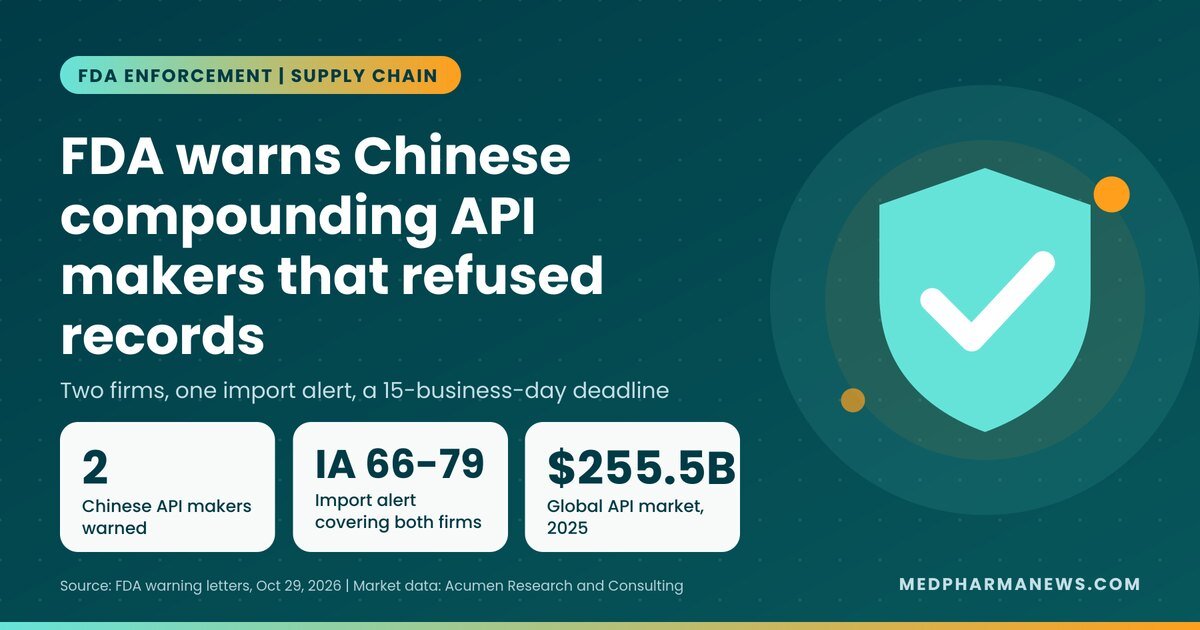
Compounding API warning letters issued by the US Food and Drug Administration to two Chinese ingredient makers, Chongqing Qiancan Technology and Tianjin Healthcare Medical Technology, were dated October 29, 2026 and posted on November 10. Both firms shipped active pharmaceutical ingredients (APIs) into the US for pharmacy compounding, and both refused FDA requests for manufacturing records. The agency had already placed all their drugs on Import Alert 66-79 in late August. The letters show the FDA is now using remote records demands, not just plant inspections, to police the overseas supply chain behind compounded medicines.
Key takeaways on compounding API warning letters
- The FDA cited section 704(a)(4) of the Food, Drug and Cosmetic Act, which lets it demand records in lieu of or before an inspection; refusing is a prohibited act under section 301(e).
- Neither letter names the APIs publicly; product names are redacted. The FDA says the firms’ APIs were still within expiry and on the US market.
- Both firms are on Import Alert 66-79, which allows US shipments to be detained without physical examination.
- Each company has 15 business days to respond, and the FDA may withhold approval of any application listing them as a supplier.
- The FDA told one firm that simply stopping US sales does not erase its obligations for product already shipped.
Timeline: from records request to warning letter
| Date (2026) | Tianjin Healthcare Medical Technology | Chongqing Qiancan Technology |
|---|---|---|
| June 17 | FDA emails records request | FDA emails records request |
| June 24-25 | Firm says it will stop producing products for the US and declines; FDA repeats request, firm refuses again | No records provided |
| June 29-30 | No records provided | Firm deregisters, drops drug listing, says it cannot meet FDA requirements |
| July 13 | – | Firm re-registers with the FDA |
| August 25-26 | Placed on Import Alert 66-79 | Placed on Import Alert 66-79 |
| October 29 | Warning letter issued | Warning letter issued |
| November 10 | Letter posted by FDA | Letter posted by FDA |
What the FDA actually found, and what it did not say
These are not classic manufacturing-defect letters. The FDA did not report contamination, potency failures or a recall. Its finding is narrower and, for compounders, arguably more worrying: the agency cannot judge quality because the firms would not show their records. In both letters the FDA states it has “no indication of the level of quality assurance” for drugs listed as made at the sites. In other words, pharmacies may have compounded medicines from ingredients whose production history no regulator has seen.
The letters do not say which ingredients were involved, and some reports have tied them to the GLP-1 debate without evidence in the letters themselves. Readers should treat any claim that these specific firms supplied semaglutide or tirzepatide as unconfirmed.
Import Alert 66-79 explained
Import Alert 66-79 covers foreign drug establishments that refuse or obstruct FDA inspection. A December 2024 revision extended it to firms that refuse remote regulatory assessments such as 704(a)(4) records requests. Once a company is on the list, its shipments can be held at the border without the FDA testing them; the importer must prove the goods are not adulterated. The visible portion of the alert’s red list already includes dozens of Chinese firms, so these two companies join a growing group.
The wider crackdown on compounding supply chains
The letters land in a year of rising scrutiny of overseas ingredients for compounded drugs, especially weight-loss peptides:
- September 2025: the FDA restricted GLP-1 API imports to a “green list” of verified facilities under Import Alert 66-80.
- May 2026: a warning letter to Harbin Jixianglong Biotech said the green-listed firm relabelled semaglutide bought from an unlisted site as its own product and altered dates before shipping it to the US.
- September 2026: 20 state attorneys general, led by Alabama, wrote to federal officials calling foreign GLP-1 and peptide supply chains a security concern and warning that the green list could become a “laundering channel” without real-time verification.
Taken together, the pattern is that regulators are moving from policing finished compounded products to tracing where the raw ingredients come from. For background on how other countries are approaching this, see our analysis of South Africa’s compounding safety warning.
Market context: who makes the world’s APIs
According to Acumen Research and Consulting, the global active pharmaceutical ingredient market was worth $255.47 billion in 2025 and is projected to reach $473.20 billion by 2035, a compound annual growth rate of 6.3%. Asia Pacific accounted for about 25% of the market in 2025 and is expected to grow fastest, at 8.5% a year. Merchant API suppliers, companies that sell ingredients to other drugmakers and pharmacies rather than using them in-house, held 58% of the market. That merchant segment is exactly where compounders buy, which is why records access to merchant suppliers in fast-growing regions matters so much to US regulators.
What compounders and buyers should do now
- Check every API supplier against current FDA import alerts and warning letters, not just its registration status. A registration can lapse and be restored, as Chongqing Qiancan’s did within two weeks.
- Ask suppliers whether they have received a 704(a)(4) request and how they answered.
- Keep certificates of analysis and chain-of-custody records for each lot, so a supplier problem can be traced fast.
- Expect more records-based enforcement; it is cheaper and faster for the FDA than flying inspectors to every site.
More regulatory analysis is in our Industry Insights section, including recent quality cases such as the Mylan telmisartan-amlodipine recall.
FAQ
Which companies received the FDA compounding API warning letters?
Chongqing Qiancan Technology Co., Ltd. and Tianjin Healthcare Medical Technology Co., Ltd., both API manufacturers in China. The letters are dated October 29, 2026.
What is a 704(a)(4) records request?
It is an FDA power to demand records from a drug manufacturer in advance of or instead of an inspection. Refusing to provide them is a prohibited act and can lead to import detention.
Do the warning letters involve semaglutide or tirzepatide?
The FDA has not said. Product names in the published letters are redacted, so any link to GLP-1 ingredients is unconfirmed.
Are compounded medicines made from these APIs unsafe?
The FDA did not report a specific defect. Its concern is that it cannot verify quality without the records. Patients with questions about a compounded medicine should speak to their prescriber or pharmacist.
Sources: FDA warning letters to Chongqing Qiancan Technology and Tianjin Healthcare Medical Technology (October 29, 2026); FDA Import Alert 66-79. Market data: Acumen Research and Consulting. This article is for information only and is not medical, legal or investment advice. Last updated: November 12, 2026.