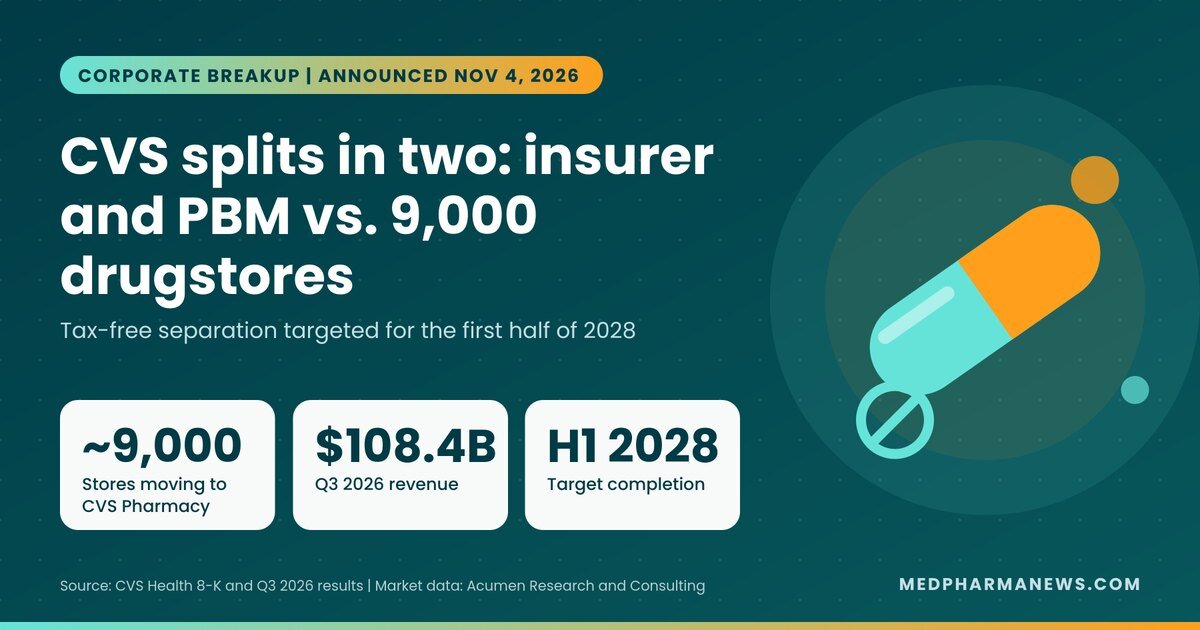
The CVS split announced on November 4, 2026 will break CVS Health into two independent public companies: a healthcare solutions business holding Aetna, CVS Caremark, CVS Specialty, Oak Street Health and Signify Health, and a standalone CVS Pharmacy with about 9,000 drugstores, mail pharmacy, MinuteClinic and the Health100 technology unit. CVS expects to complete the tax-free separation in the first half of 2028, after reporting third-quarter revenue of $108.4 billion and raising its 2026 outlook for a third straight quarter.
Key takeaways on the CVS split
- Two companies: CVS Health (insurer, PBM, specialty pharmacy and care delivery) led by chairman and CEO David Joyner, and CVS Pharmacy led by group president Prem Shah.
- Shareholders are expected to own shares of both; the separation is intended to be tax-free for U.S. federal income tax purposes.
- Target completion: first half of 2028, subject to final board approval, a Form 10 registration and tax confirmation.
- Q3 2026: revenue up 5.4% to $108.4 billion; adjusted EPS of $2.09 versus $1.60 a year earlier.
- 2026 adjusted EPS guidance raised to at least $8.20, from $7.90 to $8.10.
Who gets what
| CVS Health (healthcare solutions) | CVS Pharmacy | |
|---|---|---|
| Businesses | Aetna, CVS Caremark (PBM), CVS Specialty, Oak Street Health, Signify Health | About 9,000 retail pharmacies, mail pharmacy, MinuteClinic incl. virtual care, Health100 |
| Scale (Sept. 30, 2026) | About 87 million PBM members; about 37 million served through insurance products | Nearly 30,000 pharmacists; 1,000+ walk-in and primary care clinics across the group |
| CEO | David Joyner | Prem Shah |
| Closest peers | UnitedHealth Group, Cigna | Walgreens and other retail chains |
The interesting choice is where the PBM lands. CVS is keeping Caremark with Aetna rather than with the stores, which preserves the insurer-plus-PBM model that UnitedHealth and Cigna run. The pharmacies will keep working with Caremark and Aetna through commercial agreements rather than a shared parent. Health100, CVS’s AI-native technology business, will sit with the pharmacy company but serve both.
Why CVS is unwinding its own integration
CVS bought Caremark in 2007 and Aetna in 2018, in a deal valued at $78 billion, on the thesis that owning the drugstore, the PBM and the insurer would lower costs and keep members inside one system. Management now argues each business will do better with its own capital structure, investment-grade rating and dividend. Joyner told analysts regulation was not the driver, pointing instead to the turnaround that included about $2 billion in cost cuts, store closures and leadership changes, according to Healthcare Dive.
The policy backdrop is hard to ignore anyway. CVS is fighting state laws in Arkansas and Tennessee that would bar a PBM and a pharmacy from sharing an owner, and a bipartisan federal bill aims at the same structure. A separation would make that fight largely moot for the retail stores. Leerink analyst Michael Cherny called the announcement a complete surprise, while a J.P. Morgan analyst saw some logic in the move, according to Healthcare Dive.
The quarter behind the announcement
| Metric | Q3 2025 | Q3 2026 |
|---|---|---|
| Revenue | $102.9 billion | $108.4 billion |
| GAAP diluted EPS | $(3.13) | $1.68 |
| Adjusted EPS | $1.60 | $2.09 |
The year-ago loss reflected a $5.7 billion goodwill impairment, so the GAAP swing is less dramatic than it looks. The real driver was Aetna, where Medicare Advantage margins have recovered. CVS now guides to at least $8.20 in 2026 adjusted EPS, up about 2.5% from the prior midpoint of $8.00 by our calculation, and to at least $15.5 billion in operating cash flow, up from at least $11.5 billion.
There is a softer spot. Coverage of the earnings call indicates the Health Services segment, home to Caremark, is guided to a trough year in 2027, with lower 340B contribution and client losses weighing on profit. That segment goes with Aetna, which means the new CVS Health inherits both the strongest and the most pressured pieces of the current group.
What it means for patients, employers and drugmakers
- Patients: nothing changes before 2028. Stores, prescriptions, Aetna plans and Caremark benefits continue as today.
- Employers and plans: Caremark stays tied to an insurer, so the PBM debate over spread pricing and rebates shifts to a company that looks more like Cigna’s Evernorth model.
- Drugmakers: the standalone pharmacy may have more freedom to strike direct cash-pay and subscription arrangements. We covered that trend in prescription subscription plans gaining momentum.
- Pharmacists: a retail-only company with nearly 30,000 pharmacists, about 3.3 per store by our calculation, will need clinical services and technology to defend margins.
Market context
The insurer side of the split plays in an enormous market. Acumen Research and Consulting estimates the global health insurance market at USD 2.06 trillion in 2022, growing at a 6.5% compound annual rate to USD 3.81 trillion by 2032. Acumen finds public programs held about 60% of the market in 2022 and North America was the dominant region, which underlines how much of the new CVS Health’s fortunes will ride on Medicare Advantage rates and government policy.
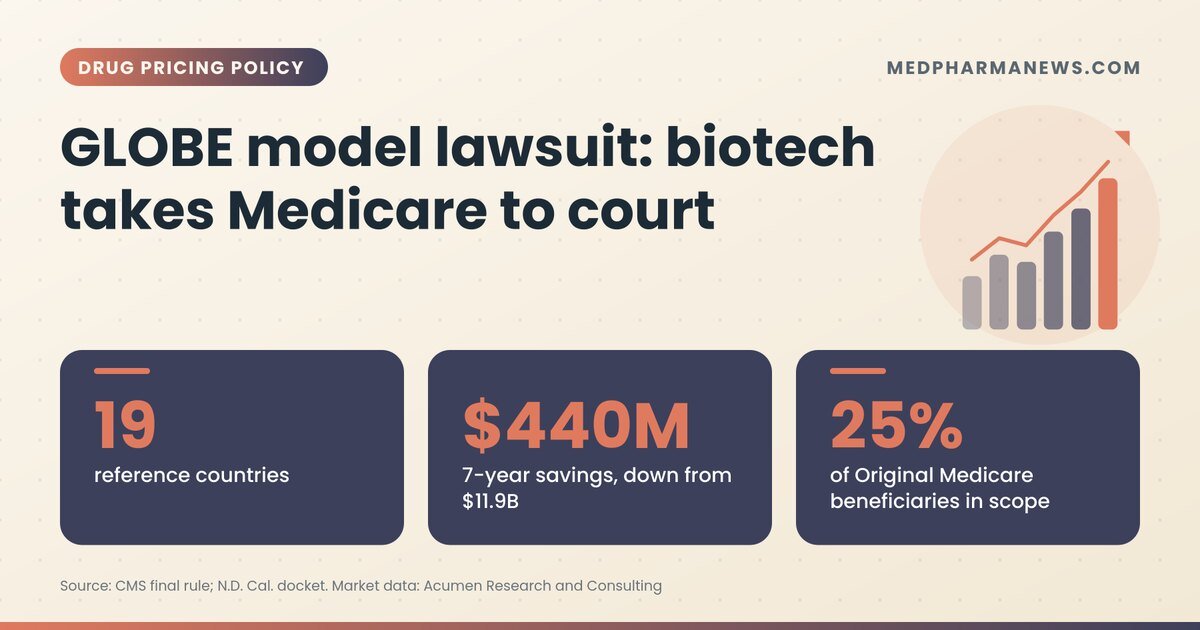
Drug pricing policy is also moving on several fronts at once, from most-favored-nation deals to the court challenge we described in BIO’s GLOBE model lawsuit. Both new CVS companies will have to plan around those changes separately.
Open questions
CVS has not yet disclosed how debt will be divided, the length and terms of the Caremark and Aetna agreements with the pharmacy company, board composition, or the final name of the healthcare solutions business. Separation costs and lost synergies are also not yet quantified. Expect most of that in the Form 10 filing.
FAQ
Is CVS splitting up?
Yes. CVS Health plans to separate into a healthcare solutions company and a pharmacy company, targeting completion in the first half of 2028.
Will Aetna stay with CVS?
Aetna stays with the healthcare solutions company, which will keep the CVS Health name in the interim, alongside Caremark, CVS Specialty, Oak Street Health and Signify Health.
What happens to CVS stores and MinuteClinic?
They move to the new CVS Pharmacy company led by Prem Shah, together with mail pharmacy and Health100. Day-to-day operations continue unchanged until the separation is completed.
Do CVS shareholders get shares in both companies?
Yes, current shareholders are expected to own shares in both, through a separation intended to be tax-free for U.S. federal income tax purposes.
Sources: CVS Health separation announcement (Form 8-K exhibit, November 4, 2026); CVS Health Q3 2026 results; Healthcare Dive. Market data: Acumen Research and Consulting. More in Industry Insights. Not investment advice. Last updated: November 12, 2026.