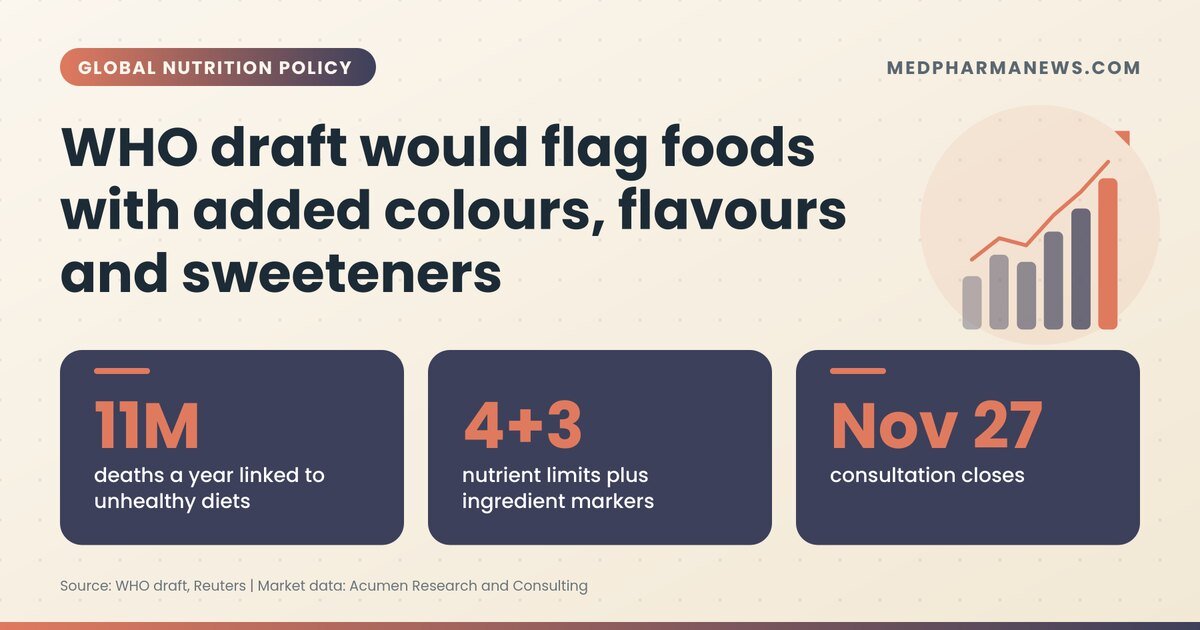
The WHO food profiling model, released in draft on November 2, 2026, would for the first time let governments flag packaged foods simply because they contain added colours, flavours or sweeteners, even when sugar, salt and fat are within limits. The World Health Organization says such products could face warning labels, marketing limits or taxes, depending on national choices. The global food industry has pushed back, and the public consultation closes on November 27, 2026.
Key takeaways on the WHO food profiling model
- The draft “integrated food profiling model” flags a packaged food if it exceeds a limit for saturated fat, trans fat, sugars or sodium, or if it contains any added flavour, colour or sweetener.
- WHO stresses the additives are not flagged as unsafe; the concern is that they make products more appealing and drive demand.
- The model is non-binding. Countries may adopt, adapt or ignore it.
- Intended uses: front-of-pack labels, marketing restrictions, taxes and rules for food in schools, hospitals and canteens.
- The International Food and Beverage Alliance says it could undermine reformulation, such as replacing sugar with sweeteners.
- Consultation: November 2 to November 27, 2026.
How the two-test model works
Traditional nutrient profile models, the basis of systems such as Chile’s black warning octagons and the UK’s advertising rules, score foods only on nutrients. WHO’s draft keeps that test and adds a second, ingredient-based one. A product is “to be consumed in moderation” if it fails either test.
| Test | What is checked | Result |
|---|---|---|
| Nutrient limits | Saturated fatty acids, trans-fatty acids, sugars, sodium (limits based on WHO intake guidance) | Flagged if any limit is exceeded |
| Ingredient markers | Added flavours, colours, sweeteners (used mainly for sensory purposes) | Flagged if any is present, regardless of nutrients |
| Scope | Industrially produced, pre-packaged foods such as soft drinks, confectionery, snacks, breakfast cereals, sauces, ready meals | Fresh and minimally processed foods are not the target |
WHO’s Katrin Engelhardt told Reuters the draft “goes beyond traditional nutrient profiling.” WHO links about 11 million deaths a year to unhealthy diets.
The sweetener problem for industry
The most commercially sensitive part is sweeteners. For a decade, manufacturers have cut sugar to escape taxes and warning labels by switching to low- and no-calorie sweeteners. Under the draft, a soft drink reformulated from sugar to a sweetener would still be flagged. That is why the draft’s reach into supply chains extends to sweetener and additive suppliers, not just brand owners.
Rocco Renaldi, secretary general of the International Food and Beverage Alliance, which represents major multinationals, said the approach could undermine established nutrition priorities and reformulation efforts. Companies also worry about labelling costs, US-style class actions over ultra-processed foods and higher taxes. Kraft Heinz chief executive Steve Cahillane told Reuters that industry should have a say. On the other side, Lindsey Smith Taillie of the Global Food Research Program at Chapel Hill argues that nutrients and processing can be assessed together, since healthiness involves several criteria.
Market context: who is exposed
The ingredient categories in WHO’s sights are sizeable industries. Acumen Research and Consulting values the global flavors and fragrances market at USD 29.3 billion in 2022, heading to USD 49.3 billion by 2032 (5.4% CAGR), with Asia-Pacific the largest region. Its alternative sweetener report puts that market at USD 4,648 million in 2022, rising to USD 7,057 million by 2032 (4.4% CAGR). By our calculation, sweeteners would grow about 52% over the decade on Acumen’s base case; WHO-inspired labelling could slow that if large markets adopt the model.
| Market (Acumen) | 2022 | 2032 | CAGR |
|---|---|---|---|
| Flavors and fragrances | $29.3B | $49.3B | 5.4% |
| Alternative sweeteners | $4.65B | $7.06B | 4.4% |
Why pharma and health investors should care
Food policy and obesity treatment are converging. Governments paying for GLP-1 drugs are under pressure to show prevention efforts too, and labelling or taxing ultra-processed food is the cheapest lever available. Our coverage of Eli Lilly’s Q3 2026 results and the GLP-1 consumer market shows how the obesity economy is reshaping adjacent industries. A WHO reference model gives health ministries a ready-made, defensible definition to act on.
What is not yet known
- Whether WHO will distinguish natural from synthetic flavours and colours; the draft does not.
- How the final version will change after consultation.
- Which countries will adopt it, and for which policies.
FAQ
Is WHO banning artificial sweeteners or food colours?
No. The draft is a non-binding profiling tool. It does not say these additives are unsafe; it suggests foods containing them be treated as “consume in moderation” for policy purposes.
When does the WHO consultation close?
November 27, 2026.
Which foods would be affected?
Industrially produced packaged foods such as soft drinks, sweets, snacks, cereals, sauces and ready meals that exceed nutrient limits or contain added flavours, colours or sweeteners.
Could this lead to food taxes?
Only if individual governments choose to use the model that way. WHO lists taxes as one possible use alongside labels and marketing rules.
More: Industry Insights
Sources: World Health Organization draft integrated food profiling model (consultation Nov 2-27, 2026); Reuters (November 9, 2026); Global Agriculture. Market data: Acumen Research and Consulting, Flavors and Fragrances Market and Alternative Sweetener Market reports. Not medical or investment advice. Last updated: November 12, 2026.