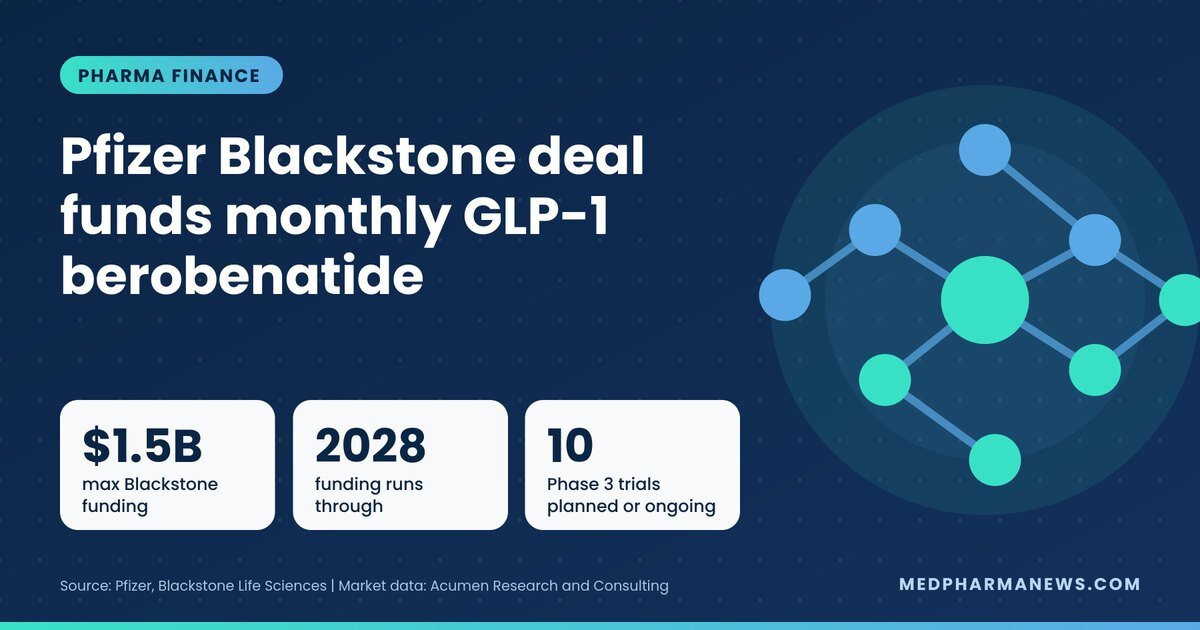
In the Pfizer Blackstone deal announced on 11 November 2026, funds managed by Blackstone Life Sciences agreed to pay up to $1.5 billion through 2028 toward development of berobenatide, Pfizer’s investigational once-monthly GLP-1 obesity injection acquired with Metsera. Blackstone takes no ownership stake. It is repaid only through milestone payments if the US approves monthly berobenatide for chronic weight management and the drug then hits sales targets.
Key takeaways on the Pfizer Blackstone deal
- Up to $1.5 billion of berobenatide development costs will be covered by Blackstone-managed funds through 2028.
- Payback depends on two conditions: US approval of monthly berobenatide monotherapy for chronic weight management, and specified commercial sales milestones.
- Pfizer keeps full ownership, control and decision-making over the drug.
- Berobenatide has 10 ongoing or planned Phase 3 trials, part of more than 20 obesity studies Pfizer planned for 2026.
- The structure shifts risk off Pfizer’s books ahead of a patent cliff that analysts tie to Eliquis from April 2028.
How the financing works
This is synthetic royalty-style risk sharing, not a licensing deal. Under the joint press release, Blackstone Life Sciences funds will invest alongside Blackstone’s perpetual private equity vehicle, BXPE. The money pays for development work. If berobenatide fails to win US approval as a monthly monotherapy for weight management, Pfizer owes nothing. If it succeeds and passes certain sales thresholds, Pfizer pays milestones spread over several years. The size of those milestones was not disclosed.
Analysts at Leerink Partners noted that the funding is drawn down over the term, with amounts rising over time, which fits a Phase 3 program that gets more expensive as trials enroll. Blackstone Life Sciences chief Nicholas Galakatos called berobenatide the anchor of Pfizer’s cardiometabolic pipeline.
How it compares with Blackstone’s Merck deal
| Term | Pfizer (berobenatide), 2026 | Merck (sac-TMT), 2025 |
|---|---|---|
| Maximum funding | Up to $1.5 billion | $700 million |
| Period covered | Through 2028 | Through 2026 |
| How Blackstone is repaid | Milestones tied to US approval of monthly monotherapy plus sales targets | Royalties on net sales across approved indications |
| Ownership transferred | None | None reported |
| Relative size | Pfizer deal is about 2.1 times larger (by our calculation) | |
The key difference is the payback trigger. A royalty on every indication gives the investor long-tail upside. Pfizer’s milestones are tied to a single regulatory outcome, so Pfizer keeps the economics of any combination products or comorbidity labels, according to BMO Capital Markets’ reading of the structure.
What berobenatide has shown so far
Berobenatide (PF’3944) is a GLP-1 receptor agonist peptide designed for once-monthly dosing in a 0.5 mL injection. Pfizer gained it through its roughly $10 billion purchase of Metsera in 2025, after a bidding contest with Novo Nordisk. Phase 2b VESPER data presented at the American Diabetes Association meeting in June 2026 included:
- VESPER-1 Part B: 15.9% average weight loss (not placebo-adjusted) in an exploratory 32-week extension on 2.4 mg weekly, with no plateau reported.
- VESPER-2: in people with type 2 diabetes, HbA1c fell 2.2 percentage points at week 28 on 1.6 mg weekly versus 0.2 with placebo.
- VESPER-3: weekly titration followed by monthly maintenance continued to produce weight loss at the doses chosen for Phase 3.
- Tolerability: Pfizer described gastrointestinal side effects and discontinuations as low, but did not publish rates in its release.
The Phase 2b release did not give placebo-adjusted figures for monthly dosing, so direct comparisons with marketed weekly drugs remain premature.
The Phase 3 program the money pays for
Three registrational studies anchor the program: VESPER-4 (weekly dosing in adults without diabetes), VESPER-5 (weekly in adults with type 2 diabetes) and VESPER-6 (monthly maintenance in adults with obesity or overweight). Seven more Phase 3 trials target comorbidities, including knee osteoarthritis and obstructive sleep apnea. Pfizer also plans to test berobenatide with amylin analogs, such as PF’3945 in the SOLIS-1 study. VESPER-6 is the trial most directly tied to Blackstone’s payback, because the milestone requires approval of monthly monotherapy.
Why Pfizer chose outside money
Pfizer grew 7% operationally in the third quarter, with new and acquired products up 32%, but faces several losses of exclusivity later this decade. Chief Financial Officer Cecile Guegan said the agreement pairs internal research with targeted outside investment while preserving financial flexibility for the wider pipeline. For a company running more than 20 obesity trials at once, moving up to $1.5 billion of spending off its own budget is significant. The obesity field is crowded, as our coverage of Eli Lilly’s Q3 2026 results shows, and a monthly injection is Pfizer’s main differentiation bet.
Market context
Acumen Research and Consulting estimated the global anti-obesity drugs market at USD 2.1 billion in 2022 and projected USD 8.2 billion by 2032, a 14.6% CAGR from 2023 to 2032, with prescription drugs holding the largest share and Asia-Pacific growing fastest. That report was last updated in September 2023, before several newer incretin products reached the market, so read it as an indicative baseline rather than a current sizing.
Open questions
- The value of the milestones Blackstone could earn, and the sales thresholds that trigger them.
- Placebo-adjusted weight loss and discontinuation rates for monthly dosing.
- When VESPER-6 will read out and when Pfizer expects to file.
FAQ
What is berobenatide?
An investigational GLP-1 receptor agonist from Pfizer, acquired with Metsera, being developed as a once-monthly injection for chronic weight management and related conditions. It is not approved anywhere.
Does Blackstone own part of Pfizer’s obesity drug?
No. Blackstone receives no rights or ownership. It may earn milestone payments only after US approval of monthly berobenatide monotherapy and certain sales levels.
When could berobenatide be approved?
Pfizer has not given a filing date. The funding runs through 2028, which suggests the key Phase 3 work is expected to be completed within that window.
Sources: Pfizer and Blackstone Life Sciences press release (11 November 2026); Pfizer Phase 2b berobenatide release (6 June 2026); BioSpace analyst coverage. Market data: Acumen Research and Consulting, Anti-Obesity Drugs Market report. Not medical or investment advice. More in Industry Insights. Last updated 12 November 2026.