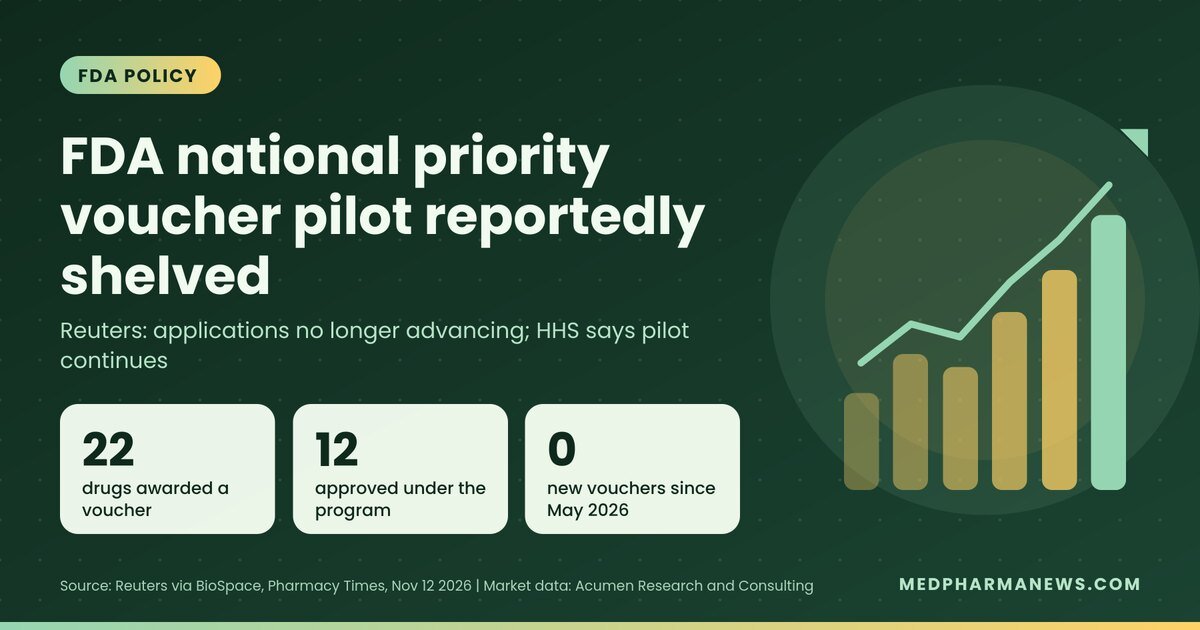
The FDA national priority voucher pilot, the Commissioner’s National Priority Voucher (CNPV) program that promised drug reviews in one to two months, has been effectively shelved, Reuters reported on November 12, 2026, citing six people familiar with the matter. Of the 22 drugs that received a voucher, 12 have been approved, but no new vouchers have been awarded since former Commissioner Marty Makary left the agency in May, and pending applications are reportedly no longer advancing. HHS disputes that account and says the pilot continues.
Key takeaways on the FDA national priority voucher
- Launched in June 2025, the CNPV pilot aimed to cut review times from the standard 10 to 12 months to 1 to 2 months for drugs aligned with national priorities.
- 22 products won vouchers; 12 were approved, five of them after Makary’s May 2026 exit.
- Reuters’ sources say companies can still apply, but applications do not move forward and the political council that oversaw reviews has gone dormant.
- HHS and the FDA say work under the pilot is ongoing and career staff are still reviewing granted applications.
- Holders still waiting include psilocybin developers Compass Pathways and the Usona Institute.
- The FDA has had no confirmed commissioner since May; a Senate committee vote on nominee Heidi Overton is set for November 18.
What the voucher was supposed to do
The CNPV was Makary’s signature speed experiment. Products qualified if they served at least one of five priorities: responding to a public health crisis, delivering a breakthrough therapy, meeting a large unmet need, onshoring manufacturing and supply chains, or improving affordability. Vouchers were tied to a single product and could not be sold, unlike rare pediatric disease vouchers. Holders received rolling review and closer contact with FDA staff, and a multidisciplinary review council met in a tumor-board format before the relevant FDA center made the final call using normal approval standards.
The scorecard in numbers
| Metric | Figure |
|---|---|
| Vouchers awarded | 22 |
| Approved under the program | 12 (about 55%, by our calculation) |
| Approved since Makary left in May 2026 | 5 (about 42% of approvals, by our calculation) |
| Products still in the program | 9 |
| New vouchers since May 2026 | 0 |
| Target review time | 1 to 2 months (vs 10 to 12 months standard) |
Several approvals arrived eight months or more ahead of a standard timeline, according to Pharmacy Times. High-profile products approved with a voucher include Novo Nordisk’s Wegovy HD (semaglutide 7.2 mg), Regeneron’s Otarmeni gene therapy for genetic hearing loss, Vertex’s Casgevy, Eli Lilly’s Foundayo (orforglipron), Merck’s Lipfendra (enlicitide), the first oral PCSK9 inhibitor, and Revolution Medicines’ Rasonque (daraxonrasib) for metastatic pancreatic cancer, which a European panel has also backed for EU approval.
Two accounts of the same program
Reuters’ sources describe a program in name only: one said FDA leadership told companies it is not moving forward, and internal documents show the executive council of political appointees has gone dormant. Career scientists have reportedly taken back control of review timelines for the remaining products. HHS spokesperson Emily Hilliard rejected that framing, saying the pilot continues and the agency is weighing feedback from a June 4, 2026 public hearing to refine the framework.
Both statements can be partly true. An application review run by career staff under ordinary priority timelines is still a review, but it is not the 30- to 60-day sprint sponsors were promised. Until the agency issues written guidance, RBC Capital Markets notes, it is unclear whether current voucher holders and new applicants will be treated differently.
Who is exposed
The sharpest risk falls on psychedelic developers. After an April 18, 2026 executive order on PTSD, depression and substance use disorders, the FDA handed vouchers to three programs: psilocybin for treatment-resistant depression, psilocybin for major depressive disorder and methylone for PTSD. Compass Pathways completed its COMP360 NDA on that basis. RBC told clients the change adds incremental timeline risk for COMP360 but expects the impact to be manageable, because breakthrough status should still make it eligible for priority review. The Usona Institute’s PSIL201 for major depressive disorder is also under review with a voucher.
- Sponsors: launch-readiness plans built around a two-month review may need to be reset to a six- to ten-month priority clock.
- Investors: catalyst dates for voucher holders are now less reliable.
- Payers and pharmacists: formulary planning that assumed early 2027 launches for voucher drugs may need revisiting.
The leadership vacuum behind it
The FDA has had no confirmed commissioner since Makary’s departure. The Senate HELP Committee is scheduled to vote on nominee Heidi Overton on November 18, and BioSpace reports analysts are unsure she has the votes, with one noting that “controversial nominations rarely advance during a lame-duck session.” A program built around one commissioner’s discretion was always likely to stall without one. The voucher had also drawn criticism over whether it rewarded companies that met White House demands, such as lower drug prices.
Market context
Less predictable FDA timelines raise the value of regulatory strategy. Acumen Research and Consulting sized the global regulatory affairs outsourcing market at USD 6,921 million in 2021 and forecast USD 16,605 million by 2030, a 10.4% CAGR, with regulatory writing and publishing the largest service segment. That report was last updated in November 2022, so the figures are indicative, but the direction is relevant: when fast lanes close, sponsors lean harder on established pathways such as breakthrough designation, priority review and accelerated approval.
What to watch
- The November 18 committee vote on Heidi Overton, and whether a new commissioner revives, rewrites or formally ends the pilot.
- Any written FDA guidance on how pending voucher applications will be handled.
- Action dates for the nine remaining voucher products, especially COMP360 and PSIL201.
More regulatory coverage is in our Industry Insights section.
FAQ
What is the FDA Commissioner’s National Priority Voucher?
A pilot launched in June 2025 that aimed to review drugs serving national priorities, such as affordability or domestic manufacturing, in one to two months instead of the usual 10 to 12.
Has the FDA officially ended the voucher program?
No. Reuters reports it has been shelved in practice, but HHS says the pilot is ongoing. No formal termination notice has been published.
Which drugs were approved with a national priority voucher?
Twelve in total, including Wegovy HD, Otarmeni, Casgevy, Foundayo, Lipfendra and Rasonque.
Does this delay psilocybin approval?
It may lengthen timelines. Analysts expect COMP360 to still qualify for priority review, but a one- to two-month decision now looks unlikely.
Sources: Reuters (November 12, 2026) as reported by BioSpace and Pharmacy Times; HHS statement. Market data: Acumen Research and Consulting. Not investment or medical advice. Last updated November 13, 2026.