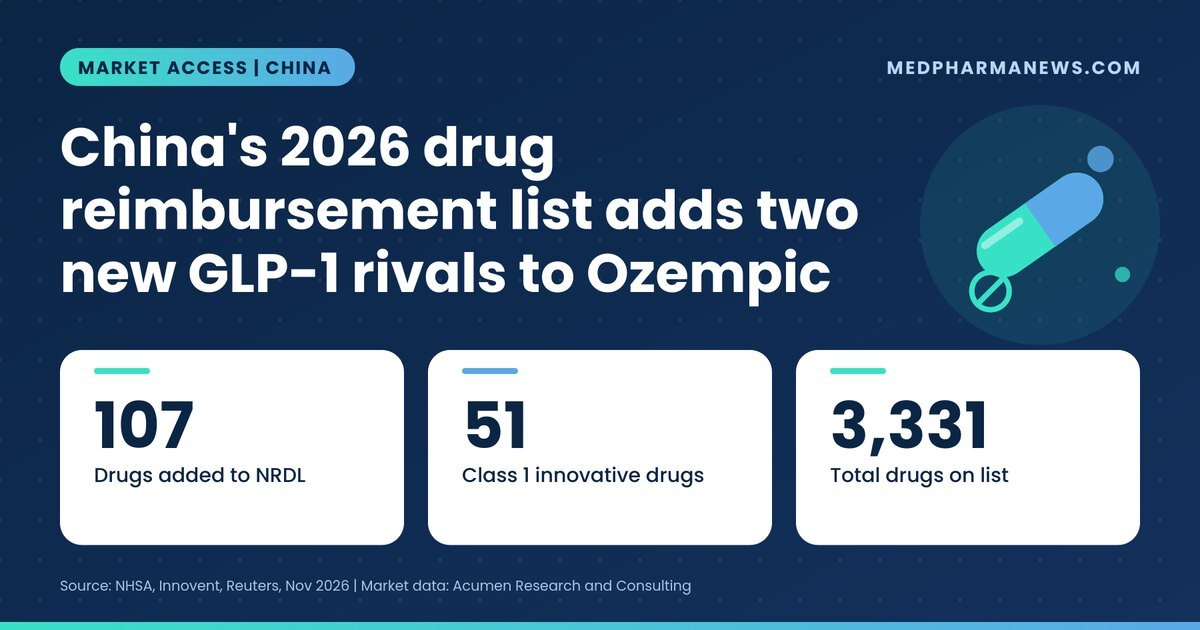
The China NRDL 2026 update, released by the National Healthcare Security Administration (NHSA) and the human resources ministry on 14 November 2026, adds 107 drugs to China’s state medical insurance list, including Pfizer’s ecnoglutide and Innovent Biologics’ mazdutide for type 2 diabetes. The new list, which takes effect on 1 January 2027, includes a record 51 Class 1 innovative drugs and brings the total to 3,331 products, putting two more GLP-1 rivals into the reimbursed market Novo Nordisk once had largely to itself.
Key takeaways on China NRDL 2026
- 107 drugs added, 51 of them Class 1 innovative drugs, a record; 34 drugs removed.
- The list now holds 3,331 drugs: 1,935 Western medicines and 1,396 traditional Chinese patent medicines.
- Pfizer’s ecnoglutide (licensed from Sciwind) and Innovent’s mazdutide (licensed from Eli Lilly) are covered for adults with type 2 diabetes.
- The separate commercial health insurance innovative drug list adds 12 drugs, for 28 in total, including a solid-tumour CAR-T and China’s first haemophilia gene therapy.
- Both lists apply from 1 January 2027.
- Neither the NHSA nor Reuters disclosed average negotiated price cuts.
The 2026 list in numbers
| Item | 2026 update |
|---|---|
| Drugs added to basic NRDL | 107 |
| Of which Class 1 innovative drugs | 51 (record) |
| Drugs removed | 34 |
| Net change | +78 codes after mergers and renaming (73 by simple subtraction, by our calculation) |
| Total drugs on list | 3,331 |
| Commercial innovative drug list additions | 12 (total 28) |
| Effective date | 1 January 2027 |
Two new GLP-1s, and what they bring
Ecnoglutide is a GLP-1 receptor agonist developed by Sciwind Biosciences and approved by China’s National Medical Products Administration for blood sugar control in adults with type 2 diabetes. In February 2026 Pfizer paid for exclusive rights to sell it in China in a deal worth up to $495 million including milestones. Sciwind has reported 15.1% placebo-adjusted weight loss in a Chinese population, and a weight-management application is under review. The NRDL listing covers diabetes only. Pfizer’s wider obesity push includes the funding pact covered in our report on the Pfizer Blackstone deal.
Mazdutide works on two receptors, GLP-1 and glucagon, and Innovent markets it in China under a licence from Eli Lilly. Innovent calls it the first and only approved dual GCG/GLP-1 agonist worldwide. It is one of seven Innovent products on the new lists, alongside the psoriasis antibody picankibart (Pecondle), the leukaemia drug quizartinib (Vanflyta), the CTLA-4 antibody ipilimumab N01 (Tabosun), new uses for sintilimab (Tyvyt) and pirtobrutinib (Jaypirca), and a renewal for the PCSK9 antibody tafolecimab. CEO Dr. Michael Yu said inclusion would “further enhance the accessibility and affordability for patients.”
A crowded reimbursed GLP-1 market
| Drug | Company | Mechanism | Joined NRDL (diabetes) |
|---|---|---|---|
| Ozempic (semaglutide) | Novo Nordisk | GLP-1 | 2022 |
| Mounjaro (tirzepatide) | Eli Lilly | GIP/GLP-1 | 2025 list |
| Efsubaglutide alfa | Guangzhou Innogen | GLP-1 | 2025 list |
| Ecnoglutide | Sciwind / Pfizer | GLP-1 | 2026 list (from 2027) |
| Mazdutide | Innovent / Lilly | GLP-1/glucagon | 2026 list (from 2027) |
Reuters framed the decision as a fresh challenge to Novo Nordisk. Ozempic sales in greater China, Novo’s biggest market after the US, fell 7% in 2025 to about 5.4 billion Danish crowns ($850 million). Novo has been widening access elsewhere too, as described in our coverage of its diabetes commitments in low- and middle-income countries. With five reimbursed incretin drugs from 2027, plus domestic biosimilars, price pressure in China’s diabetes market is likely to intensify.
Beyond diabetes: CAR-T and gene therapy
The NHSA said a CAR-T therapy for lymphoma that had been priced at more than one million yuan has entered the basic list, and Reuters identified it as JW Therapeutics’ product. Two Eli Lilly drugs for ulcerative colitis and Crohn’s disease were also added, along with non-factor haemophilia treatments.
The commercial health insurance innovative drug list, now in its second year, is designed for high-cost therapies that the basic scheme cannot fund. It adds what the NHSA called the world’s first solid-tumour CAR-T and China’s first haemophilia gene therapy. The agency said the 19 drugs on the first commercial list had reached 1,710 institutions and nearly 30,000 patients by October 2026, generating about 600 million yuan in sales, and two of them graduated to the basic list this year.
What drugmakers should weigh
- Volume for price. NRDL inclusion typically trades a steep negotiated discount for hospital access and much larger volumes. The 2026 discounts were not published.
- Indication matters. Both new GLP-1s are covered for diabetes, not weight loss, which remains largely self-pay in China.
- Two-track access. The commercial list gives a route for million-yuan therapies that would not pass basic-scheme budget tests.
- Timing. Sales effects begin in 2027, so 2026 earnings will not reflect them.
Market context
Acumen Research and Consulting projected the global antidiabetics market to reach around US$75 billion by 2027, growing at a CAGR of about 10.3% over 2020 to 2027, and identified Asia-Pacific as the fastest-growing region. The report dates from January 2021, before the incretin boom, so its figures are indicative only. China’s decision to reimburse five GLP-1-class drugs is one reason the Asia-Pacific growth call has held up.
FAQ
When does the 2026 NRDL take effect?
On 1 January 2027, for both the basic reimbursement list and the commercial health insurance innovative drug list.
Is mazdutide covered for weight loss in China?
No. The listing covers adults with type 2 diabetes. Weight-loss use is not part of this reimbursement decision.
How many drugs were added to China’s NRDL in 2026?
107, including 51 Class 1 innovative drugs. Another 12 joined the commercial innovative drug list, and 34 were removed from the basic list.
What is ecnoglutide?
A GLP-1 receptor agonist injection developed by Sciwind Biosciences, approved in China for type 2 diabetes and sold there by Pfizer under a 2026 licence.
Sources: National Healthcare Security Administration; Innovent; Reuters (14 Nov 2026); BioSpace on the Pfizer-Sciwind deal. Market data: Acumen Research and Consulting. More in Pharmaceuticals. Not medical or investment advice. Last updated 14 November 2026.