The FDA on November 13, 2026 approved Imfinzi Padcev bladder cancer treatment for adults with muscle-invasive bladder cancer (MIBC) who cannot receive or have refused cisplatin chemotherapy. The regimen pairs AstraZeneca’s PD-L1 antibody durvalumab (Imfinzi) with the antibody-drug conjugate enfortumab vedotin (Padcev) before bladder removal surgery, followed by durvalumab alone afterwards. It is the second immunotherapy-plus-Padcev option for this group in a year, and it turns a once-empty treatment slot into a two-company contest.
Key takeaways on Imfinzi Padcev bladder cancer approval
- Approval is based on the 695-patient Phase 3 VOLGA trial, which compared the combination with surgery alone.
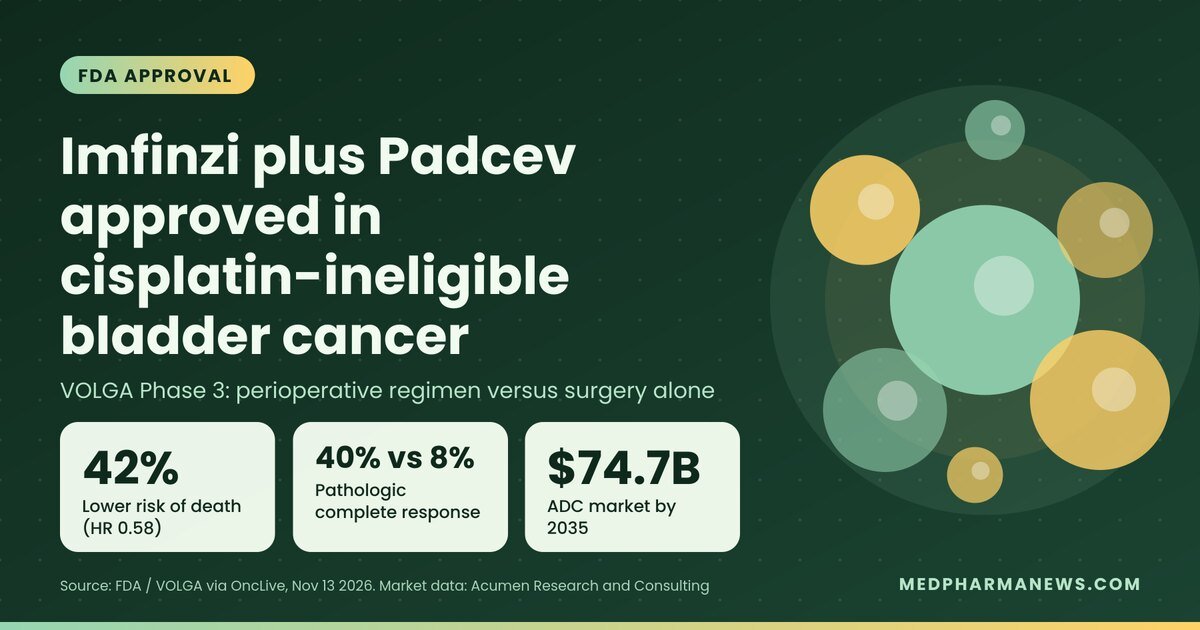
- The regimen cut the risk of a disease event by 49% (HR 0.51) and the risk of death by 42% (HR 0.58).
- 40% of treated patients had no cancer left in the removed bladder (pathologic complete response) versus 8% with surgery alone.
- Serious adverse events were more common: 63% versus 44%.
- Merck’s Keytruda plus Padcev won the same cisplatin-ineligible setting in November 2025, so Padcev, sold by Pfizer and Astellas, benefits whichever immunotherapy partner doctors choose.
The patients left behind by cisplatin
For years the standard cure attempt for muscle-invasive bladder cancer was cisplatin-based chemotherapy followed by radical cystectomy. The catch is that cisplatin is hard on the kidneys and poorly tolerated by frail or older patients. AstraZeneca estimates that up to half of MIBC patients are ineligible, and that about 50% of patients who have their bladder removed still see the cancer come back. Bladder cancer is the ninth most common cancer worldwide, with more than 614,000 new cases a year, and roughly one in four is muscle-invasive. Until recently, cisplatin-ineligible patients had surgery alone as their main option.
VOLGA results in numbers
| Endpoint | Imfinzi + Padcev (n=233) | Surgery alone (n=229) |
|---|---|---|
| Median event-free survival | Not reached | 12.1 months |
| Event-free at 24 months | 64% | 45% |
| Alive at 24 months | 78% | 69% |
| Pathologic complete response | 40% | 8% |
| Grade 3 or 4 adverse events | 64% | 44% |
| Adverse events leading to death | 7% | 6% |
The benefit held across subgroups, including PD-L1-low tumors (HR 0.46) and patients who refused rather than could not take cisplatin (HR 0.49). By our calculation, the complete response rate was five times higher with the combination, consistent with the reported risk ratio of 4.8. A third VOLGA arm that added AstraZeneca’s tremelimumab improved event-free survival but did not reach statistical significance for overall survival, and it is not part of the approval. That outcome is a quiet win for simplicity: doctors get a two-drug regimen rather than three.
How the regimen is given
Patients receive three three-week cycles of durvalumab 1,500 mg plus enfortumab vedotin 1.25 mg/kg on days 1 and 8 before surgery. After radical cystectomy, they continue durvalumab alone every four weeks for up to nine cycles. Treatment-related grade 3 or 4 side effects affected 30% of patients, and 21% stopped at least one drug early. The most common side effects were itching (44%), urinary tract infection (36%) and anemia (32%). Skin reactions (49%) and peripheral neuropathy (18%) are known Padcev issues that oncologists already manage. Surgery was delayed in 4% of patients on the combination, a figure surgeons will watch closely.
The business angle: AstraZeneca versus Merck, Pfizer either way
The approval sets up a direct commercial contest. Merck’s Keytruda plus Padcev, based on KEYNOTE-905, was approved for cisplatin-ineligible MIBC in November 2025 and was expanded in July 2026 to patients regardless of cisplatin eligibility on the strength of KEYNOTE-B15. AstraZeneca already holds the cisplatin-eligible setting with Imfinzi through the NIAGARA trial, approved in more than 40 countries, and now adds a cisplatin-free regimen to its bladder franchise. There is no head-to-head trial between the two immunotherapy partners, so choice will come down to familiarity, dosing schedule, contracting and the depth of each company’s urology sales force.
The clearest winner is Padcev. Every perioperative regimen approved in this space now includes it. Hoag Family Cancer Institute oncologist David J. Benjamin told Targeted Oncology the approval will “provide another option for patients,” which in market terms means more patients exposed to enfortumab vedotin earlier in their disease. For more on AstraZeneca’s oncology strategy, see our analysis of its Claudin 18.2 ADC race.
Market context: ADCs move into curative settings
According to Acumen Research and Consulting, the global antibody-drug conjugate market was valued at USD 16.4 billion in 2025 and is projected to reach USD 74.7 billion by 2035, growing at a 16.3% CAGR. Acumen ranks Padcev as the second-largest ADC with a 14.6% share in 2025, citing Pfizer’s reported Padcev sales of USD 1.94 billion that year, up 22%, driven by its pairing with pembrolizumab in first-line and perioperative bladder cancer. Acumen projects Padcev’s share easing to 11% by 2035 as newer ADCs arrive, so early-stage bladder cancer approvals like this one are central to sustaining its growth.
Open questions
- Median follow-up was 26 months; longer data will show whether the survival gap widens.
- About 7% of patients in the combination arm died of adverse events, close to the control arm, but real-world use in frailer patients could look different.
- Whether either immunotherapy partner is better for specific patients is unknown without a head-to-head trial.
- The POTOMAC trial of Imfinzi plus BCG in non-muscle-invasive disease is under review and could extend AstraZeneca’s bladder franchise further.
FAQ
What did the FDA approve for bladder cancer on November 13, 2026?
Durvalumab (Imfinzi) plus enfortumab vedotin (Padcev) before surgery, then durvalumab alone after surgery, for adults with muscle-invasive bladder cancer who are ineligible for or refuse cisplatin.
How is Imfinzi plus Padcev different from Keytruda plus Padcev?
Both pair an immunotherapy with Padcev around surgery. Imfinzi targets PD-L1, Keytruda targets PD-1, and the schedules differ. No trial has compared them directly.
What is the VOLGA trial?
A Phase 3 study of 695 cisplatin-ineligible MIBC patients at 182 centres in 25 countries, comparing durvalumab-based perioperative regimens with surgery alone.
Browse more approvals in our Pharmaceuticals section.
Sources: OncLive and Targeted Oncology, November 13, 2026; AstraZeneca VOLGA release (SEC Form 6-K), May 14, 2026. Market data: Acumen Research and Consulting. Not medical or investment advice. Last updated November 14, 2026.