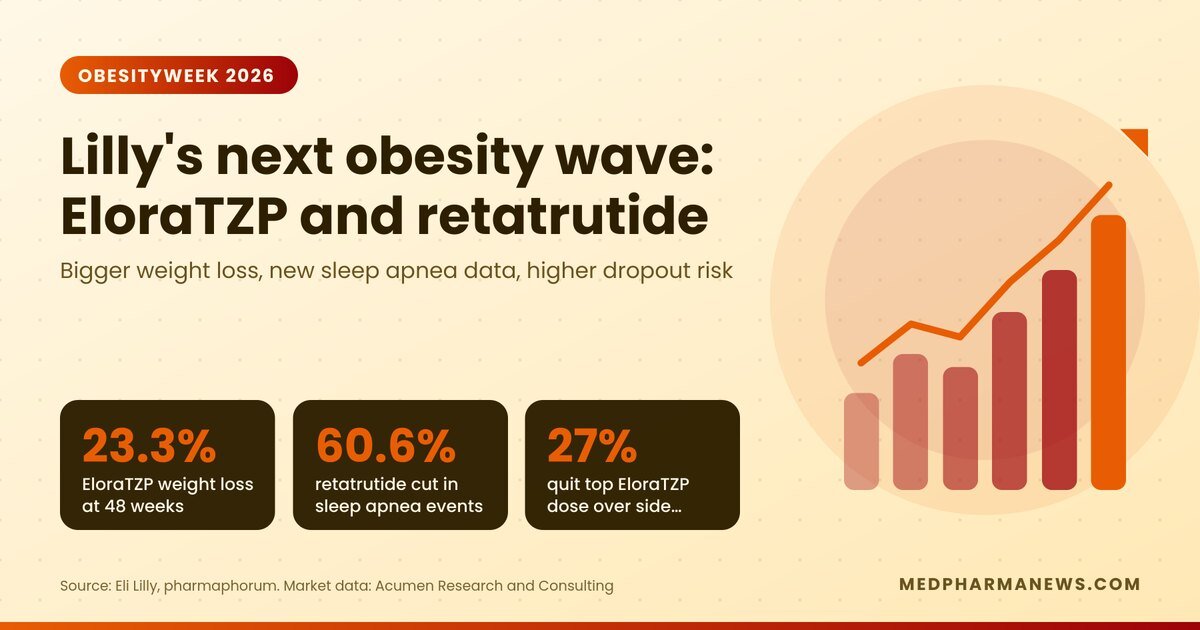
Eli Lilly’s ObesityWeek 2026 data, released on November 14 ahead of presentations in Washington, D.C. (November 14 to 17), put numbers behind its next wave of obesity medicines: EloraTZP, a combination of the amylin analogue eloralintide with tirzepatide, produced average weight loss of up to 23.3% (54.1 lbs) at 48 weeks in people with type 2 diabetes, while the triple agonist retatrutide cut sleep apnea events by up to 60.6% in Phase 3. Zepbound also posted a 21.4% average BMI reduction in adolescents. The common thread is Lilly’s effort to sell obesity care on health outcomes, not just pounds lost.
Key takeaways on Lilly’s ObesityWeek 2026 data
- EloraTZP Phase 2: up to 23.3% weight loss and up to 2.9 points of A1C reduction at 48 weeks in obesity plus type 2 diabetes, versus 14.8% with tirzepatide 15 mg alone.
- The catch: up to 27% of patients on the most effective EloraTZP dose stopped treatment because of side effects, mostly gastrointestinal.
- Retatrutide TRIUMPH-1 and TRIUMPH-2: apnea-hypopnea index fell by up to 60.6% and 48.1% at 80 weeks in moderate-to-severe obstructive sleep apnea.
- Zepbound SURMOUNT-ADOLESCENTS: 21.4% average BMI reduction at 72 weeks in 12 to 17 year olds, with more than half no longer meeting obesity criteria.
- Phase 3 obesity trials of eloralintide are under way; Lilly said pivotal EloraTZP studies would start before the end of 2026.
The scorecard: what Lilly is presenting
Lilly’s press release listed results across four medicines. The headline figures are summarised below; each comes from a separate study, so they should not be compared directly against one another.
| Medicine | Study | Population | Headline result | Timepoint |
|---|---|---|---|---|
| EloraTZP (eloralintide + tirzepatide) | Phase 2 | Obesity or overweight with type 2 diabetes | Up to 23.3% weight loss; A1C down up to 2.9% | 48 weeks |
| Retatrutide | TRIUMPH-1 (OSA) | Moderate-to-severe OSA with obesity | AHI down up to 36.1 events/hour (60.6%) | 80 weeks |
| Retatrutide | TRIUMPH-2 (OSA) | OSA with obesity and type 2 diabetes | AHI down up to 28.4 events/hour (48.1%) | 80 weeks |
| Zepbound (tirzepatide) | SURMOUNT-ADOLESCENTS | Ages 12 to under 18 with obesity | BMI down 21.4% on average | 72 weeks |
| Foundayo (orforglipron) | FOUNDERS survey | Real-world users | 96% to 98% found the daily pill simple and convenient | Survey |
EloraTZP: more weight loss, more dropouts
EloraTZP pairs tirzepatide, the GIP/GLP-1 agonist sold as Mounjaro and Zepbound, with eloralintide, a long-acting amylin analogue. Amylin is a hormone released with insulin after meals that slows stomach emptying and signals fullness, so combining it with incretin drugs is meant to push appetite suppression further. The 48-week Phase 2 trial enrolled 367 adults with type 2 diabetes and obesity or overweight, a group that usually loses less weight on GLP-1 drugs than people without diabetes.
Against tirzepatide 15 mg, which produced 14.8% weight loss, the best EloraTZP arm delivered 23.3%, a gap of 8.5 percentage points by our calculation. From an average starting weight of 232.4 lbs, that equals the 54.1 lbs Lilly cited. Up to 77% of participants reached normal blood sugar and up to 60% no longer met BMI criteria for obesity. Exit interviews added colour: 74% reported fewer food cravings and 41% of those who drank alcohol at baseline said they drank less.
The trade-off is tolerability. As pharmaphorum reported when the topline data were first shown at EASD, 27% of patients on the most effective EloraTZP dose discontinued because of adverse events, compared with 2.9% on tirzepatide. Gastrointestinal effects drove most of those exits. Phase 3 dose-escalation design will decide whether that number can be brought down, and it will shape how payers view the combination.
Retatrutide moves into sleep apnea
Retatrutide activates GIP, GLP-1 and glucagon receptors. In TRIUMPH-1, participants with moderate-to-severe obstructive sleep apnea and obesity saw breathing interruptions fall by up to 36.1 events per hour, or 60.6%, at 80 weeks. In TRIUMPH-2, which included people with type 2 diabetes, the reduction was up to 28.4 events per hour (48.1%). Zepbound already holds a US label for OSA in adults with obesity, so these results set up retatrutide as a potential successor in the same niche. Lilly is running further Phase 3 studies of retatrutide in diabetes, chronic low back pain, cardiovascular and kidney outcomes and MASLD.
Why this matters for Lilly’s business
Lilly is defending a lead in incretin drugs against Novo Nordisk, which is presenting CagriSema analyses at the same meeting, and a growing field of challengers. Each new indication (sleep apnea, knee osteoarthritis, adolescent obesity) widens the population that insurers may be asked to cover and strengthens the argument that these drugs prevent costly complications. That framing is commercially important as employers push back on price; a CVS Health analysis this week argued GLP-1s only break even for employers below about $350 a month. On the competitive side, Pfizer’s recent financing deal for a monthly shot shows how crowded the field is becoming; see our coverage of the Pfizer Blackstone berobenatide deal and China’s 2026 drug reimbursement list.
Market context
Acumen Research and Consulting estimated the global anti-obesity drugs market at USD 2.1 billion in 2022 and projects USD 8.2 billion by 2032, a CAGR of 14.6%, with Asia-Pacific the fastest-growing region and prescription drugs holding the largest share. The report was last updated in September 2023, before the sharpest phase of GLP-1 uptake, so its baseline should be read as indicative.
What is still unknown
Lilly’s release reported “up to” figures, which describe the best-performing dose, and did not include full safety tables for retatrutide or the adolescent study. Full presentations on November 15 should add discontinuation rates and dose-by-dose results. None of the investigational medicines (EloraTZP, eloralintide, retatrutide) is approved, and Lilly has not given filing dates. For more industry analysis, visit our Pharmaceuticals section.
Frequently asked questions
What is EloraTZP?
EloraTZP is Lilly’s investigational once-weekly combination of eloralintide, an amylin analogue, and tirzepatide, the active ingredient in Zepbound and Mounjaro.
How much weight did people lose on EloraTZP?
Up to an average of 23.3% of body weight (54.1 lbs) after 48 weeks in adults with obesity and type 2 diabetes, compared with 14.8% on tirzepatide alone.
Does retatrutide help sleep apnea?
In Phase 3 TRIUMPH-1 and TRIUMPH-2, retatrutide reduced the apnea-hypopnea index by up to 60.6% and 48.1% at 80 weeks. It is not yet approved for any use.
When could EloraTZP be approved?
Not soon. Lilly said pivotal Phase 3 trials would begin before the end of 2026, and these typically take more than a year to read out.
Sources: Eli Lilly press release (14 Nov 2026), pharmaphorum, BioSpace. Market data: Acumen Research and Consulting, Anti-Obesity Drugs Market report. Not medical or investment advice. Last updated: 15 November 2026.