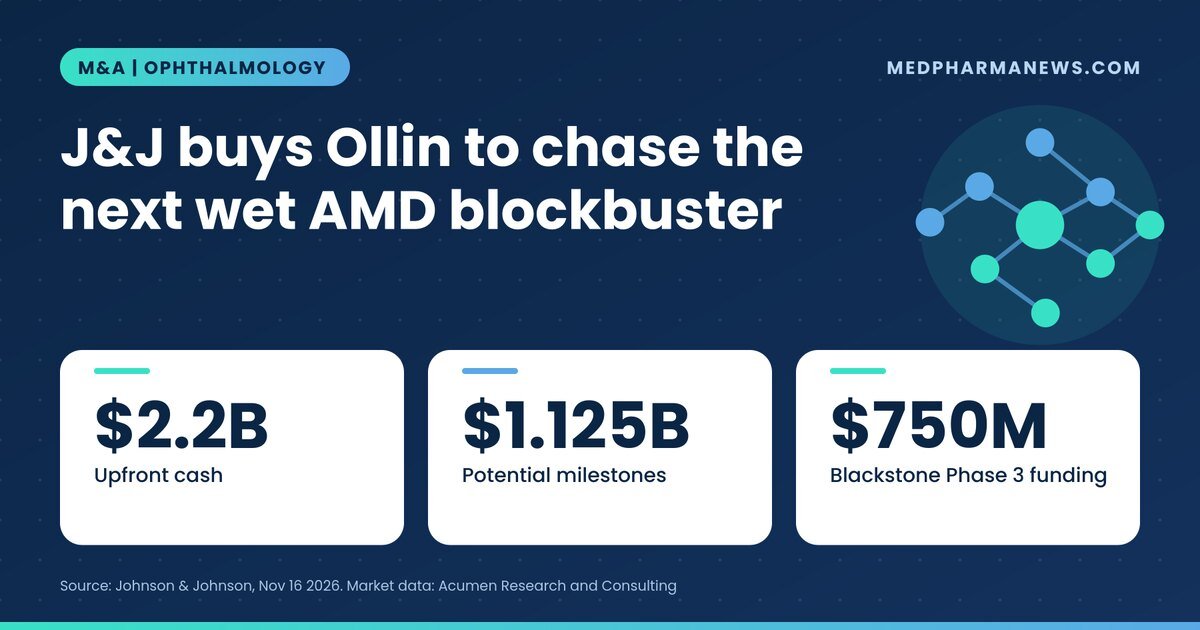
The J&J Ollin acquisition, announced on November 16, 2026, will see Johnson & Johnson pay $2.2 billion upfront for Ollin Biosciences, a clinical-stage eye disease company, with up to about $1.125 billion more tied to regulatory and commercial milestones. The prize is OLN324, a VEGF/Ang2 bispecific antibody heading into Phase 3 for wet age-related macular degeneration (AMD) and diabetic macular edema (DME), and Blackstone Life Sciences has agreed to put up $750 million to fund that Phase 3 program.
Key takeaways on the J&J Ollin acquisition
- Upfront: $2.2 billion. Milestones: up to about $1.125 billion. Headline value: roughly $3.3 billion by our calculation.
- Lead asset OLN324 hits the same two targets as Roche’s Vabysmo (VEGF and Ang2) but in a smaller minibody format.
- Blackstone Life Sciences will pay J&J $750 million over several years to fully fund OLN324’s Phase 3, in return for milestones and single-digit royalties.
- Ollin also owns OLN102, a TSHR/IGF-1R bispecific for thyroid eye disease and Graves’ disease.
- Closing is expected before the end of 2026, subject to regulatory clearance.
The deal in numbers
| Item | Figure |
|---|---|
| Upfront cash | $2.2 billion |
| Potential milestones | Up to ~$1.125 billion |
| Total potential value (by our calculation) | ~$3.33 billion |
| Blackstone Phase 3 funding | $750 million over multiple years |
| Ollin Series B (June 2026) | $330 million |
| Expected close | Before end of 2026 |
By our calculation, the Blackstone money offsets roughly a third of J&J’s upfront outlay over the life of the Phase 3 program, although J&J gives up a slice of future sales through royalties. It is the second big Blackstone Life Sciences funding deal in a week: Pfizer struck a similar arrangement of up to $1.5 billion for its monthly obesity shot, as we reported.
What OLN324 is and why J&J wants it
Wet AMD and DME are driven by leaky, abnormal blood vessels in the retina. The standard treatments block VEGF, a growth signal for those vessels. Roche’s Vabysmo (faricimab) added a second target, angiopoietin-2 (Ang2), which destabilises vessels, and has become one of the fastest-growing eye drugs. OLN324 hits the same pair but is built as a minibody, a smaller protein format that J&J says has high Ang2 potency and could deliver better control of retinal fluid and longer gaps between injections.
The case rests on JADE, a 164-patient randomised Phase 2 study that compared OLN324 directly with faricimab. Ollin reported faster and greater improvements in retinal anatomy in both DME and wet AMD, with numerically greater vision gains. Detailed figures have not been published in a peer-reviewed journal, and the vision difference was not described as statistically significant, so Phase 3 will have to prove a real clinical edge. Kip Connor, who leads J&J’s ophthalmology area, said in the announcement that OLN324 “selectively targets two important drivers of retinal disease.”
A second shot on goal: thyroid eye disease
Ollin’s earlier stage asset, OLN102, is a bispecific antibody aimed at both the TSH receptor and the IGF-1 receptor, the two signals implicated in thyroid eye disease. Amgen’s Tepezza blocks only IGF-1R. Ollin said in June that OLN102 would enter clinical testing later in 2026, and J&J’s release does not discuss it, so investors should treat it as an option rather than a core part of the price.
Market context
J&J says wet AMD and DME together affect more than 40 million people worldwide. Acumen Research and Consulting sized the global retinal biologics market at USD 21.6 billion in 2022 and projects USD 54.7 billion by 2032, a 9.9% compound annual growth rate, with VEGF-A antagonists holding the largest share and North America the biggest region. That is the commercial pool a differentiated VEGF/Ang2 drug would compete in, against incumbents such as Eylea, Lucentis biosimilars and Vabysmo.
What it says about biotech M&A in 2026
Ollin was founded in 2023 and backed by ARCH Venture Partners and Mubadala Capital, and raised $330 million only five months ago. A sale at $2.2 billion upfront is a fast return for a company that has not yet started Phase 3. The deal also fits a pattern of large drugmakers buying de-risked mid-stage assets and sharing late-stage costs with financial partners such as Blackstone, a structure that keeps big trial bills off the buyer’s books. J&J has been an active buyer, including its $14.6 billion purchase of Intra-Cellular Therapies in 2025, and frames ophthalmology as one of its focus areas.
What to watch next
- Antitrust clearance and closing before year end.
- Start dates and design of the global Phase 3 trials, including whether OLN324 is tested head-to-head against Vabysmo again.
- Publication of full JADE Phase 2 data.
- J&J’s accounting treatment, which it says will be disclosed by closing.
FAQ
How much is J&J paying for Ollin Biosciences?
$2.2 billion upfront plus up to about $1.125 billion in milestones, for a potential total of around $3.3 billion.
What is OLN324?
An investigational bispecific minibody that blocks VEGF and Ang2, being developed as an eye injection for wet AMD and diabetic macular edema. It is not approved anywhere.
Is OLN324 better than Vabysmo?
Not proven. A 164-patient Phase 2 study showed faster and greater anatomical improvement and numerically better vision gains, but Phase 3 trials are needed to confirm any advantage.
What is Blackstone’s role in the deal?
Blackstone Life Sciences will provide $750 million to fund OLN324’s Phase 3 program once the deal closes, earning milestones and single-digit royalties in return.
More deal coverage: Industry Insights | IMVIONIX takes over Novartis eye drug Beovu
Sources: Johnson & Johnson announcement (November 16, 2026); Ollin Biosciences Series B release (June 24, 2026); Reuters. Market data from Acumen Research and Consulting, Retinal Biologics Market report. Not medical or investment advice. Last updated November 16, 2026.