Big drugmakers say AI drug discovery timelines have shortened sharply in 2026, with top scientists at GSK, Bristol Myers Squibb, Novartis, Eli Lilly, Novo Nordisk, AstraZeneca and Sanofi telling Reuters on 20 November that artificial intelligence has cut the time needed to produce new molecules and move them toward the clinic by as much as half. The companies say AI has moved well beyond drafting regulatory documents into designing molecules, ranking candidates and flagging safety risks early.
The claims arrive as frontier AI developers, Anthropic among them, push directly into life sciences, and as pharma decides whether those firms are suppliers, partners or future rivals. What the companies did not claim is just as important: there is still no evidence that AI-designed drugs succeed more often in late-stage trials.
Key takeaways on AI drug discovery timelines
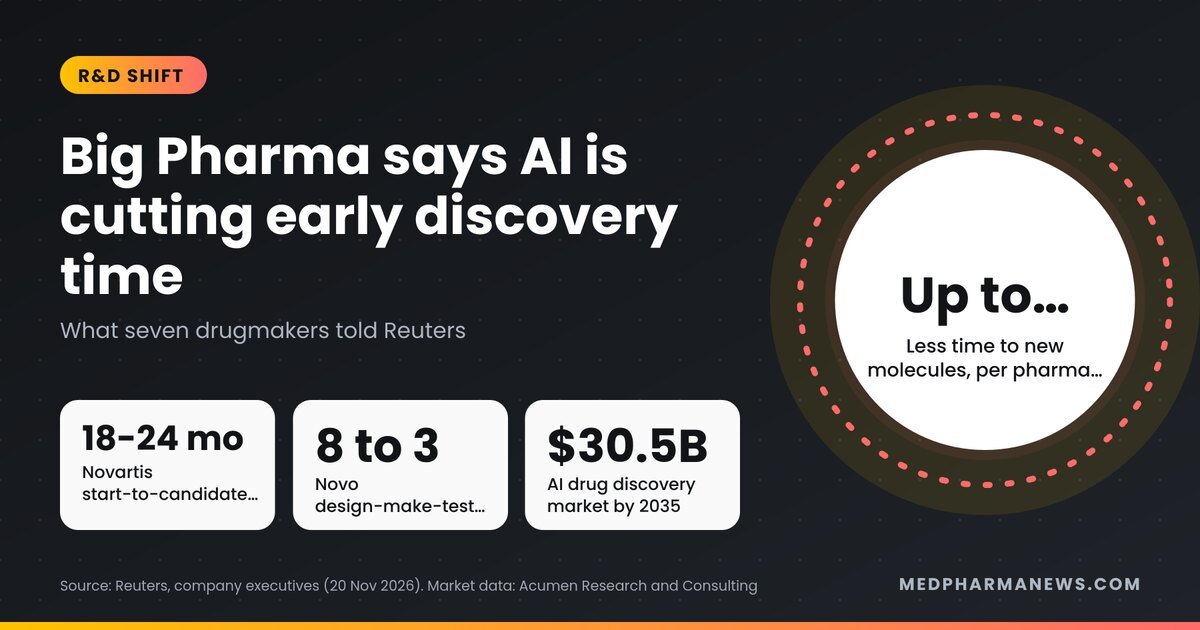
- Seven large drugmakers report AI is now used across early research, cutting time to new molecules by up to 50%.
- Novartis says average time from project start to drug candidate has fallen from about three years to roughly 18 to 24 months.
- Novo Nordisk says AI cut design-make-test cycles from about eight to three, and halved each cycle from eight weeks to four.
- Sanofi says it saved at least a year on asthma candidate lunsekimig by skipping a dose-selection study.
- Clinical attrition is unchanged so far: nearly 9 in 10 conventionally developed drugs fail in trials, according to PhRMA.
- Acumen Research and Consulting projects the AI in drug discovery market will grow from US$2.8 billion in 2025 to US$30.5 billion by 2035.
Company by company: what each drugmaker claims
| Company | Executive cited | Reported AI gain |
|---|---|---|
| Novartis | Fiona Marshall, President, Biomedical Research | Project start to candidate cut from ~3 years to ~18-24 months; AI helped prioritise five kidney disease targets |
| Novo Nordisk | R&D leadership | Design-make-test cycles cut from ~8 to 3; each cycle from 8 to 4 weeks |
| Sanofi | Matt Truppo, global head of computational and AI strategy | At least one year saved on lunsekimig; expects 20-25% faster early discovery within two years, possibly 50% within five, across 100+ programmes |
| Bristol Myers Squibb | Robert Plenge, Chief Research Officer | A sickle cell candidate would not exist without its AI systems; next step is linking models to lab automation |
| AstraZeneca | Sharon Barr | AI used at every stage from discovery to development |
| Eli Lilly | Aliza Apple, TuneLab | Shares some internal models with smaller biotechs; cautions against “cure everything” claims |
Taken together, the numbers point to the same place: AI is compressing the slow, iterative loop of designing a compound, making it, testing it and redesigning it. By our calculation, Novo’s figures imply total cycle time for a typical optimisation campaign dropping from roughly 64 weeks (8 cycles of 8 weeks) to about 12 weeks (3 cycles of 4 weeks), though the company did not present it that way and real projects vary widely.
Novartis puts a number on the whole pipeline
Separately, Novartis chief executive Vas Narasimhan has set a goal of shrinking total development time from about 12 years to eight and raising the share of drugs that succeed after entering human testing from 8% to 12%. Novartis says generative chemistry, simulated trial enrolment that now runs thousands of scenarios in minutes, and AI-assisted document writing have already shortened clinical study report timelines by 25%. These are targets, not results, and the company acknowledges that faster paperwork does not prove drugs will clear Phase 3 or regulators sooner.
Partners or competitors: the frontier AI question
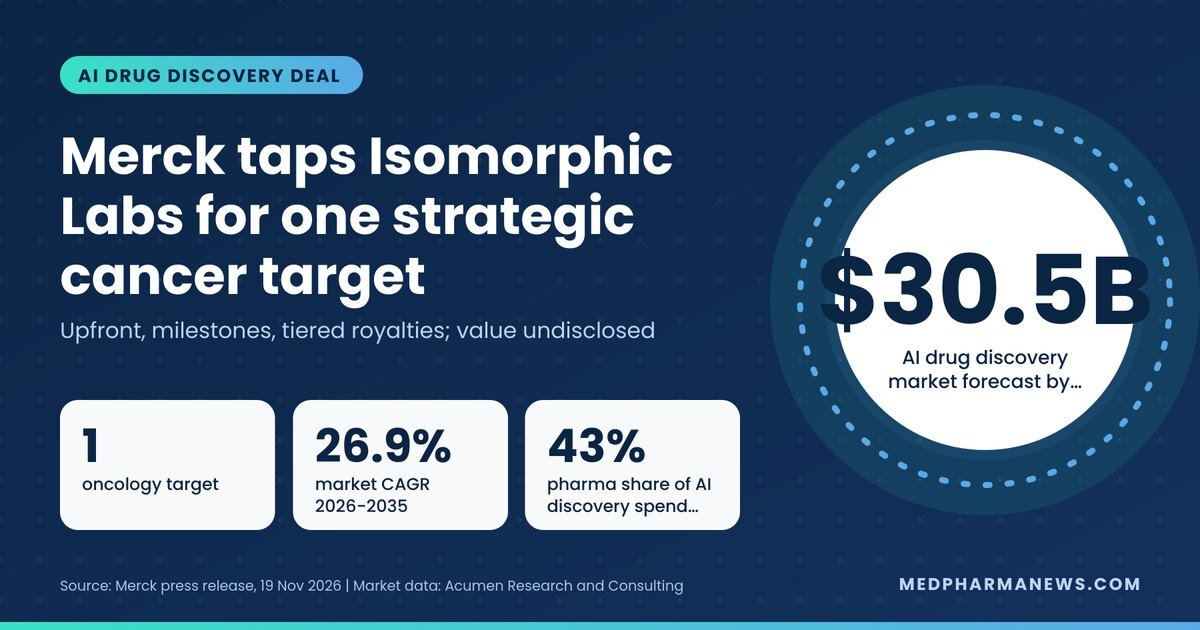
The Reuters report was framed around Anthropic, whose chief executive Dario Amodei has argued that AI can greatly accelerate the path to cures. Anthropic works with Bristol Myers Squibb, offers a research-focused product, and Novo Nordisk says it uses Anthropic models in R&D. Narasimhan also sits on Anthropic’s board. Alphabet-backed Isomorphic Labs, which closed a record raise this week and signed with Merck, is pursuing the same goal from inside drug discovery; we covered its US$5 billion Series C and the Merck collaboration.
Pharma is split on how to treat these companies. GSK’s chief scientific officer Tony Wood called Anthropic another competitor, while BMS and Novo lean towards partnership. Novo and Sanofi both said they do not hand proprietary data to frontier labs, which matters because Sanofi’s own team thinks the biggest AI gains will come where companies hold the deepest private datasets. One venture investor told Reuters that frontier labs are looking at pharma acquisitions; that is an unconfirmed claim, and Anthropic did not comment.
What AI has not fixed
Early discovery is usually only a few years of a 10 to 15 year journey that can cost billions. The expensive failures happen later, when drugs meet patients. A March 2026 count found 129 AI-enabled drug candidates across 69 companies, up from about 117 eight months earlier, but most remain early-stage and the number reaching clinical testing has climbed only gradually. University of Chicago oncology fellow Waqas Haque, who worked on that dataset, expects a sharp rise over one to three years but says it is unknown whether these drugs will succeed more often given trial and regulatory bottlenecks.
Market context
According to Acumen Research and Consulting, the AI in drug discovery market was valued at US$2.8 billion in 2025 and is projected to reach about US$30.5 billion by 2035, a 26.9% compound annual growth rate. Pharmaceutical companies accounted for 43% of spending in 2025, ahead of biotechs at 30% and contract research organisations at 13%, and cloud deployment held a 52% share. Acumen expects big pharma’s share to slip towards 47% by 2035 as smaller biotechs adopt AI platforms, a trend Lilly’s TuneLab model-sharing scheme is designed to tap.
What to watch next
- Whether AI-originated candidates such as BMS’s sickle cell programme show better Phase 2 success rates than the industry norm.
- Whether Sanofi hits its 20-25% early-timeline target within two years.
- New deals, or acquisitions, between frontier AI labs and drugmakers.
- How FDA and EMA handle submissions that rely on AI-generated modelling in place of traditional studies, as Sanofi did with lunsekimig dose selection.
Frequently asked questions
How much faster is drug discovery with AI?
Large drugmakers report early-stage gains of up to 50%. Novartis, for example, says project start to drug candidate now takes about 18 to 24 months instead of three years.
Has AI made drugs more likely to be approved?
Not yet. Most AI-enabled candidates are still early in development, and there is no evidence so far of higher success rates in late-stage trials.
Which pharma companies use Anthropic’s AI?
According to Reuters, Anthropic works with Bristol Myers Squibb, and Novo Nordisk uses Anthropic models in its research. Other companies, including GSK, view frontier AI labs more as competitors.
How big is the AI drug discovery market?
Acumen Research and Consulting estimates US$2.8 billion in 2025, rising to about US$30.5 billion by 2035.
More from our industry insights coverage.
Sources: Reuters via Investing.com, TokenPost on Novartis. Market data: Acumen Research and Consulting. This article is for information only and is not investment advice. Last updated 20 November 2026.