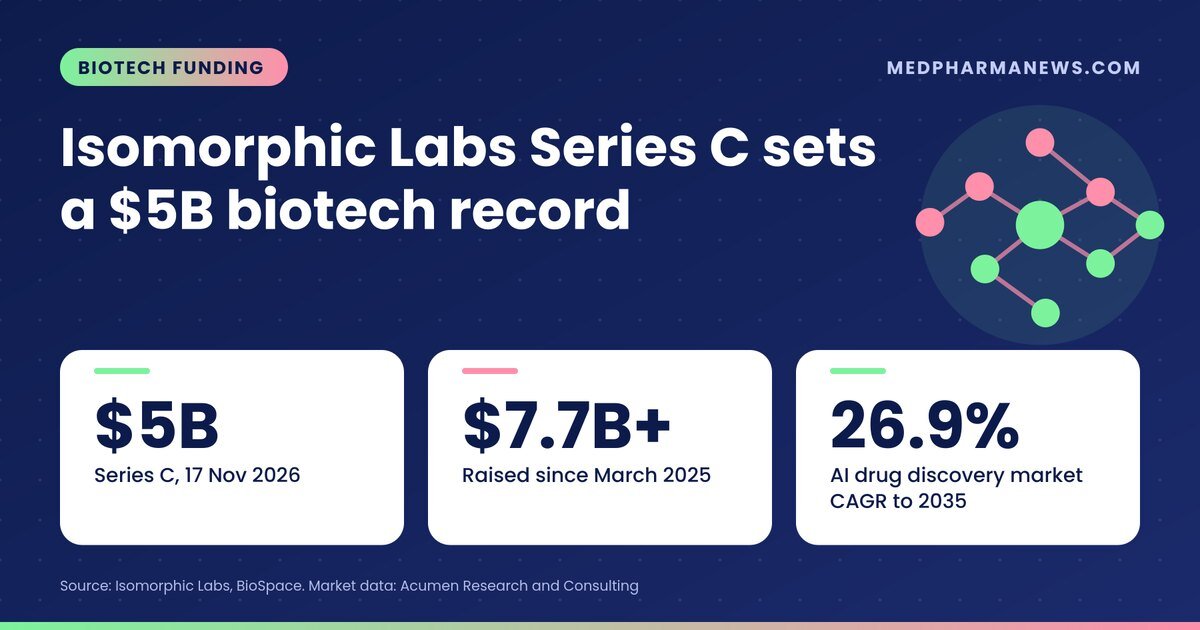
The Isomorphic Labs Series C, announced on 17 November 2026, raised $5 billion for the Alphabet-backed AI drug designer, the largest private financing the biotech industry has ever recorded. Greenoaks and Sequoia Capital co-led the round with Andreessen Horowitz and other new backers joining, while Alphabet and existing investors including Thrive Capital, MGX, GV, CapitalG, Temasek and the UK Sovereign AI Fund put in more, according to the company’s announcement. The London company has not disclosed a valuation, and it has not yet put a drug into human trials.
Key takeaways on the Isomorphic Labs Series C
- $5 billion is more than double the $2.1 billion Series B the company closed in May 2026, only six months ago.
- It overtakes the $3 billion launch of Altos Labs in 2022 as biotech’s biggest venture round, as BioSpace reported.
- Isomorphic has now raised at least $7.7 billion since its first outside round of $600 million in March 2025.
- The money will scale its drug design engine, IsoDDE, and push internal oncology and immunology programmes toward clinical trials. No start date has been given.
- Partners include Eli Lilly, Novartis and Johnson & Johnson.
The funding curve in one table
| Round | Date | Amount | Named leads or backers |
|---|---|---|---|
| First external round | March 2025 | $600M | Thrive Capital-led, with Alphabet and GV |
| Series B | May 2026 | $2.1B | Not restated in the latest release |
| Series C | 17 Nov 2026 | $5.0B | Greenoaks, Sequoia Capital (co-leads); a16z; Alphabet |
| Total | $7.7B+ | Valuation undisclosed |
By our calculation, each round has been roughly 2.4 to 3.5 times the size of the one before it, and the Series C alone is larger than the combined first two raises. That is the trajectory of a frontier AI lab, not a typical drug developer, and it reflects who is writing the cheques: generalist technology and growth investors rather than specialist life sciences funds.
What Isomorphic is actually building
Isomorphic was spun out of Google DeepMind in 2021 by Sir Demis Hassabis, who still runs both. Its core asset is IsoDDE, which BioSpace describes as a suite of foundational simulation models designed to work across therapeutic areas and drug types, building on the protein structure work that began with AlphaFold. The aim is to predict how a candidate molecule binds, behaves and might fail before chemists make it, cutting the trial-and-error cycles that dominate early discovery.
Hassabis said the engine is producing molecules “with unprecedented precision and speed” and that the round will help move the company’s first programmes toward the clinic. President Max Jaderberg framed the goal as tackling the hardest problems in drug discovery. The company has reported preclinical results in oncology and immunology but has not named any compound publicly.
The gap between the money and the evidence
This is where readers should be careful. A record cheque is a vote of confidence in a platform, not proof that AI-designed drugs work better in people. Benchmarks on binding prediction and design speed say little about the questions that sink most programmes: unexpected toxicity, poor exposure in humans, or a biological target that does not drive disease. Earlier AI-first biotechs have learned this the hard way; several have reported mixed mid-stage data and narrowed their pipelines. Our recent look at Recursion’s REC-4881 Phase 2 results shows how clinical reality can temper platform promises.
Isomorphic’s advantage is runway. With $5 billion fresh, it can afford to run several programmes in parallel and absorb failures without returning to investors soon, something few biotechs can do. The test over the next two to three years is simple: how many molecules enter Phase 1, how fast, and whether any show a clear safety or efficacy edge over conventionally designed drugs.
Market context: how big is AI in drug discovery?
According to Acumen Research and Consulting, the AI in drug discovery market was valued at about $2.8 billion in 2025 and is projected to reach roughly $30.5 billion by 2035, a compound annual growth rate of 26.9% (report updated September 2026). Acumen finds pharmaceutical companies were the largest buyers in 2025 with a 43% share, followed by biotechnology companies at 30%, and cloud deployment accounted for 52% of the market.
Set side by side, the Series C is close to 1.8 times Acumen’s estimate of the entire market’s 2025 revenue, by our calculation. The two numbers measure different things (capital raised versus annual spending on AI tools and services), but the comparison shows how far investor expectations are running ahead of today’s commercial market. Acumen also notes that generative AI companies drew about $35.3 billion of venture investment globally in 2025, part of the wider capital pool now reaching life sciences.
What it means for pharma and the wider biotech market
- Partners gain leverage, and competition: Lilly, Novartis and J&J get access to a better-funded collaborator, but Isomorphic now has the means to keep more assets for itself instead of licensing them early.
- Capital concentration: mega-rounds for AI platforms sit alongside a tight market for many clinical-stage biotechs, widening the gap between the best-funded companies and the rest.
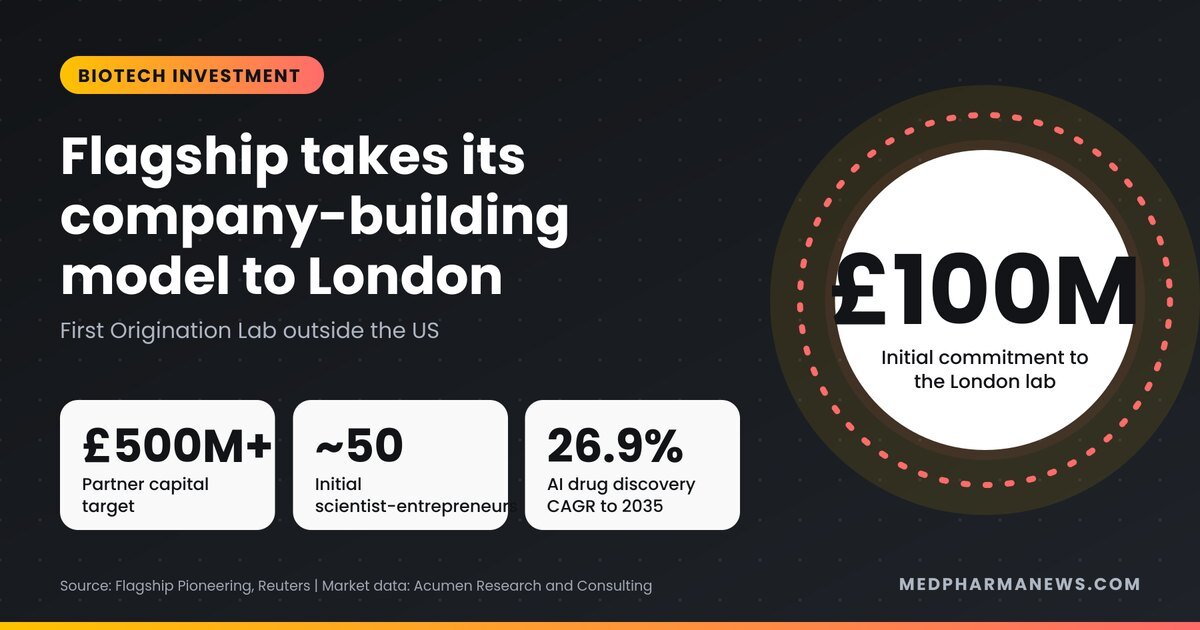
- The UK angle: participation by the UK Sovereign AI Fund and Isomorphic’s London base strengthen Britain’s case as an AI biotech hub, a theme also behind Flagship Pioneering’s new London lab.
FAQ
How much did Isomorphic Labs raise in its Series C?
$5 billion, announced on 17 November 2026 and co-led by Greenoaks and Sequoia Capital, with Alphabet continuing to invest.
What is Isomorphic Labs’ valuation?
The company has not disclosed a valuation for the Series C or for earlier rounds.
Does Isomorphic Labs have any drugs in clinical trials?
Not yet. It has internal preclinical programmes in oncology and immunology and says the funding will drive its first programmes toward trials, without giving a date.
Is this the biggest biotech funding round ever?
Yes. It surpasses the $3 billion Altos Labs launch in 2022, previously the largest private biotech raise.
More deal coverage: Industry Insights.
Sources: Isomorphic Labs announcement; BioSpace; Reuters. Market data: Acumen Research and Consulting, AI in Drug Discovery Market report. Not investment or medical advice. Last updated 18 November 2026.