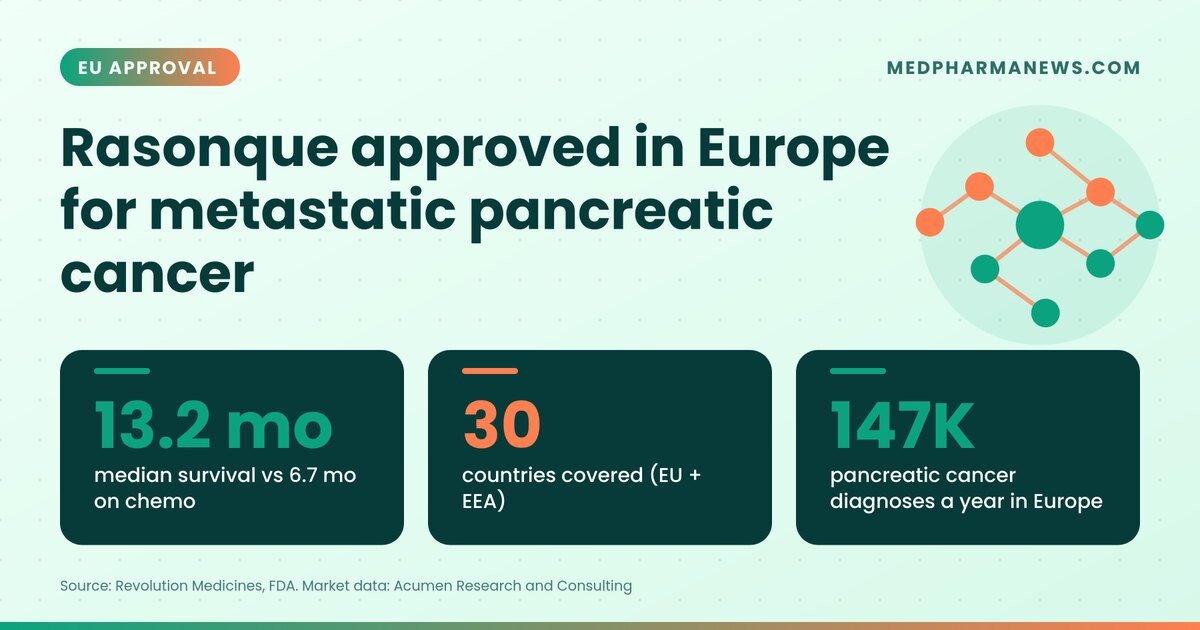
The Rasonque EU approval came on November 16, 2026, when the European Commission authorised Revolution Medicines’ daraxonrasib for adults with metastatic pancreatic adenocarcinoma who have already had at least one systemic therapy. The once-daily tablet is the first broad RAS-targeted medicine cleared in the region for this cancer, and it is approved whether or not a patient’s tumour carries an identified RAS mutation. The decision covers all 27 EU member states plus Iceland, Norway and Liechtenstein, but patients will only get it once each country settles pricing and reimbursement.
Key takeaways on the Rasonque EU approval
- The European Commission approved Rasonque (daraxonrasib) monotherapy for previously treated metastatic pancreatic adenocarcinoma on November 16, 2026.
- The label is mutation-agnostic: patients with or without an identified RAS mutation are eligible.
- Approval rests on the Phase 3 RASolute 302 trial, where median overall survival was 13.2 months versus 6.7 months on chemotherapy in the FDA’s summary of the 500-patient study.
- The UK and Switzerland are not covered and need separate approvals.
- Revolution Medicines now faces country-by-country health technology assessment, the step that decides how fast patients in Europe actually receive the drug.
From CHMP opinion to a signed approval
The Commission decision follows the positive opinion from the EMA’s human medicines committee, which we covered when the EU panel backed Rasonque. That review ran as an expedited, phased assessment under the EMA’s Cancer Medicines Pathfinder project, a route reserved for medicines with the potential to meet a high unmet need. The Commission almost always follows CHMP advice, so the approval itself was expected. What it changes is legal status: Revolution Medicines can now start pricing talks and launch where reimbursement allows.
The speed is notable for a company that only became commercial this year. The FDA approved Rasonque on August 26, 2026, about six and a half months before its user fee deadline, after a review that also ran under the agency’s Commissioner’s National Priority Voucher pilot. That pilot has since been shelved, as we reported in our piece on what happens to the 22 voucher drugs, but Rasonque had already crossed the line.
US and EU labels compared
| Item | United States (FDA) | European Union (EC) |
|---|---|---|
| Approval date | August 26, 2026 | November 16, 2026 |
| Who is eligible | Adults with metastatic PDAC after at least one prior systemic therapy, or who are not candidates for multiagent therapy | Adults with metastatic PDAC after at least one prior systemic therapy |
| RAS mutation required? | No | No |
| Regulatory route | Priority Review, Breakthrough and Orphan designations, voucher pilot | Phased review under Cancer Medicines Pathfinder |
| Territory | US | EU 27 plus Iceland, Norway, Liechtenstein |
The one practical difference is the US option for patients who are not fit for combination chemotherapy. The EU label does not include that group, so in Europe Rasonque is strictly a second-line or later treatment for now.
Why the survival data carried the review
Second-line pancreatic cancer has been one of oncology’s hardest settings, with chemotherapy offering only modest gains. In RASolute 302, patients took 300 mg of daraxonrasib daily or the investigator’s choice of four chemotherapy regimens. The trial met all of its primary and key secondary goals, in the RAS G12-mutant group and in the full intent-to-treat population, which included tumours with no identified RAS mutation. By our calculation, the 13.2-month versus 6.7-month median survival figures represent roughly a doubling of life expectancy in this setting. The data were presented at ASCO 2026 and published in the New England Journal of Medicine.
The drug is not gentle. The US label carries warnings for skin and soft tissue toxicity, mouth sores, diarrhoea, gastrointestinal perforation, interstitial lung disease and embryo-fetal toxicity. The most common side effects listed by the FDA include rash, diarrhoea, stomatitis, nausea, fatigue and vomiting.
The commercial test: Europe’s reimbursement maze
Revolution Medicines estimates that about 147,000 people are diagnosed with pancreatic cancer in Europe each year, that roughly 80% are diagnosed after the disease has spread, and that five-year survival stays below 10%. Those numbers suggest a large eligible pool in the second-line setting. Turning that into revenue depends on national HTA bodies such as Germany’s G-BA and France’s HAS, which judge added benefit and drive price. Germany typically allows launch soon after approval, while some southern and eastern European markets can take a year or more.
Chief executive Mark Goldsmith said the company is working with health systems across the region “to support timely access for eligible patients.” The company has not disclosed a European list price or launch sequence.
Market context
Acumen Research and Consulting valued the global pancreatic cancer therapeutics market at about US$3.58 billion in 2021 and projected it would reach US$6.58 billion by 2030, a compound annual growth rate of 7.2%, with North America leading and Asia-Pacific growing fastest. The report was last updated in June 2022, before any RAS inhibitor had reached patients, so the forecast is dated and indicative. A first-in-class pill with a survival benefit of this size is exactly the kind of shift that could push the category above earlier projections.
What comes next for daraxonrasib
The bigger prize is first-line treatment. At the ENA 2026 symposium in Barcelona on November 20, updated Phase 1/2 data showed daraxonrasib plus gemcitabine and nab-paclitaxel shrank tumours in 60.7% of 61 previously untreated patients, with median progression-free survival of 12.8 months and 12-month survival of 76.6%. That study had no control arm. The randomised Phase 3 RASolute 303 trial is testing daraxonrasib alone and with chemotherapy against chemotherapy alone, and a positive result would greatly widen the label. Revolution Medicines is also running Phase 3 work in RAS-mutant lung cancer. More approvals coverage is in our pharmaceuticals section.
FAQ
Is daraxonrasib approved in Europe?
Yes. The European Commission approved it as Rasonque on November 16, 2026 for adults with metastatic pancreatic adenocarcinoma after at least one prior systemic therapy.
Do patients need a RAS mutation test to get Rasonque?
No. The EU and US approvals cover patients with or without an identified RAS mutation, reflecting benefit seen across the full trial population.
When will Rasonque be available in my country?
Timing varies by country and depends on national pricing and reimbursement decisions. The UK and Switzerland require separate regulatory approvals.
How much longer did patients live on Rasonque?
In RASolute 302, median overall survival was 13.2 months with daraxonrasib versus 6.7 months with standard chemotherapy, according to the FDA.
Sources: Revolution Medicines release, November 16, 2026; FDA press announcement; ENA 2026. Market data: Acumen Research and Consulting. Not medical or investment advice. Last updated November 21, 2026.