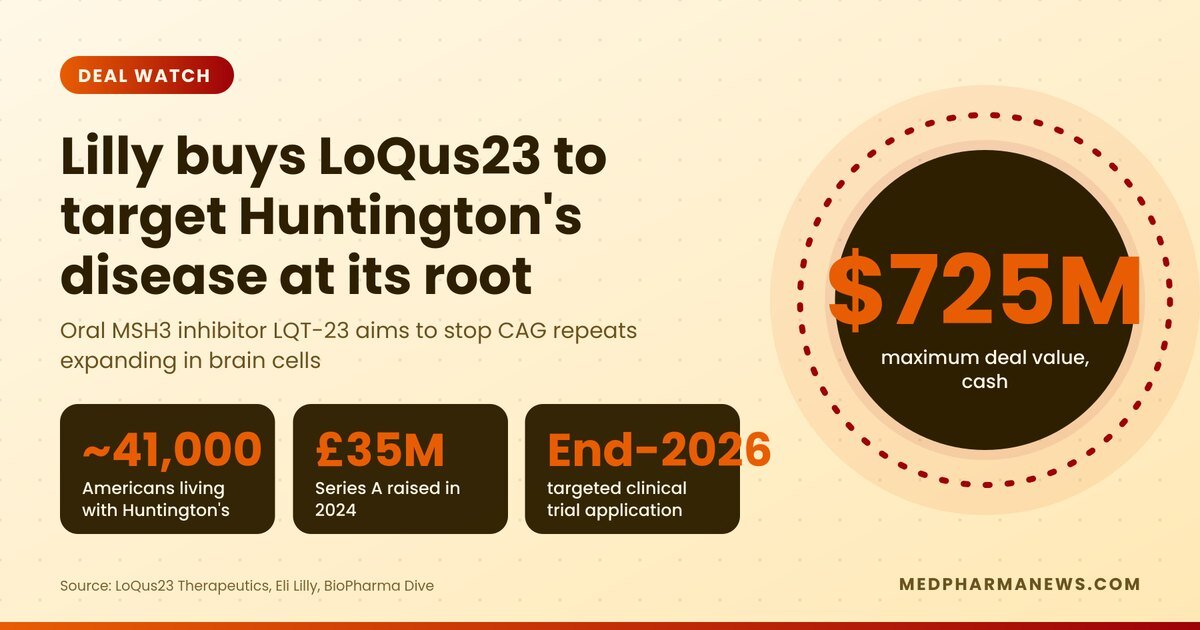
The Lilly LoQus23 acquisition, announced on 23 November 2026, sees Eli Lilly pay up to $725 million in cash for a Cambridge, UK biotech developing an oral pill that targets MSH3, a DNA repair protein thought to drive the progression of Huntington’s disease. The lead drug, LQT-23, is still preclinical, with a clinical trial application expected around the end of 2026. Lilly shares rose about 2% on the news.
Key takeaways on the Lilly LoQus23 acquisition
- Total value up to $725 million in cash: an undisclosed upfront payment plus development and regulatory milestones.
- LoQus23’s lead asset, LQT-23, is a selective, oral, allosteric small-molecule inhibitor of MSH3.
- The idea is to slow somatic expansion of the CAG repeat in brain cells, a process linked to when symptoms start and how fast they progress.
- No human data yet; LoQus23 had guided to a clinical trial application by the end of 2026.
- The deal extends a 2026 neuroscience buying spree by Lilly that includes Centessa ($6.3 billion) and AtaiBeckley ($2.8 billion).
Deal terms at a glance
| Item | Detail |
|---|---|
| Buyer | Eli Lilly and Company |
| Target | LoQus23 Therapeutics, Cambridge, England (private) |
| Maximum value | Up to $725 million in cash |
| Structure | Upfront (undisclosed) plus development and regulatory milestones |
| Lead asset | LQT-23, oral MSH3 inhibitor, preclinical |
| Founded | 2019, in SV Health Investors’ Dementia Discovery Fund |
| Prior funding | Seed from DDF; seed extension led by Novartis Venture Fund (2021); £35 million Series A led by Forbion (2024) |
| Advisers to LoQus23 | Centerview Partners (financial), Goodwin Procter (legal) |
The science: why MSH3 is a target worth paying for
Huntington’s disease is caused by an expanded run of CAG repeats in the huntingtin gene. Everyone with the disease inherits that expansion, but the repeat does not stay still. In vulnerable brain cells, particularly in the striatum, it keeps lengthening over a lifetime, a process called somatic expansion. Large human genetic studies of what modifies the age of onset have repeatedly pointed to DNA mismatch repair genes, and MSH3 is one of the most prominent. People carrying variants that weaken this machinery tend to develop symptoms later.
That gives MSH3 an unusual advantage among neurology targets: human genetics already suggests that turning it down is tolerated and helpful. MSH3 works as part of the MutS-beta complex, which appears to mistake the repeat’s loop structures for damage and, in trying to repair them, adds more repeats. LoQus23 says LQT-23 blocked somatic expansion in Huntington’s cell systems and in animal models. Because it is a pill, it could in principle reach the brain without the injections into the spinal fluid or brain surgery needed by some gene-silencing approaches.
The same expansion biology is shared by other repeat disorders, including several spinocerebellar ataxias and myotonic dystrophy, which gives Lilly potential follow-on options if the mechanism works.
Where this sits in Lilly’s 2026 deal spree
Flush with revenue from its obesity and diabetes franchise, Lilly has done more than a dozen acquisitions this year, according to BioPharma Dive. Neuroscience has been a recurring theme: the $6.3 billion purchase of Centessa Pharmaceuticals brought in orexin-class sleep medicines, and a deal valued at $2.8 billion added AtaiBeckley’s psychedelic programmes. Only a week earlier, Lilly agreed to buy blood-cancer biotech Calytrix for up to $1.5 billion. LoQus23 is small by comparison, a classic early bet where most of the money is paid only if the drug advances. Similar structures have shown up across recent big-pharma deals such as Pfizer’s Starna transaction and AbbVie’s DISCO deal.
The unmet need
LoQus23 cites about 41,000 people living with Huntington’s disease in the US, with many more at risk because each child of an affected parent has a 50% chance of inheriting the gene. Current medicines, such as the VMAT2 inhibitors used for chorea, ease movement symptoms but do not slow the disease. A therapy that delays onset in gene carriers who are not yet ill would be a step change, and a pill is far more practical for long-term preventive use than repeated invasive procedures.
Risks and open questions
- No human data: LQT-23 has not been dosed in people. Safety of long-term mismatch repair inhibition, including any effect on cancer risk outside the brain, has to be established.
- Proving benefit: Huntington’s progresses slowly, so showing an effect on clinical outcomes takes large, long trials. Biomarkers of somatic expansion may help but are not yet accepted endpoints.
- Undisclosed upfront: without the split between upfront and milestones, the real risk Lilly is taking cannot be judged.
- Timing: LoQus23 had targeted a trial application by the end of 2026; Lilly has not given its own clinical timeline.
Frequently asked questions
How much is Lilly paying for LoQus23?
Up to $725 million in cash, made up of an undisclosed upfront payment plus milestone payments tied to development and regulatory progress.
What does LoQus23’s drug do?
LQT-23 is an oral small molecule that inhibits MSH3, a DNA repair protein that helps the Huntington’s CAG repeat keep expanding in brain cells. Blocking it aims to slow the disease process itself.
Is there a cure for Huntington’s disease?
No. Approved drugs treat symptoms such as chorea. Disease-modifying approaches, including MSH3 inhibitors, are still in research or early trials.
When will LQT-23 enter clinical trials?
LoQus23 said it expected to file a clinical trial application around the end of 2026. First human data would follow later.
Read more deal coverage in our pharmaceuticals section.
Sources: LoQus23 Therapeutics press release, 23 Nov 2026; BioPharma Dive; Reuters. This article is for information only and is not medical or investment advice. Last updated 24 November 2026.