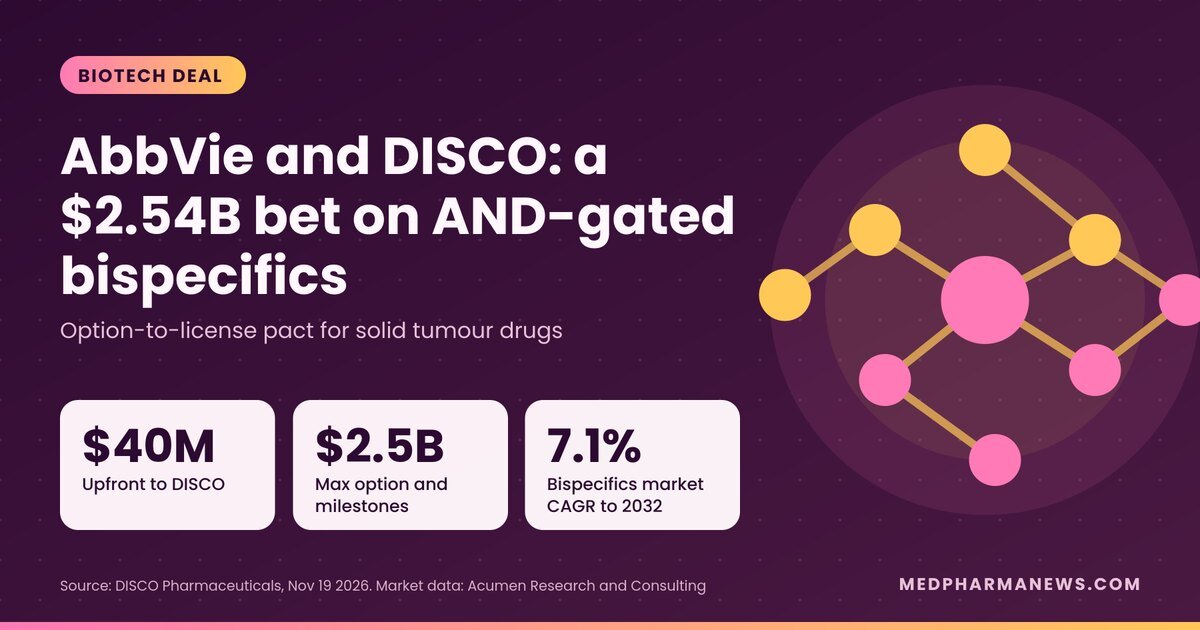
The AbbVie DISCO Pharmaceuticals deal, announced on November 19, 2026, gives AbbVie options on a new class of “AND-gated” bispecific cancer drugs from the Cologne-based biotech, with DISCO receiving $40 million upfront and up to $2.5 billion in option, development and other milestones, plus tiered royalties on worldwide sales. Combined, the headline value comes to roughly $2.54 billion, the figure carried in Reuters coverage.
The agreement is small upfront and large on paper, which is typical of early-stage discovery pacts. What makes it worth a closer look is the science: DISCO is trying to solve one of the oldest problems in solid tumour drug design, which is finding targets that are on cancer cells but not on healthy tissue.
Key takeaways on the AbbVie DISCO Pharmaceuticals deal
- DISCO gets $40 million upfront and is eligible for up to $2.5 billion more, plus tiered royalties.
- The deal is a research collaboration with an option: AbbVie can exclusively license selected programs after DISCO completes agreed research work.
- The focus is AND-gated bispecifics for solid tumours with high unmet need. Specific targets were not disclosed.
- AbbVie already had a link to DISCO: AbbVie Ventures took part in DISCO’s EUR 36 million seed round, closed in December 2025.
- By our calculation, only about 1.6% of the headline value is guaranteed upfront.
The money, broken down
| Component | Amount | Notes |
|---|---|---|
| Upfront payments | $40 million | Paid on signing |
| Option, development and other milestones | Up to $2.5 billion | Contingent on AbbVie exercising options and programs advancing |
| Royalties | Tiered, undisclosed rates | On worldwide net sales of licensed products |
| Headline value | About $2.54 billion | Upfront plus maximum milestones, by our calculation |
| Guaranteed share | About 1.6% | $40M divided by $2.54B, by our calculation |
Neither company disclosed how many programs are covered or how the milestones are split between option fees and later clinical or commercial events. AbbVie did not issue its own release; the terms come from DISCO’s announcement.
What “AND-gated” means and why it matters
Most antibody-based cancer drugs hit a single protein on the cell surface. The problem is that very few proteins are found only on tumours, so drugs that kill cells carrying a target can also damage healthy organs that carry it at lower levels. That on-target, off-tumour toxicity limits doses and has sunk many promising programs.
An AND-gated bispecific is engineered to bind two different surface proteins, and to bind strongly only when both are present on the same cell. Healthy tissue that carries just one of the two targets should, in theory, be largely spared. DISCO says its bispecifics achieve high-avidity binding only when both targets are engaged together on a tumour cell.
The hard part is choosing the pairs. DISCO’s DISCOtech platform maps the “surfaceome”, the full set of proteins displayed on a cell’s surface, to find combinations that occur together on cancer cells but rarely on normal ones. The company says the same approach can feed AND-gated antibody-drug conjugates and T-cell engagers as well as bispecific antibodies.
Who is DISCO Pharmaceuticals?
- Base: Cologne, Germany.
- Leadership: CEO Mark Manfredi, Ph.D., appointed in December 2025 and previously CEO of Ikena Oncology. Founder Roman Thomas, M.D., now serves as a strategic advisor.
- Funding: a EUR 36 million seed round co-led by Ackermans & van Haaren and NRW.Bank, with Sofinnova Partners, AbbVie Ventures, M Ventures and Panakes Partners participating.
- Own pipeline: lead programs, described as antibody-drug conjugates, are heading towards the clinic in small cell lung cancer and microsatellite-stable colorectal cancer. These sit outside the AbbVie pact as far as the release states.
AbbVie’s oncology strategy in context
AbbVie has been building a broader solid tumour presence, including a large PD-1xVEGF bispecific licensing deal with RemeGen earlier this year. The DISCO agreement is a different kind of bet: earlier, cheaper and focused on target discovery rather than a near-clinic asset. It also follows a run of big pharma moves into next-generation tumour targeting this month, including Lilly’s tumour-only target pact and Pfizer’s in vivo CAR-T licensing; see our analysis of the Pfizer Starna deal and Lilly’s Calytrix acquisition, which also targets a cancer-only mutation.
The common thread is selectivity. Drugmakers are paying for technology that sharpens the difference between tumour and healthy tissue, because that difference decides how much drug a patient can safely receive.
Market context
Bispecifics are still a young commercial category. Acumen Research and Consulting’s bispecific antibodies market report sized the global market at USD 554 million in 2022 and projects USD 1,084 million by 2032, growing at 7.1% a year, with North America the largest region and Asia-Pacific the fastest growing. The report was last updated in August 2023, before several recent bispecific approvals and licensing deals, so its figures are best read as an indicative baseline rather than a current estimate.
Risks and what to watch
- Option exercise: most of the value depends on AbbVie choosing to license programs. Discovery collaborations are often trimmed or ended before that point.
- Clinical proof: AND-gating has strong logic but limited clinical validation so far. Early human data will be the real test of tolerability.
- Target disclosure: watch for the first named target pairs and tumour types.
- DISCO’s own clinic entry: progress in small cell lung and colorectal cancer will show whether the platform delivers.
FAQ
How much is the AbbVie DISCO deal worth?
DISCO receives $40 million upfront and up to $2.5 billion in milestones, about $2.54 billion in total, plus tiered royalties on sales.
What is an AND-gated bispecific antibody?
It is an antibody designed to bind tightly only when two specific proteins are present on the same cell, aiming to hit tumour cells while sparing healthy cells that carry just one of the targets.
Is AbbVie acquiring DISCO Pharmaceuticals?
No. It is a collaboration with an option to license selected programs, not an acquisition. DISCO remains independent.
Which cancers will the AbbVie DISCO programs target?
The companies said solid tumours with high unmet medical need but did not name specific cancers or targets for the partnered programs.
Sources: DISCO Pharmaceuticals press release (November 19, 2026); DISCO seed financing release (December 11, 2025); Reuters reporting. Market data: Acumen Research and Consulting. More in Industry Insights. Not investment or medical advice. Last updated November 20, 2026.