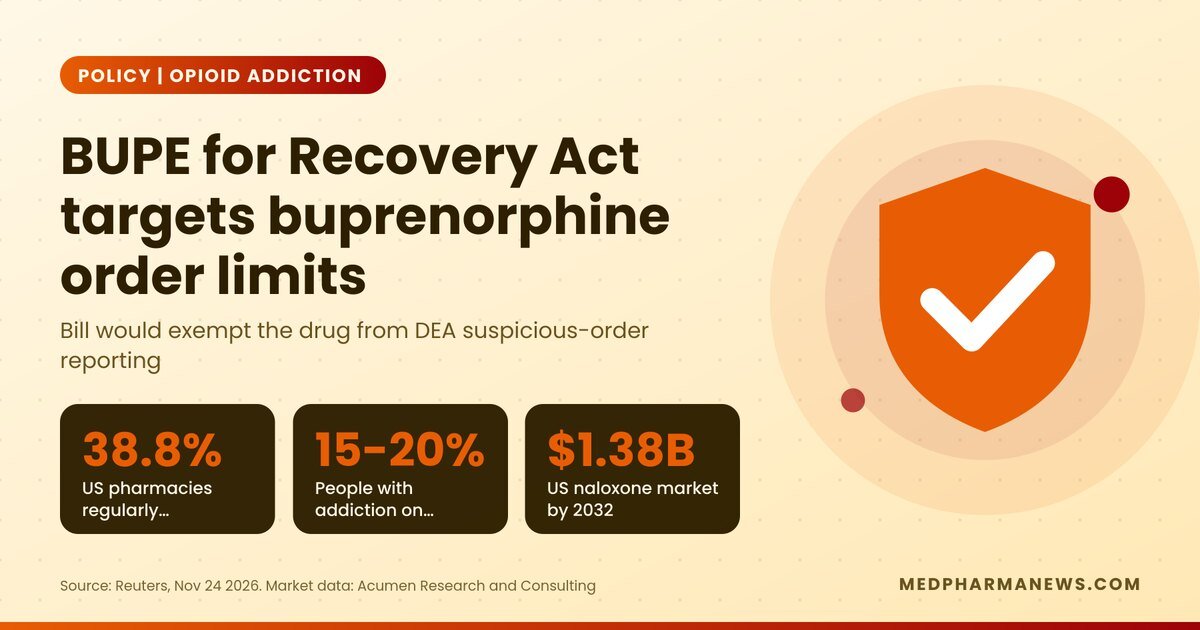
The BUPE for Recovery Act, unveiled on November 24, 2026 by Senator Martin Heinrich of New Mexico and Representative Paul Tonko of New York, both Democrats, would exempt the opioid addiction medicine buprenorphine from the Drug Enforcement Administration’s suspicious-order reporting system for as long as the US opioid public health emergency lasts. Supporters say the reporting rules lead distributors to cap pharmacy orders, leaving only about 38.8% of US pharmacies regularly dispensing the drug as of 2023, Reuters reported.
Key takeaways on the BUPE for Recovery Act
- The bill targets one supply-chain bottleneck: DEA suspicious-order reporting, which covers buprenorphine because it is technically an opioid.
- It would lift that reporting duty for buprenorphine only during the opioid public health emergency first declared in 2017, then require a study on whether to restore it.
- Only 15% to 20% of Americans with opioid addiction use any medication for it, according to recent US surveys cited by Reuters.
- A previous version stalled in 2024; Democrats take control of both chambers of Congress on January 3.
- Wholesalers such as McKesson and Cardinal Health, pharmacies and generic makers would all feel the change.
How suspicious-order reporting slows buprenorphine
After the prescription painkiller crisis, the DEA required drug distributors to flag unusually large or frequent orders of controlled substances through its Suspicious Order Reporting System (SORS). Orders that trip a flag can be held or refused. The thresholds are set by distributors and are not shared with pharmacies, so a pharmacy that starts serving more addiction patients cannot easily tell when it will be cut off.
Buprenorphine sits in the same bucket as oxycodone and fentanyl for this purpose, even though it is a partial opioid agonist used to treat addiction, has been on the US market since 2002, and has a ceiling effect on breathing suppression that makes overdose less likely than with full opioids. Addiction physician Gregory Famiglio summed up the frustration to Reuters: “The treatment is flagged the same as the poison.”
The access gap in numbers
| Indicator | Figure | Source as reported |
|---|---|---|
| Americans with addiction using medication treatment | 15% to 20% | Recent US surveys |
| US pharmacies regularly dispensing buprenorphine (2023) | 38.8% | USC and UC Berkeley study |
| Pharmacies not regularly dispensing it, by our calculation | About 61% | Derived from the figure above |
| Opioid public health emergency first declared | 2017 | US government |
| Buprenorphine on the US market since | 2002 | Reuters |
A 2025 University of Texas study cited in the same report found that heightened monitoring led to rationing and interruptions in care. For a patient in early recovery, a missed refill is not a paperwork problem; it can mean withdrawal and a return to illicit fentanyl.
Who stands to gain, and who has concerns
Pharmacies would be able to stock buprenorphine in line with local demand without fearing that a bigger order triggers a compliance review. Distributors would shed one category of reporting burden and some of the legal exposure that shaped their cautious approach after opioid litigation. Generic manufacturers of buprenorphine and buprenorphine-naloxone tablets and films could see steadier volumes if more pharmacies keep the drug on the shelf.
The main counter-argument is diversion. Buprenorphine can be misused or sold, and reporting systems exist partly to catch pill-mill style patterns. The bill’s sunset structure, tied to the emergency declaration and followed by a government study, is designed to answer that worry, but critics may still press for a narrower carve-out. Reuters did not report any formal opposition at introduction.
Odds of passage in the next Congress
Introducing a bill this late in a session is largely a signal. A spokesperson for Heinrich told Reuters the move helps build awareness and momentum. The real test comes after January 3, when Democrats take control of both chambers and committee calendars reset. Addiction policy has drawn bipartisan votes before, notably the 2022 repeal of the special “X-waiver” doctors once needed to prescribe buprenorphine, which suggests the idea is not dead on arrival. Still, no Republican co-sponsor was reported, and the DEA’s position is not yet known.
Market context: the wider overdose-response business
Treatment access and overdose reversal tend to move together in policy. According to Acumen Research and Consulting, the United States naloxone market was worth USD 532.7 million in 2022 and is projected to reach USD 1,383.8 million by 2032, growing at a CAGR of 10.1%. Globally, Acumen sizes the naloxone market at USD 1,127.3 million in 2022, rising to USD 3,036.8 million by 2032, with North America the dominant region. Easier buprenorphine access would not change those projections directly, but it reflects the same shift toward treating addiction as a medical condition. Our earlier report on the US naloxone market has more detail, and further analysis sits in our Industry Insights section.
Questions readers are asking
What does the BUPE for Recovery Act do?
It would exempt buprenorphine from DEA suspicious-order reporting by distributors while the opioid public health emergency remains in place, and require a study on whether to reinstate it later.
Why is buprenorphine hard to get at some pharmacies?
Distributors apply undisclosed order thresholds to controlled substances, including buprenorphine, so pharmacies may limit stock to avoid being flagged. Only about 38.8% were regularly dispensing it in 2023.
Who introduced the buprenorphine bill?
Senator Martin Heinrich (D-New Mexico) and Representative Paul Tonko (D-New York) introduced it on November 24, 2026.
Is the bill law yet?
No. It has only been introduced. A similar version stalled in 2024, and it would need to pass both chambers and be signed by the president.
Sources: Reuters reporting on the BUPE for Recovery Act, November 24, 2026. Market data: Acumen Research and Consulting naloxone market reports (last updated September 2023). This article is for information only and is not medical, legal or investment advice. Last updated November 24, 2026.