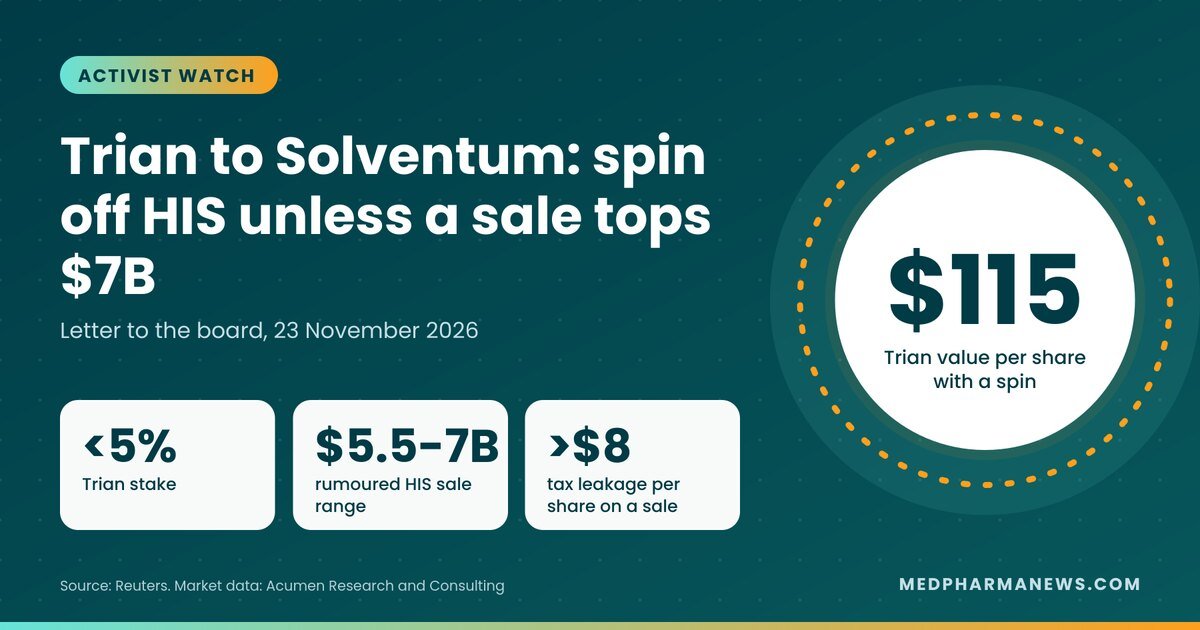
In a letter to the board dated Monday, 23 November 2026, Trian Solventum pressure stepped up: Nelson Peltz’s Trian Fund Management, which owns just under 5% of the medtech company, urged Solventum to spin off its Health Information Systems (HIS) unit tax-free unless a buyer pays materially more than the top of the rumoured US$5.5 billion to US$7 billion range, according to a Reuters exclusive. Trian argues a sale could cost shareholders more than US$8 a share in tax leakage.
Key takeaways on Trian Solventum
- Trian wants a tax-free spin-off of HIS as the default, with a sale only if the price clears US$7 billion by a clear margin.
- The activist says the separation path supports a Solventum value of about US$115 per share, against a share price of US$84.51 cited by Reuters.
- Tax leakage from a taxable sale could exceed US$8 per share, close to 10% of Solventum’s roughly US$14 billion market value.
- Solventum already said in August 2026 that it plans to separate HIS to concentrate on medical technology; the debate is about how, not whether.
- Trian says the HIS platform is used in about 75% of US hospitals, which makes it a prized asset for health IT buyers.
Inside the letter: sale versus spin
Solventum, the healthcare business 3M spun off in April 2024, has been running a review of HIS, the coding, clinical documentation and revenue-integrity software business that hospitals use to turn patient records into billable claims. Reuters reported that analysts have floated a sale value of US$5.5 billion to US$7 billion. Trian’s position is that anything near that range would leave money on the table once taxes are counted, because Solventum’s low tax basis in HIS would trigger a sizeable bill on a cash sale, whereas a qualifying spin-off to existing shareholders would not.
The fund therefore set a simple test: sell only if the offer is “materially above the high end” of the rumoured range; otherwise distribute HIS as a separate listed company. Trian first pushed publicly for a new home for HIS in April 2026. Solventum did not immediately comment to Reuters; secondary reports say the company indicated its separation work is continuing and it will update investors when the review concludes. No bidders were named.
The numbers behind Trian’s case
| Metric | Figure | Source |
|---|---|---|
| Trian stake | Just under 5% | Reuters |
| Rumoured HIS sale range | US$5.5B to US$7.0B | Analysts via Reuters |
| Trian value estimate with spin | About US$115 per share | Trian letter |
| Share price cited | US$84.51 | Reuters |
| Implied gap to Trian estimate | About 36% | By our calculation |
| Tax leakage on a sale | Potentially more than US$8 per share | Trian letter |
| Leakage as share of price | About 9.5% | By our calculation |
| Solventum market value | About US$14B | Reuters |
By our calculation, if leakage is US$8 per share and Solventum has roughly 165 million to 175 million shares outstanding (implied by a US$14 billion value at US$84.51), the tax cost of a sale would be in the region of US$1.3 billion to US$1.4 billion. That is the gap a buyer would need to bridge for a sale to beat a spin on Trian’s logic, and it explains why the fund is setting the bar above US$7 billion.
Why HIS attracts buyers and activists
Hospital coding and documentation software sits at the point where clinical data becomes revenue. Accurate coding affects reimbursement, audit exposure and quality reporting, and the shift toward AI-assisted documentation has made the category more valuable to private equity and to large health IT vendors. A platform embedded in three-quarters of US hospitals also brings recurring subscription revenue that tends to command higher valuation multiples than medtech hardware. For Solventum, whose third-quarter 2026 revenue fell about 7% to US$1.95 billion according to secondary reports, separating HIS would let management focus capital on wound care, dental, filtration and medical-surgical products.
Portfolio splits have become a recurring theme across healthcare. Our analysis of what Abbott’s nutrition split signals covers the same tension between tax-efficient spins and cash sales, and the end of Smith+Nephew’s talks with J&J shows how hard it can be to agree a price on a medtech carve-out.
Market context from Acumen Research and Consulting
The broader healthcare IT market that HIS competes in is large and growing quickly. According to the Healthcare IT Market report by Acumen Research and Consulting, the global market was worth US$142.3 billion in 2022 and is projected to reach US$707.7 billion by 2032, a compound annual growth rate of 17.5% from 2023 to 2032. Acumen says healthcare providers, led by hospitals, are expected to hold a significant share, and North America dominates the market. That growth profile helps explain why Trian believes a standalone HIS would be valued richly by public investors.
Risks and open questions
- Timing: a tax-free spin usually takes longer than a sale and needs IRS-related structuring, which delays cash returns.
- Standalone costs: a separately listed HIS would carry its own public-company overhead and could face competition from larger health IT platforms.
- Bidder appetite: no buyer has been named, so the rumoured range is untested.
- Board response: Solventum has not published a reply to the letter.
FAQ
What does Trian want Solventum to do?
Spin off its Health Information Systems unit in a tax-free transaction, unless a sale offer comes in materially above US$7 billion.
How much of Solventum does Trian own?
Just under 5%, according to Reuters.
What is Solventum’s Health Information Systems business?
It sells hospital software for medical coding, clinical documentation and revenue integrity. Trian says it is used in about 75% of US hospitals.
Is Solventum selling HIS?
Solventum said in August 2026 it plans to separate HIS but has not announced whether that will be a sale or a spin-off.
More analysis in Industry Insights.
Sources: Reuters exclusive on Trian’s letter to Solventum (23 Nov 2026); secondary market reports on Solventum Q3 2026 results. Market data: Acumen Research and Consulting, Healthcare IT Market report. Not investment advice. Last updated 24 November 2026.