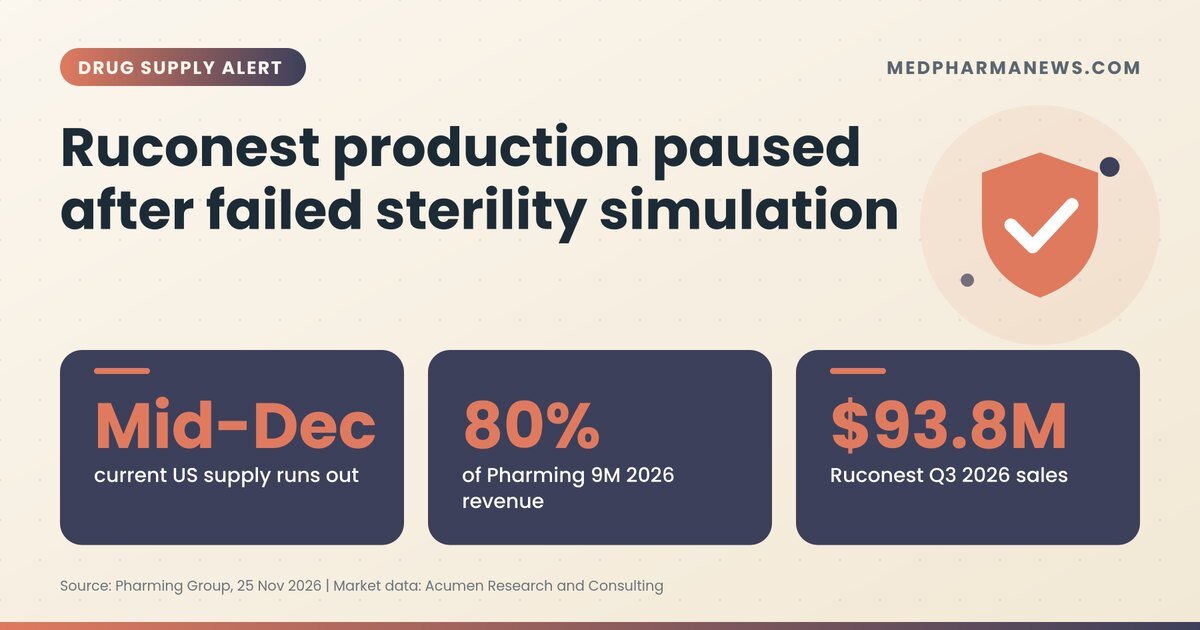
A Ruconest supply interruption is now likely in the United States after Pharming Group said on 25 November 2026 that it has paused manufacturing of the hereditary angioedema (HAE) drug following a failed media fill, the routine simulation used to prove a sterile production line is working. Current US supply is expected to last only through mid-December, and Pharming has given no restart date.
The pause hits the Dutch company’s core franchise. Ruconest, a recombinant C1 esterase inhibitor used to treat acute HAE attacks, generated about four in every five dollars of Pharming’s revenue in the first nine months of 2026, and the company had told investors only a month ago that sales were returning to growth.
Ruconest supply: the short version
- Manufacturing stopped after a media fill failure at Pharming’s third-party fill-finish contractor, which the company has not named.
- Pharming has notified the FDA of a likely US supply interruption; existing stock should cover demand until about mid-December.
- Production will resume only after the root cause is found and fixed and the process is requalified.
- Vials already at specialty pharmacies or with patients are not affected and can be used as directed.
- No other Pharming medicine, including Joenja (leniolisib), is affected, the company says.
What a failed media fill actually means
In a media fill, a manufacturer runs its aseptic filling line exactly as it would for a real batch but fills containers with a sterile growth broth instead of drug. The containers are then incubated. If microbes grow, the line has failed to show it can keep product sterile, and regulators expect production to stop while the cause is investigated.
A failed simulation is not the same as finding contaminated medicine, and Pharming has not reported any problem with distributed product. But it does mean the company cannot release new batches until the line is requalified, which typically requires repeat successful simulations. That is why Pharming describes both the timeline and the financial impact as still to be confirmed, and why availability after mid-December will depend on the investigation, the release of finished inventory, and the restart.
How much of Pharming rides on one product
| Period | Ruconest revenue | Total revenue | Ruconest share (by our calculation) |
|---|---|---|---|
| FY 2025 | US$317.9M (+26%) | US$376.1M | 84.5% |
| 9M 2026 | US$224.5M (-3%) | US$280.2M | 80.1% |
| Q3 2026 | US$93.8M (+14%) | US$117.6M | 79.8% |
Almost all of those sales are now American. Pharming completed a planned withdrawal of Ruconest from non-US markets during 2026; European and rest-of-world Ruconest revenue was just US$0.3 million in the first nine months of the year. A US shortage therefore cuts straight into the company’s main revenue line.
The timing is awkward. On 27 October Pharming narrowed its 2026 total revenue guidance to US$380 million to US$390 million and pointed to Ruconest stabilising and returning to growth in the second half. The November statement did not update that guidance, but every week without new batches after mid-December falls into the seasonally important end of the year and the start of 2027.
What patients and prescribers should do
Pharming’s advice is straightforward in substance: product already dispensed can be used as directed, and patients should review their HAE action plan with their doctor. Interim co-CEO and chief commercial officer Leverne Marsh said patients “count on RUCONEST for acute treatment for HAE, and we take that responsibility seriously.”
HAE attacks can cause dangerous swelling of the throat, so on-demand medicine has to be on hand. Other on-demand HAE treatments exist, including plasma-derived C1 inhibitor and drugs that act on the bradykinin pathway, but they differ in how they are given and in suitability for each patient. Any switch, or any change to prophylaxis to reduce attack frequency during a shortage, is a decision for the treating specialist, not something patients should improvise.
Market context: a growing, competitive HAE field
The pause comes in a market where competitors are ready to absorb displaced patients. According to Acumen Research and Consulting, the global hereditary angioedema treatment market was valued at USD 2.9 billion in 2022 and is projected to reach USD 6.7 billion by 2032, growing at a CAGR of 8.9%. Acumen reports that C1 esterase inhibitors held the largest drug-class share, on-demand treatment was the largest treatment type, and North America dominated revenue. Those are exactly the segments where Ruconest competes, which is why a prolonged gap could cost Pharming share that is hard to win back.
Open questions
- Root cause: was the failure tied to equipment, environment or operator technique? The answer drives how long requalification takes.
- Inventory: how much finished product is awaiting release, and can any of it ship once the investigation clears it?
- Guidance: Pharming has not quantified the revenue hit; investors will look for an update when the investigation closes.
- Leadership: the company is run by interim co-CEOs Leverne Marsh and Kenneth Lynard since Fabrice Chouraqui stepped down in September, adding to execution risk.
- Diversification: Joenja sales rose 58% to US$23.8 million in Q3 2026, but the drug is not yet large enough to offset a Ruconest gap.
Sterile manufacturing failures have been a recurring theme this month; see our report on the Par Health recall of six injectables over particulate matter and on Savara’s delayed FDA decision. Browse more in our Pharmaceuticals section.
FAQ
Is there a Ruconest shortage?
Not yet, but one is likely. Pharming says current US supply should last through mid-December 2026 and has told the FDA it expects a supply interruption after that.
Is my Ruconest safe to use?
Pharming says product already at specialty pharmacies or with patients is not affected and can be used as directed. The pause relates to a failed process simulation, not a recall.
Why did Pharming stop making Ruconest?
A media fill, a routine test of the sterile filling process at its contract fill-finish site, failed. Production will stay paused until the cause is fixed and the process is requalified.
When will Ruconest production restart?
Pharming has not given a date and says it will update the market once its investigation concludes.
Sources: Pharming Group press release and SEC Form 6-K (25 Nov 2026); Pharming Q3 2026 and FY2025 results. Market data: Acumen Research and Consulting, Hereditary Angioedema Treatment Market report. Not medical or investment advice. Last updated 25 November 2026.