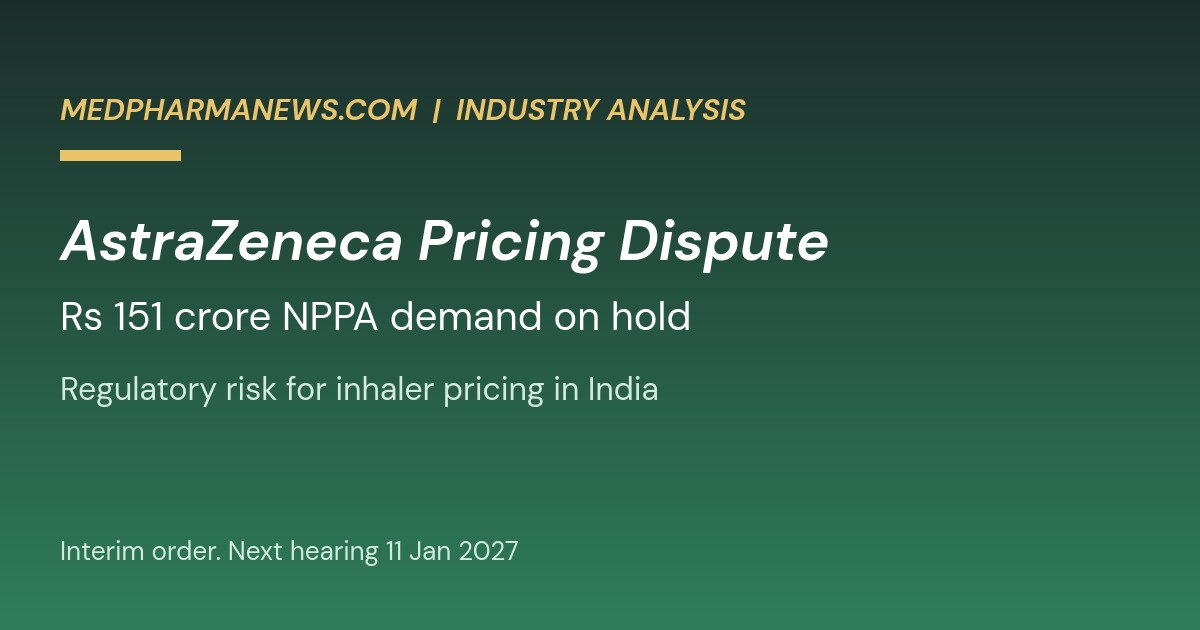
The AstraZeneca ₹151 crore case is a reminder that, for drugmakers in India, a pricing liability can be created years after a product is sold. The Delhi High Court has temporarily barred the National Pharmaceutical Pricing Authority (NPPA) from coercive steps to recover about ₹151.20 crore from AstraZeneca Pharma India over its Symbicort Turbuhaler 160/4.5 inhaler, and the protection runs to 11 January 2027.
Key takeaways from the AstraZeneca ₹151 crore case
- NPPA’s demand is ₹1,51,19,66,035, covering the alleged overcharge for May 2016 to November 2025 plus interest to 30 October 2026, according to the company.
- The court found a prima facie case that the inhaler may not be in the price-controlled category under DPCO 2013.
- The order is interim. AstraZeneca denies selling above the notified price.
- The company disclosed the order under stock-exchange rules on 2 November 2026.
- The financial impact on the company has not been quantified in the disclosure we reviewed.
What the AstraZeneca ₹151 crore case means for the business
For a listed subsidiary, a demand of this size is a contingent liability: a possible cost that depends on how a dispute ends. Companies typically disclose such orders because they can be material to investors. The disclosure does not say whether AstraZeneca has provisioned for the amount, so we cannot say how it appears in its accounts, and we do not estimate it.
The interim order reduces near-term cash risk because NPPA cannot enforce recovery before the next hearing. It does not remove the risk. If the court ultimately finds the inhaler to be price-controlled, the demand, with interest, would again become live.
Timeline of the AstraZeneca ₹151 crore case
- 11 September 2025: NPPA show-cause notice.
- 29 July 2026: demand notice, followed by a reminder.
- 29 October 2026: Delhi High Court interim order.
- 2 November 2026: AstraZeneca Pharma India discloses the order.
- 11 January 2027: next hearing.
Why classification is the commercial pressure point
India’s DPCO 2013 sets ceiling prices for scheduled formulations and monitors increases on others. A manufacturer that treats a product as unscheduled prices it freely within the annual increase limit; if the regulator later disagrees, the exposure can reach back across a decade of sales, with interest. That is the shape of the claim here, which spans nearly ten years.
The practical lesson for industry is that classification decisions on combination products and new device presentations carry long-tail risk. Companies often seek written clarification or contest demands; this case shows the contest route and the interim relief courts can give. See the authority’s notices on the NPPA website.
How the AstraZeneca ₹151 crore case could play out: three scenarios
These scenarios are our own illustration of possible paths, not predictions, and none is based on information beyond the public record.
- Classification upheld for the company: if the court ultimately finds the inhaler outside the price-controlled category, the overcharge demand would lose its foundation, although the company would still be subject to the general cap on annual increases for non-scheduled medicines.
- Classification upheld for NPPA: if the product is held to be a scheduled formulation, the dispute moves to the amount, including how the overcharge and interest were computed, which the company has already challenged.
- Extended interim protection: the court may continue the no-coercive-steps order past 11 January 2027 while pleadings are completed, leaving the liability unresolved for longer.
What this means for pricing and compliance teams
For industry readers, the case points to a few practical questions that apply well beyond one company. How is each product mapped to the schedule, and is that mapping documented? Are price changes tested against the annual increase limit and, where relevant, the ceiling? And when a regulator issues a notice, how quickly is a legal position taken? We raise these as questions that companies commonly consider, not as a description of what AstraZeneca did.
The size of the claim relative to a single brand also illustrates why a ten-year window matters. Because the alleged period runs from May 2016 to November 2025, each additional year of sales under a disputed classification widens the potential exposure. That arithmetic is general and ours; the company has not published a year-by-year breakdown.
Market context: a steady, inhaler-led asthma market
Per Acumen Research And Consulting, the global asthma therapeutics market was USD 21.6 billion in 2022 and is projected to reach USD 30.6 billion by 2032, a 3.6% compound annual growth rate for 2023 to 2032. North America was the largest region at about USD 10.8 billion in 2022; Asia-Pacific is expected to grow fastest at above 4%. Long-term control medications held about 76% of the market and inhalation was the largest route.
That is a mature, slow-growth category, where price regulation matters more to returns than rapid volume growth. Note the report page shows a last-updated date of 25 July 2023, and our own check puts USD 21.6 billion at 3.6% over ten years at about USD 30.4 billion rather than the stated USD 30.6 billion, likely rounding. These figures are global and do not measure this product.
Our analysis
In our assessment, this is a risk-management story rather than a verdict. The court has bought the company time and signalled that the classification point is arguable, but the amount at stake is large relative to a single brand’s regulated margin and the eventual outcome is uncertain. Peer companies with combination or device-based products should expect closer attention to how they are categorised. We offer this as analysis, not as a forecast of the ruling or of any share-price effect.
What is not disclosed
- Whether AstraZeneca has made any accounting provision.
- The principal-versus-interest split.
- NPPA’s overcharge computation.
- Symbicort’s India sales.
Risks and caveats
- The interim order can change once NPPA responds.
- Our comments on accounting treatment are general and not investment advice.
- Details come from a company disclosure and press reports, not the full order.
What to watch next
- NPPA’s response to the petition.
- The 11 January 2027 hearing.
- Any note on the matter in AstraZeneca Pharma India’s next quarterly results.
- Whether NPPA raises similar demands against other companies.
General background
AstraZeneca has been in other recent business news, including its AI drug-discovery pact with insitro. More industry coverage is in our pharmaceuticals section. Court listings are on the Delhi High Court website.
Questions readers are asking about the AstraZeneca ₹151 crore case
Does AstraZeneca have to pay now?
No. The court restrained coercive recovery until at least 11 January 2027.
Is the ₹151 crore a fine?
It is a recovery demand for alleged overcharging plus interest; the disclosure does not mention a separate penalty.
Which product is involved?
Symbicort Turbuhaler 160/4.5, a budesonide and formoterol inhaler for asthma.
FAQ
What does the order mean for investors?
It lowers near-term enforcement risk but leaves the outcome open. This is not investment advice.
When did the alleged overcharging occur?
May 2016 to November 2025, per NPPA’s claim as described by the company.
Does the company deny the claim?
Yes.
How we reported this: details come from AstraZeneca Pharma India’s stock-exchange disclosure, press reports and regulator and court sources; market figures are attributed to Acumen Research And Consulting. Last updated 3 November 2026. This is news reporting and not investment, legal or medical advice.