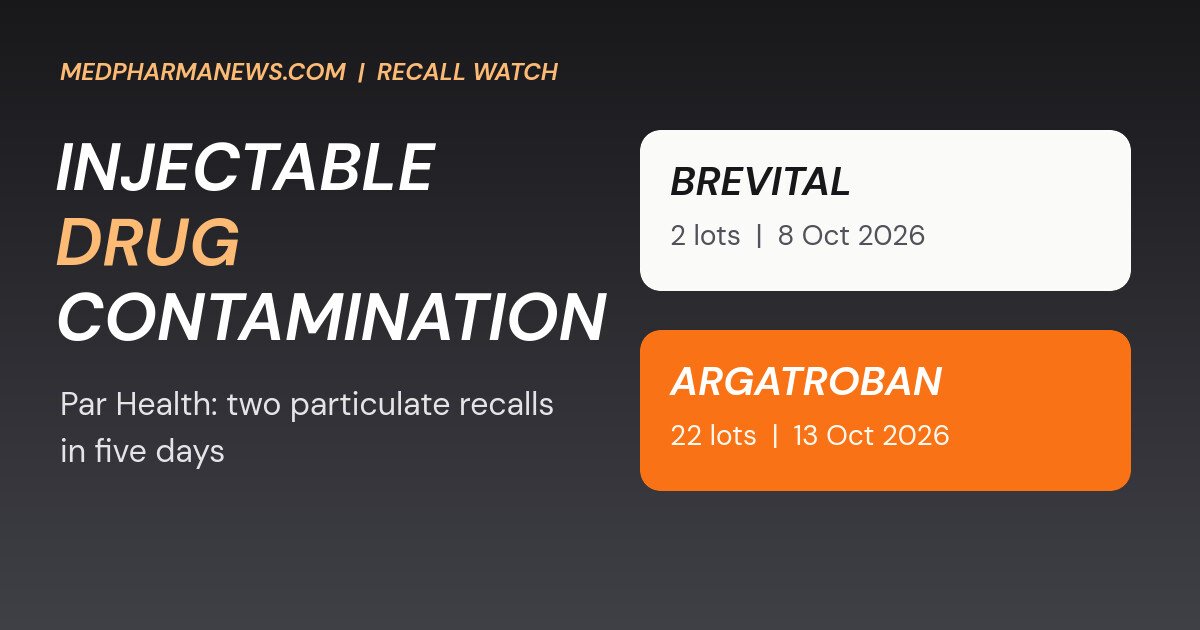
Par Health has now issued two particulate recalls of hospital injectables within a week, a sequence that puts injectable drug contamination in the spotlight for the company. On 8 October 2026 it announced a recall of two lots of Brevital Sodium, an anaesthetic, and on 13 October it announced a recall of 22 lots of argatroban injection, an anticoagulant. The FDA posted the notices on 9 and 14 October. Both are at the hospital level, and in both the company says it has no reports of adverse events.
The FDA notices do not link the two recalls or identify a common cause. This report sets them side by side, explains the shared risk language and lists the questions that remain open.
Injectable drug contamination: key takeaways
- Two recalls, five days apart: by our count, the company announcements are 8 and 13 October 2026.
- 24 lots in total: two Brevital lots and 22 argatroban lots, by our addition.
- Same level: both are hospital or user-level recalls.
- No reported harm: the company states it has received no related adverse-event reports for either.
- No stated link: the notices do not say the two are connected.
Injectable drug contamination: the two Par Health recalls side by side
Argatroban injection, 13 October
- Product: Argatroban Injection 250 mg/2.5 mL, 22 lots, distributed from 30 December 2024 to 5 May 2026.
- Particulates: cellulose, polystyrene, polyethylene terephthalate, stopper material and possibly stainless steel.
- Drug use: an anticoagulant for patients with heparin-induced thrombocytopenia and for certain heart procedures. See the FDA’s argatroban recall notice.
Brevital Sodium, 8 October
- Product: Brevital Sodium 500 mg/vial (methohexital sodium for injection), two lots, 86930 and 88623.
- Particulate: cellulose, distributed to wholesalers from 8 July 2025 to 11 May 2026.
- Details are in the FDA’s Brevital recall notice.
The two products serve different purposes and went out over overlapping periods. Both distribution windows ended in May 2026, which is our observation from the notice dates rather than a statement by the company. By our count, the argatroban recall involves eleven times as many lots as the Brevital recall, so it is by far the larger of the two.
What injectable drug contamination can do
Both notices use the same risk language. The company says administration of the affected product has a reasonable probability of causing life-threatening adverse health consequences, and lists pulmonary emboli, blockage of other blood vessels that can lead to tissue death, and inflammation of vein walls that may lead to clotting. These are potential outcomes described by the company, not reported events.
Particles are a particular concern in injectable products because they bypass the body’s digestive barriers and enter the bloodstream directly. That is why hospitals are told to quarantine suspect lots, whether or not harm has been reported.
What a hospital-level recall means for injectable drug contamination
A recall at the hospital or user level is aimed at the places that hold and administer the product: wholesalers, hospital pharmacies and other healthcare providers. It does not ask members of the public to return anything. In the argatroban notice, wholesalers and hospital pharmacies are asked to discontinue use and distribution immediately, to expect written notification, and to send stock back through the returns contractor Inmar, Inc.
For a pharmacy team the work is practical: find every vial that matches a listed National Drug Code and lot number, remove it from automated cabinets and satellite stock, record the quantity and arrange return. For a drug used in urgent situations, such as argatroban, the speed of that exercise matters, and so does the question of what replaces the quarantined stock. Neither notice discusses supply.
Who is behind the injectable drug contamination recalls
The argatroban notice says the product was distributed by Par Pharmaceutical or Endo USA, and that the current distributor is Par Health USA, LLC. It describes Par Pharmaceutical, Inc. and Endo USA, Inc. as predecessor companies. The recalled vials carry the Par Health and Endo USA brand names.
What the notices do not tell us about injectable drug contamination
- Whether the two recalls share a manufacturing site, supplier or packaging component.
- How and when the particles were detected.
- Which particle appeared in which argatroban lot.
- Whether more Par Health injectables could be affected.
- Whether hospitals face supply gaps for argatroban or Brevital.
Risks and caveats for injectable drug contamination coverage
- Two recalls in a week do not prove a common cause, and the FDA notices do not state one.
- Both documents are company announcements posted by the FDA and may be updated.
- Particle types named in the argatroban notice differ from the single type named for Brevital, so the cases may not be the same.
- No adverse events have been reported, but that can change as hospitals check stock.
In our assessment, the most useful signal will be any update from Par Health explaining the cause. If the particles come from a shared component or process, more lots could follow. If they are separate issues, each recall will need its own explanation. Until then, hospital pharmacies should check both products.
For other coverage of product recalls, see our earlier report on the Perrigo infant formula recall, or browse more pharmaceutical news. Anyone who suspects a problem with a product can report it through FDA MedWatch.
What to watch next on injectable drug contamination
- A root-cause statement from Par Health.
- Any additional lots or products added to either recall.
- FDA classification of the recalls.
- Adverse-event reports submitted through MedWatch.
Frequently asked questions
What is injectable drug contamination?
Contamination of a medicine given by injection or infusion, such as particles in the vial, which can be dangerous because the product goes straight into the bloodstream.
Which Par Health injectables have been recalled?
Two lots of Brevital Sodium 500 mg/vial, announced on 8 October, and 22 lots of Argatroban Injection 250 mg/2.5 mL, announced on 13 October 2026.
Are the two recalls related?
The FDA notices do not say so.
Has anyone been harmed?
Par Health says it has received no reports of adverse events related to either recall.
What should hospitals do?
Stop using and distributing the listed lots and follow the return instructions in each notice.
Do patients need to return anything?
No. These are hospital-level recalls, and patients do not hold this product.
How we reported this: we relied on the FDA recall notices of 9 and 14 October 2026 for Par Health’s Brevital and argatroban products. Figures labelled as ours are our own calculations. Last updated: 15 October 2026. This article is news reporting and not medical advice.