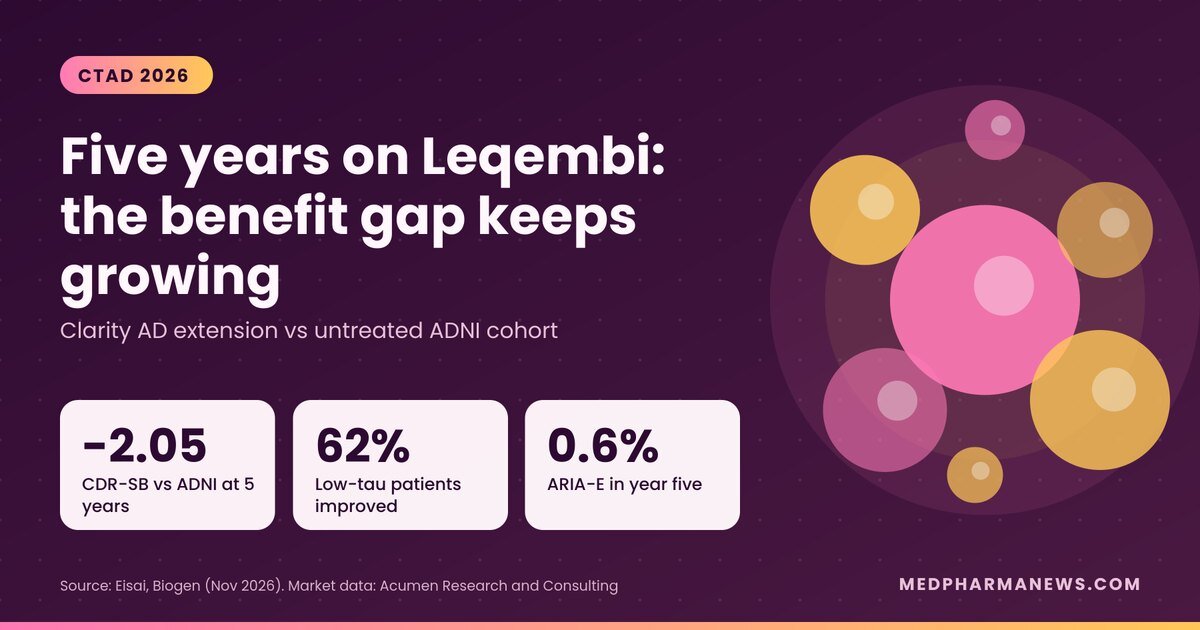
Leqembi five-year data presented by Eisai and Biogen at the CTAD 2026 conference in Boston on 16 November show that patients kept on lecanemab continuously for five years were 2.05 points better on the CDR-SB dementia scale than a matched untreated cohort, a gap that has widened every year since the drug’s pivotal trial ended. The update, drawn from 351 people treated without interruption in the Clarity AD extension, arrives as both companies push subcutaneous dosing to keep patients on therapy longer.
Key takeaways on Leqembi five-year data
- Versus the ADNI natural-history cohort, continuous lecanemab slowed CDR-SB decline by 1.00 point at three years, 1.78 at four and 2.05 at five.
- Against a second cohort, BioFINDER, the gap reached 2.54 points at five years.
- Among early-stage patients with low tau on PET, 62% had improved on CDR-SB after five years.
- Brain swelling (ARIA-E) clustered early: 13.5% in year one, then 0.6% to 3.6% a year afterwards.
- The comparisons are against external cohorts, not placebo, so they are supportive rather than definitive.
The widening gap, year by year
Clarity AD randomized 1,795 people with early Alzheimer’s disease to lecanemab or placebo for 18 months. About 95% of those who completed the core study moved into the open-label extension, where everyone received the drug. The Eisai and Biogen release compares the 351 patients treated continuously for five years with how similar untreated people declined in two observational studies.
| Time on lecanemab | CDR-SB benefit vs ADNI | CDR-SB benefit vs BioFINDER |
|---|---|---|
| 3 years | -1.00 | -1.42 |
| 4 years | -1.78 | -2.24 |
| 5 years | -2.05 | -2.54 |
Negative numbers mean less decline than the comparison group. For scale, the original 18-month trial showed a 0.45-point difference versus placebo. By our calculation, the five-year gap versus ADNI is roughly four and a half times that figure, which is the central argument Eisai and Biogen are making: the benefit compounds the longer patients stay on treatment.
Fewer patients moved to the next disease stage
The companies also tracked how many patients progressed to a more severe stage. By five years, 61.9% of the lecanemab group had moved from mild cognitive impairment or mild dementia to the next stage, versus 77.5% in ADNI, a 36% relative risk reduction. Progression from early Alzheimer’s to moderate or severe disease occurred in 31% of treated patients against 48.7% in ADNI, a 49% reduction. Those are the kinds of figures payers and health systems weigh when they price years of infusions against delayed nursing-home care.
The earliest patients did best
The most striking numbers come from a tau PET substudy of patients with low tau, a marker of earlier disease. After five years, 66% showed no decline on CDR-SB and 62% had improved. On a daily-living scale (ADCS MCI-ADL), 69% showed no decline and 62% improved, and on the ADAS-Cog14 cognitive test, 55% showed no decline. The subgroup is small and selected, but the pattern supports the field’s push to diagnose and treat earlier, ideally with blood tests rather than PET scans.
Safety: ARIA risk concentrates in year one
| Period on treatment | ARIA-E incidence |
|---|---|
| Months 0 to 12 | 13.5% |
| Months 12 to 24 | 3.6% |
| Months 24 to 36 | 1.1% |
| Months 36 to 48 | 1.3% |
| Months 48 to 60 | 0.6% |
| Placebo, 18 months (core study) | 1.7% |
ARIA-E, swelling seen on MRI, appeared most often in the first six months, and the companies reported no new safety signals across five years. That matters commercially because intensive early MRI monitoring is one of the main brakes on uptake. If risk falls this sharply after year one, maintenance treatment looks less burdensome than starting treatment.
What it means for Eisai and Biogen
The data underpin a commercial strategy built on keeping patients on drug. Lecanemab is approved in 53 countries and regions. Less frequent IV maintenance every four weeks is approved in nine countries with filings in 11 more, and the at-home subcutaneous pen, Leqembi Iqlik, is now cleared in the US for both maintenance (360 mg, August 2025) and initiation (500 mg, July 2026), with China and Japan approving initiation in September 2026. That positioning contrasts with Lilly’s Kisunla, whose label lets doctors stop dosing once amyloid is cleared. Five-year evidence of a growing benefit is Eisai’s answer to the question of why patients should continue.
For Biogen, which shares Leqembi economics with Eisai, the readout supports a franchise that featured in its third-quarter 2026 results. It is also a long way from the drug’s rocky European path, recounted in our earlier report on the initial EMA rejection.
The caveats investors and clinicians should keep in mind
- The extension is open-label with no concurrent placebo arm; ADNI and BioFINDER are external cohorts that may differ in ways matching cannot fully fix.
- The 351 five-year completers are survivors of a longer study; patients who stopped because of side effects or decline drop out of the analysis.
- Data were presented at a conference and have not yet been published in a peer-reviewed journal.
Market context
Acumen Research and Consulting projected the global Alzheimer’s disease treatment market to grow at about 12.8% a year from 2020 to 2027, reaching around US$5.65 billion by 2027. That forecast was built largely before anti-amyloid antibodies reached the market, when cholinergic drugs held the largest share, so it should be read as an indicative baseline. Acumen also cites CDC projections that the number of Americans with Alzheimer’s could reach nearly 14 million by 2060, the demand curve that long-term disease-modifying therapy is chasing.
FAQ
Does Leqembi keep working after five years?
The extension data suggest the gap versus untreated decline keeps widening through five years, reaching 2.05 CDR-SB points against ADNI. Because the comparison is with external cohorts, it is supportive evidence rather than proof from a randomized trial.
Can Alzheimer’s patients improve on Leqembi?
In a low-tau, earlier-stage subgroup, 62% scored better on CDR-SB after five years than at baseline. Most patients overall still declined, but more slowly.
Is long-term Leqembi treatment safe?
No new safety findings emerged over five years. ARIA-E brain swelling occurred in 13.5% of patients in the first year and fell to 0.6% by year five.
Is there an at-home version of Leqembi?
Yes. Leqembi Iqlik is a subcutaneous autoinjector approved in the US for maintenance and, since July 2026, for starting treatment.
More from our Pharmaceuticals desk.
Sources: Eisai and Biogen joint release, CTAD 2026 (16 November 2026). Market data: Acumen Research and Consulting, Alzheimer’s Disease Treatment Market report. Not medical or investment advice. Last updated 17 November 2026.