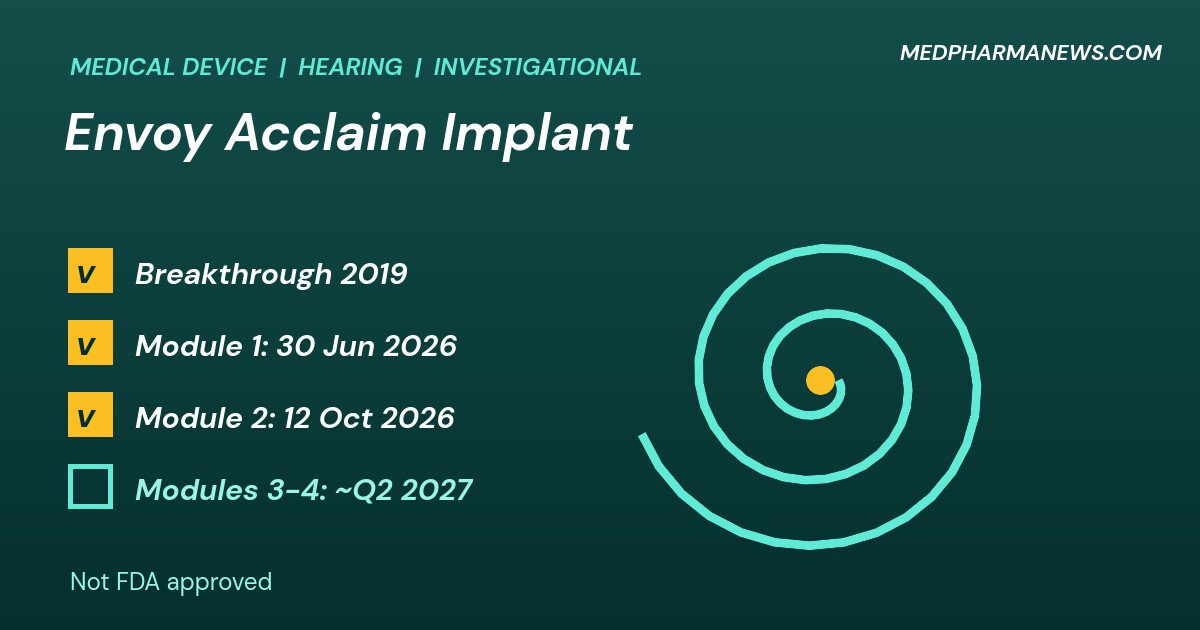
Think of the Envoy Medical Acclaim cochlear implant as a project on a board with four boxes to tick. On 12 October 2026, Envoy Medical ticked the second: a module of engineering information sent to the US Food and Drug Administration as part of a staged premarket approval application. Two boxes remain, the last holding the clinical data, and the company is aiming for the second quarter of 2027. This article sets out where the project stands, what has been left blank, and why a fully implanted hearing device is harder to finish than the label suggests.
One fact frames everything else: Acclaim is investigational. It cannot be sold in the US, and no regulator has approved it.
Status board: the Envoy Medical Acclaim cochlear implant at a glance
Done
- Breakthrough Device Designation from the FDA, granted in 2019.
- Module 1 of the application, submitted on 30 June 2026.
- Module 2, mainly engineering information, announced on 12 October 2026.
In progress
- A US-based pivotal clinical trial, whose results will form the final module.
- Preparation of the two remaining modules.
Still ahead
- The final clinical module, which completes the application, targeted around the second quarter of 2027.
- The FDA’s full review and decision. No date has been given.
- Any commercial launch, which is impossible without approval.
Not disclosed in the announcement we reviewed
- The number of trial participants, endpoints and any interim results.
- Where the sensor sits in the ear, how the device is powered and how it is recharged.
- What Module 3 contains and when it will be filed.
Why the staged format helps the Envoy Medical Acclaim cochlear implant, and what it cannot do
Under a modular application, the company hands the FDA finished sections as they are ready. Envoy says this lets the agency review those sections while the clinical trial still collects data, and gives the company a chance to hear questions early. That is a practical advantage for a device with long-lasting hardware inside the body, because engineering questions can be settled while patients are still being followed.
The limits matter as much. The staged format does not change the legal test, which is that the FDA must find reasonable assurance of safety and effectiveness. It also does not tell the public anything about how the agency has responded. Companies are not obliged to publish FDA correspondence, so outside observers see only what Envoy chooses to disclose. The FDA’s Breakthrough label, explained on FDA’s Breakthrough Devices Program, brings closer contact with reviewers; it is not a promise of approval.
The hardware challenge behind the Envoy Medical Acclaim cochlear implant
Standard cochlear implants split the work between an external processor worn on the head and an internal part under the skin. Acclaim is designed to place everything inside the body. According to Envoy, it uses a sensor designed to work with the ear’s natural anatomy instead of a microphone to capture sound, and it is intended for adults with severe to profound sensorineural hearing loss who are not adequately helped by hearing aids.
The trade-off is easy to state and hard to solve. In general, without an external processor, a device has no easy way to be opened, charged or swapped after surgery unless it is designed for it. Every question about battery life, sealing, and replacement strategy becomes a safety and reliability question that the FDA will ask. We have not seen how Envoy answers these, because its public announcement keeps to the headline facts. That is why the engineering module, dull as it sounds, carries so much weight. Reviewers typically want evidence that the housing stays sealed for years, that materials are tolerated by tissue, that the electronics keep working under everyday movement, and that any fault can be detected and managed safely. Clearing that review early would leave the clinical data module as the main remaining hurdle, but the company has not said whether the FDA has raised any questions yet.
Who could benefit if the Envoy Medical Acclaim cochlear implant is approved
The intended group is adults whose hearing loss is severe to profound and who do not get enough help from hearing aids. Global figures on hearing loss are summarised by the World Health Organization’s hearing loss page. A device without external parts could appeal to patients who dislike wearing equipment, or who are active in water or sport, though these are our own examples of possible benefits and not claims from the company. Whether Acclaim actually delivers better listening, comfort or reliability will only be known when trial data appear. For market background, see our report on the cochlear implant market outlook.
Envoy Medical Acclaim cochlear implant: the company and its risks
Envoy Medical trades on Nasdaq as COCH and already sells the Esteem implant, a fully implanted active middle ear device approved by the FDA for adults with moderate to severe sensorineural hearing loss and available in the US since 2010. Esteem is a different product for a different degree of hearing loss, so its record is not evidence for Acclaim.
The company’s own caution is clear: timing may slip, FDA decisions are unpredictable, and more capital may be needed to complete the pivotal trial and bring a product to market. Investors can read the full risk factors in the annual report available through the SEC’s EDGAR database and on Envoy’s investor site.
Our reading of the Envoy Medical Acclaim cochlear implant milestone
In our assessment, this is an on-schedule procedural step that deserves a modest headline. It removes some uncertainty about the company’s ability to meet its self-set timetable, but it provides no new information on whether Acclaim helps patients hear. Readers wanting another example of FDA oversight can look at our report on the FDA early alert on Philips Lumify ultrasound, and more is in our medical devices section.
Frequently asked questions
What is the Envoy Medical Acclaim cochlear implant?
An investigational, fully implanted cochlear implant for adults with severe to profound sensorineural hearing loss.
How many FDA modules has the Envoy Medical Acclaim cochlear implant filing reached?
Two of four planned. The first went in on 30 June 2026 and the second was announced on 12 October 2026.
When could the Envoy Medical Acclaim cochlear implant be approved?
No date has been given. The final clinical module is targeted around the second quarter of 2027, and the FDA review would follow.
Does the Envoy Medical Acclaim cochlear implant filing include clinical results?
No. It mainly contains engineering information.
How we reported this: we relied on the company’s announcement of 12 October 2026 and public summaries of it. The application itself is not public and we did not see it. Examples of possible patient benefit are ours. Last updated: 13 October 2026. This article is news reporting and not medical advice.