Hospital leaders have a reason to read the new at-home heart failure treatment study closely, and an equal reason not to over-read it. Interim findings from the Gator SCALES-WHF study, presented at the Heart Failure Society of America meeting and announced by SQ Innovation on 12 October 2026, say 18 of 21 patients at imminent risk of admission had their fluid overload treated at home using Lasix ONYU.
This article is written for the people who would have to act on such a result: clinicians, administrators and payers. It sets out what the result supports and what it does not.
At-home heart failure treatment study: the result in one line, the caveat in another
The result: 86% (18 of 21) were decongested at home without hospitalisation, and three were admitted within 30 days. The caveat: there were only 21 of them, at one site, with no randomised comparison group. Nothing here shows that home treatment is better than hospital care. It shows that, for a selected group, a home pathway could be run.
Where the at-home heart failure treatment study sits on the evidence ladder
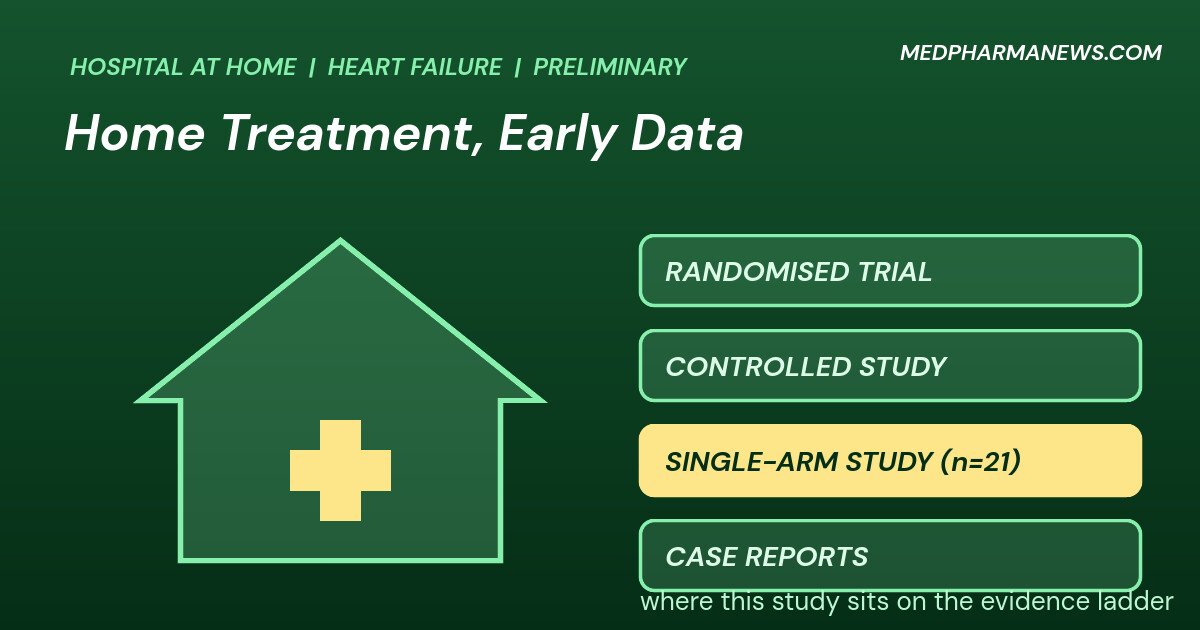
Think of clinical evidence as a ladder. The bottom rungs are case reports and uncontrolled series; higher up are controlled comparisons; at the top are randomised trials and their pooled analyses. Gator SCALES-WHF is a prospective, open-label, single-arm study, which places it on a low rung. That is not a criticism: the registry entry says its main purpose is to develop, implement and evaluate a site-specific clinical pathway for at-home treatment and to identify process improvements before routine use. In other words, it is a feasibility study. Full details are on the study’s registry page.
Who the patients were in the at-home heart failure treatment study
Participants were adults aged 18 to 80 with heart failure and fluid overload despite higher doses of oral diuretics, who were expected to need at least three days of parenteral therapy. The reported averages show a seriously ill group: mean age 63, two-thirds with reduced ejection fraction, and one report puts the median ejection fraction at 17.5%.
People over 80, those with electrolyte disturbances that diuretics might worsen, and those with unsuitable home environments were excluded. For hospital planners, that means eligibility rules, not just the drug, will decide how many real patients could use such a pathway.
What the treatment involves
Lasix ONYU, approved by the FDA in October 2025, pairs a prefilled 80 mg furosemide cartridge with a wearable infusor that delivers the dose under the skin over roughly five hours. Patients in the study treated themselves, alone or with a caregiver. It is a second-generation product after Furoscix (2023).
The approval is not new; what is new is early real-world data on using it to keep patients out of hospital. Listed side effects include dehydration, low blood pressure, high blood sugar, tinnitus, sun sensitivity and infusion-site reactions, so patients still need clinical oversight.
What hospital administrators can take from the at-home heart failure treatment study
- A structured home pathway for selected heart failure patients appears feasible in a busy heart failure clinic, according to the principal investigator.
- The company reports 95 doses given, with minimal user, device or safety issues and no discontinuations for those reasons. One report counts 95 of 104 applications as successful, a discrepancy the sources do not explain.
- A patient survey cited in one report found 92% rated the device easy to use and 83% preferred home treatment to hospitalisation. The number of respondents was not stated.
What they cannot take from the at-home heart failure treatment study
- That home treatment lowers admissions compared with usual care. There is no comparator.
- That it saves money. No cost data were reported.
- That it suits every patient. The sample excluded older and more complex cases.
- That the 86% rate will hold in a larger group. By our calculation, the approximate 95% confidence interval for 18 of 21 spans roughly 65% to 95%.
- That support was minimal. The company mentions “study-related constraints” without describing them, so staffing and follow-up needs are unknown.
Operational questions the at-home heart failure treatment study leaves open
Anyone planning a similar service would want to know how patients were selected in the clinic or emergency department, who monitored them at home, how quickly a worsening patient could be brought back in, and what blood tests were needed. The sources we reviewed do not answer these. They matter because hospital-at-home programmes succeed or fail on logistics.
Cost matters too: payment rules for home-based care differ between health systems, and the sources say nothing about reimbursement, so administrators would need their own analysis of drug, device, nursing and follow-up costs against the cost of a typical admission. For another look at how hospitals are using technology to spot patients who need closer attention, see our report on Healthleap’s funding for AI that flags hospital patients.
What comes next for the at-home heart failure treatment study
The investigators aim to reach 100 patients and to add a comparison group of contemporaneous patients treated with oral diuretic escalation and sequential nephron blockade. That would improve the picture but still lack randomisation, so the strongest evidence is some way off. Meanwhile, readers can find general information on the condition from the American Heart Association and on the clinic from University of Florida Health. Our market coverage includes the congestive heart failure drugs market outlook, and more device news is in our medical devices section.
Our verdict on the at-home heart failure treatment study
In our assessment, the data justify larger, controlled studies, not changes to practice. The most useful number is not 86% but the number of patients still to be studied. A hospital leader weighing a home programme should treat this as a reason to ask questions, run a pilot with careful safeguards, and wait for comparative evidence.
A sensible pilot would define clear eligibility criteria, a rapid route back to hospital, and tracking of readmissions, kidney function and potassium, which the investigators themselves follow.
Frequently asked questions
What is the at-home heart failure treatment study?
Gator SCALES-WHF, a University of Florida study of Lasix ONYU given at home to patients with worsening heart failure.
How many patients took part?
Twenty-one completed 30-day follow-up in the interim analysis. The protocol target is 100.
Did the at-home heart failure treatment study have a control group?
No. It is a single-arm study.
Is Lasix ONYU new?
The drug-device combination was approved in October 2025. The new information is the interim real-world data.
How we reported this: we relied on the company announcement of 12 October 2026, a report of the HFSA presentation and the study’s registry entry, and did not see the full data. Calculations labelled as ours are our own. Last updated: 13 October 2026. This article is news reporting and not medical advice.