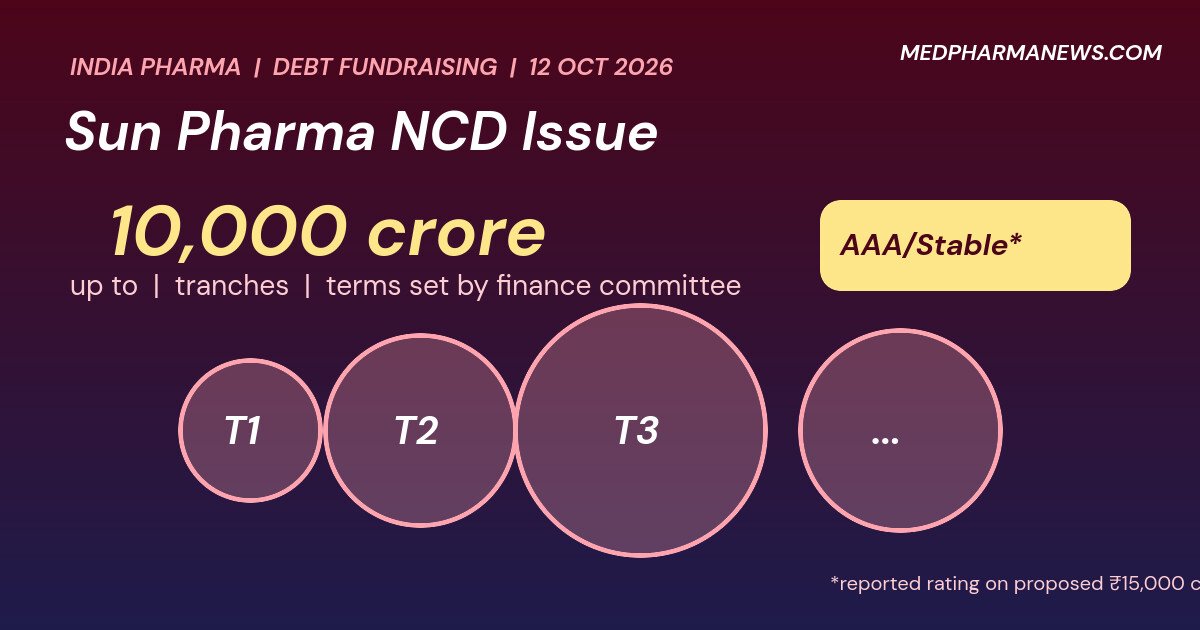
Bond-market news rarely tops pharma headlines, yet the Sun Pharma ₹10,000 crore NCD issue deserves a careful read. On 12 October 2026, the drugmaker told investors its board had cleared the sale of up to ₹10,000 crore of non-convertible debentures, a cut from the ₹15,000 crore it had said the board would consider. On the same day, independent director Gautam Doshi left the board. This guide explains the instrument, the numbers, the context and the gaps in the disclosure.
The Sun Pharma ₹10,000 crore NCD issue in five numbers
- ₹10,000 crore: the maximum the board approved.
- ₹15,000 crore: the figure the company flagged on 7 October as the amount the board would consider.
- ₹5,000 crore: the difference, or one-third of the earlier figure (our arithmetic).
- 12 October: the date of both the board decision and the director’s exit.
- $11.75 billion: the enterprise value of the Organon acquisition the company agreed in April, which some readers will link to the debt plan. The company has not.
NCDs decoded: what each word in the approval means
- Non-convertible: the bonds cannot be exchanged for shares, so there is no dilution for existing shareholders.
- Unsecured: no specific asset is pledged. Investors depend on the company’s credit strength.
- Redeemable: the principal is repaid at maturity. The maturity has not been disclosed.
- Listed and rated: the debentures will trade on an exchange and carry a credit rating from a rating agency.
- Private placement: they are offered to selected institutional buyers, not the public.
- Tranches: the money can be raised in several instalments, each priced separately.
Who sets the final terms of the Sun Pharma ₹10,000 crore NCD issue?
The board did not fix a coupon, tenure or timetable. It handed those decisions to its finance committee, which will determine the terms of each issuance. That is routine for large Indian issuers, because bond pricing moves with the market and a committee can act faster than a full board. It also means that the first real data points, such as the interest rate and who bought, will arrive only with the first tranche.
Why the Sun Pharma ₹10,000 crore NCD issue and not a bank loan?
Companies generally turn to debentures to diversify away from bank borrowing, to match repayment dates to expected cash flows, and to lock in pricing when markets are favourable. A ceiling rather than a fixed sum lets an issuer tap the market in stages. Sun Pharma has not said which of these motives applies, so read this as a description of how such issues usually work, not a statement about this one. Highly rated Indian borrowers tend to pay some of the lowest coupons in the domestic bond market, but the coupon here is unknown.
Reading the cut behind the Sun Pharma ₹10,000 crore NCD issue
The company has given no reason for the lower ceiling, so any explanation is speculation. In our reading, three possibilities are plausible: the issue may have been sized to near-term needs; the company may plan to use other sources, such as bank loans, for part of the amount; or the amount may have been revised after the board reviewed the plan. None is confirmed. What can be said is that a ceiling is a maximum, and the real borrowing could turn out lower.
Ratings for the Sun Pharma ₹10,000 crore NCD issue: reported and unverified
One report says CRISIL and ICRA assigned AAA ratings with a stable outlook to a proposed ₹15,000 crore NCD programme, and affirmed the company’s existing long-term AAA and short-term A1+ ratings. The agencies’ own notes are on CRISIL and ICRA. We have not seen them, and the rating on a ₹15,000 crore programme does not automatically cover a ₹10,000 crore one.
A separate summary says Moody’s assigned a Baa1 and S&P Global a BBB+ issuer rating, both stable, in September 2026. That summary was machine-assisted, so treat it as unconfirmed. In any case, Indian domestic scale ratings such as AAA and international scale ratings such as Baa1 are not comparable, because they measure risk against different benchmarks.
Where Organon fits in the Sun Pharma ₹10,000 crore NCD issue
Sun Pharma agreed in April 2026 to buy Organon & Co. for $14 a share in cash, an enterprise value of about $11.75 billion. Organon’s stockholders approved the merger on 24 July, and Sun Pharma has talked of closing by early 2027, subject to regulatory approvals. Filings about the transaction are available through the SEC’s EDGAR database.
Reports on how the purchase will be funded disagree. One describes an 11-bank loan syndication of more than $10 billion, with the balance from cash. Another lists a possible euro bond, offshore loans of $3 billion to $4 billion and a swap of Organon bonds into Sun Pharma debt. Reports also differ on leverage today: one calls Sun Pharma net-cash positive, while another says its net debt to earnings could rise from 1.5 times to 2.0 times by FY2028. Because the company has not stated a use for the rupee debentures, we treat the Organon link as an open question, not a fact. Related coverage of large deals includes our report on the Becton Dickinson $3 billion manufacturing investment.
The board change alongside the Sun Pharma ₹10,000 crore NCD issue
Doshi, a non-executive independent director, resigned from the board and its committees with immediate effect. The company said he cited personal reasons and had no other material reasons, and the board thanked him. We have not seen his tenure or committee roles, nor any statement on a successor. For a listed company, the practical questions are whether the board still has the independent members it needs and who will fill the committee seats. We have no evidence that the resignation relates to the financing.
Questions the Sun Pharma ₹10,000 crore NCD issue leaves open
- What will the money be used for: refinancing, working capital, the Organon deal or something else?
- Why was the ceiling cut by a third, and will the rating be updated?
- When will the first tranche come, and at what coupon and tenure?
- Does the issue need shareholder approval, and has it been obtained?
- Who will join the board as an independent director?
Indian capital-market activity in healthcare is busy. For another example, see our report on the Sahajanand Medical Technologies IPO price band, and for wider industry stories visit our pharmaceuticals section. Official updates should appear on Sun Pharma’s website and the exchanges.
Frequently asked questions
How much will Sun Pharma raise through NCDs?
Up to ₹10,000 crore, in one or more tranches. The final amount depends on the finance committee.
Is the Sun Pharma ₹10,000 crore NCD issue linked to Organon?
The company has not said. The disclosure does not give a use of proceeds.
Who is Gautam Doshi?
He was a non-executive independent director of Sun Pharma, who resigned effective 12 October 2026 for personal reasons.
Can these debentures be converted into shares?
No. They are non-convertible.
How we reported this: we relied on reports of the company’s 7 and 12 October 2026 disclosures and on public reports about the Organon transaction, and did not read the filings. Interpretations are labelled as ours. Last updated: 13 October 2026. This article is news reporting and not investment advice.