A diagnosis of Barrett’s esophagus often arrives with a practical question: how closely do I need to be watched? The TissueCypher Barrett’s esophagus test, made by Castle Biosciences, is designed to help answer it by estimating risk from a standard biopsy. At the American College of Gastroenterology meeting in Nashville, the company reported three studies, including a multicenter cohort in which doctors’ recommendations changed to match the test’s risk class for 96% of patients. This article follows the patient pathway, from diagnosis to surveillance to treatment, to show where such a test fits and where the evidence runs out.
Barrett’s esophagus in plain language
In Barrett’s esophagus, the normal lining of the lower oesophagus is replaced by a different, intestine-like tissue, commonly after years of acid reflux. It matters because the changed tissue can, in a small share of people, go on to develop abnormal cells (dysplasia) and eventually oesophageal adenocarcinoma. Most people never reach that point. Background on the cancer itself is available from the US National Cancer Institute’s esophageal cancer pages.
Pathologists grade biopsies as non-dysplastic, indefinite for dysplasia, low-grade dysplasia or high-grade dysplasia (HGD). Higher grades usually call for closer watching or treatment such as radiofrequency ablation, which uses heat to remove abnormal tissue.
How surveillance decisions are made today, before the TissueCypher Barrett’s esophagus test
Doctors currently rely on endoscopy, biopsy grading and clinical factors to set how often a patient returns. The weak spot is the middle ground. Reading dysplasia under the microscope involves judgement, and the studies the company presented include a patient whose biopsies were read as non-dysplastic, then low-grade dysplasia, then indefinite for dysplasia. A tool that adds an independent measurement could help in exactly that situation, which is the argument for molecular testing.
Where the TissueCypher Barrett’s esophagus test enters the pathway
According to Castle, the test analyses protein biomarkers and tissue architecture in routine pinch biopsies, using an AI-derived method called spatialomics, to give an individual five-year probability of progression to HGD or oesophageal cancer. The company says it is for non-dysplastic Barrett’s, indefinite for dysplasia or low-grade dysplasia, and cites more than 17 peer-reviewed publications and biopsies from over 8,000 patients. Those are claims by the manufacturer, which we have not independently checked.
One point of clarity: this is a surveillance tool for people already known to have Barrett’s. It is not a screening test for the general population, and it does not detect cancer directly. It estimates the likelihood that existing tissue will progress. Surveillance means repeat endoscopies at intervals chosen according to risk; a risk score could lengthen or shorten those intervals, or prompt treatment, which is why the company reports changes in recommendations as its main result.
What the new TissueCypher Barrett’s esophagus test studies reported
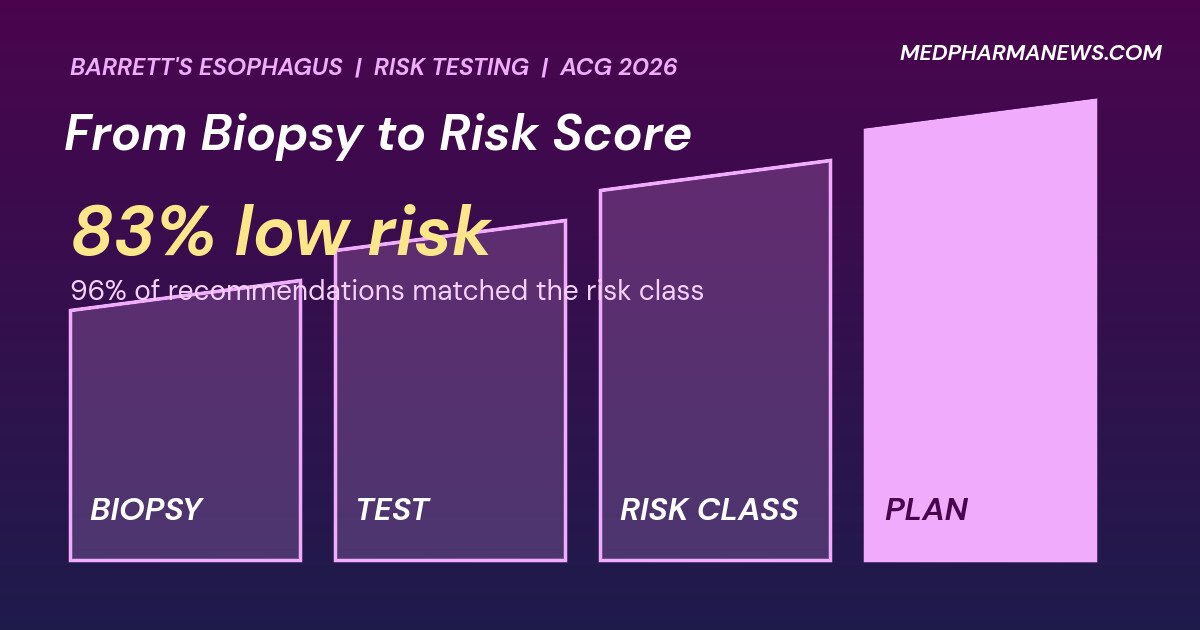
- Cohort (Emory University): TissueCypher rated 83% of patients low risk and 17% intermediate or high risk, while the clinical Progression in Barrett’s (PIB) score rated 31% low and 69% intermediate or high. Agreement between the two was slight (Cohen’s kappa 0.04). Management recommendations were consistent with the TissueCypher class for 96% of patients, including five-year surveillance for 38 and endoscopic eradication therapy for eight, five of whom had no dysplasia on biopsy.
- Case report (University of Kansas): a patient reading as non-dysplastic received a 62% five-year progression risk; a repeat endoscopy six months later found HGD that had been missed.
- Case report (Emory): a patient with an indefinite-for-dysplasia biopsy got a high-risk result (47%); ablation two months later found HGD, and later biopsies showed the abnormal tissue had been eradicated.
Three things the TissueCypher Barrett’s esophagus test numbers cannot tell patients
1. Whether outcomes improved
The 96% figure measures what clinicians recommended, not what happened to patients. The company itself says the findings suggest molecular testing may add information. Only years of follow-up can show whether acting on a result prevents cancers or avoids needless procedures.
2. Whether the low-risk call is safe
The test sorted most patients into the low-risk group, and 38 patients were advised to have five-year surveillance. Neither case report involves a low-risk patient. If a few of those patients later progress, the real-world accuracy of the low-risk label would matter more than any agreement statistic. We have no data on that yet. Longer intervals between endoscopies are convenient and may reduce the burden of procedures, but they only make sense if the low-risk label reliably identifies people who are unlikely to progress.
3. How firm the evidence is
Two of the three studies are single-patient case reports, all three were conference presentations, and the release does not say whether they were peer reviewed. The cohort’s total size was also not given in the summaries we reviewed. The source is the test’s maker, and its release warns that later studies could contradict these results. Further company information is on Castle Biosciences’ investor site and in filings available through the SEC’s EDGAR database.
Questions about the TissueCypher Barrett’s esophagus test for your gastroenterologist
- Would a molecular result change my surveillance schedule, and on what evidence?
- How do my pathology grade and any other risk factors fit with the result?
- Is the test covered by my insurance? (The sources we reviewed did not discuss coverage.)
- What would happen if the result and my biopsy grade disagreed?
These are prompts for discussion, not medical advice. Guidance on surveillance comes from professional bodies such as the American College of Gastroenterology.
The TissueCypher Barrett’s esophagus test and the wider picture for precision diagnostics
Tissue-based risk scores are one strand of a broader shift towards diagnostics that go beyond what a clinician can see. For another example of testing aimed at earlier answers, see our report on Roche’s newborn screening test for SMA, SCID and SCD, and for more device and diagnostics coverage visit medical devices.
Our reading of the TissueCypher Barrett’s esophagus test data
In our assessment, the cohort result is intriguing mainly because of the gap between two risk scores that barely agree. That suggests the tools capture different things, and it raises a fair question about which better predicts real cancers. The new data do not answer it. Until outcome studies appear, the sensible view is that the test may help refine decisions but has not yet been shown to improve them.
Frequently asked questions
What is the TissueCypher Barrett’s esophagus test?
A lab test from Castle Biosciences that analyses a Barrett’s biopsy to estimate the five-year probability of progression to high-grade dysplasia or oesophageal cancer.
Is the TissueCypher Barrett’s esophagus test a cancer screening test?
No. It is for patients already diagnosed with Barrett’s esophagus and estimates progression risk.
What did the 96% figure measure?
The share of patients whose management recommendations were consistent with the test’s risk class.
Does the TissueCypher Barrett’s esophagus test reduce cancer deaths?
Not shown. The new studies did not measure cancer outcomes.
How we reported this: we relied on the company’s press release of 12 October 2026 and summaries of it, and did not see the posters. Interpretations are labelled as ours. Last updated: 13 October 2026. This article is news reporting and not medical advice.