The Viking SUNRISE trials give the company a second late-stage route to market for its obesity candidate VK2735. On 14 October 2026, Viking Therapeutics announced it had started SUNRISE, a pair of Phase 3 studies of a once-daily tablet, alongside its separate programme of weekly injections that is already fully enrolled. The tablet has so far been tested for only 13 weeks in a Phase 2 study, so these studies are the real test of whether it can deliver sustained weight loss.
VK2735 remains investigational, and starting Phase 3 establishes neither efficacy nor approval. This report lays out how the two programmes fit together, what the earlier data show and where the hurdles are.
Viking SUNRISE trials: key takeaways
- Two studies: SUNRISE-1 in adults with obesity or overweight without type 2 diabetes, and SUNRISE-2 in adults with type 2 diabetes.
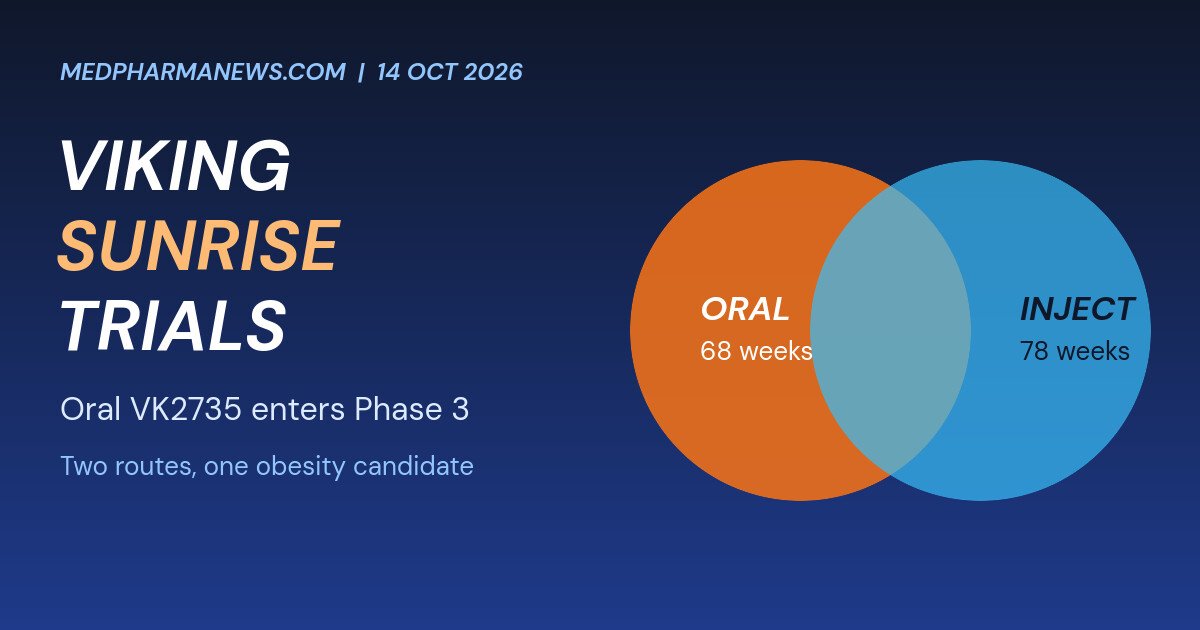
- Design: randomised, double-blind, placebo-controlled, with about 560 adults each and 68 weeks of treatment.
- Doses: 27.5, 35 or 55 mg of oral VK2735 once daily, or placebo.
- Main measure: percentage change in body weight against placebo at 68 weeks.
- Parallel programme: two 78-week injection studies, VANQUISH-1 and VANQUISH-2, are fully enrolled.
Viking SUNRISE trials at a glance
The registry entries for SUNRISE 1 and SUNRISE 2 list the two studies. According to the company, the populations are as follows.
- SUNRISE-1: a body mass index (BMI) of 30 or more, or 27 or more with at least one weight-related condition, and no type 2 diabetes.
- SUNRISE-2: obesity or overweight together with type 2 diabetes.
- Secondary measures: the proportion of participants losing at least 5%, 10%, 15% or 20% of body weight, and safety.
The announcement does not give the allocation ratio between arms or a first-dosing date, so we do not report either.
How the oral and injection programmes fit together
Viking’s release says the injection studies, VANQUISH-1 and VANQUISH-2, are fully enrolled at about 4,500 and 1,000 adults and run for 78 weeks, with weekly doses of 7.5, 12.5 or 17.5 mg or placebo. By our calculation, the two SUNRISE studies, at about 1,120 adults combined, are roughly a fifth the size of the roughly 5,500-person injection programme. An oral maintenance dosing trial is also ongoing.
Viking’s chief executive, Brian Lian, said oral VK2735 could be used as induction or maintenance therapy, and that oral and injected options would give clinicians and patients more choice. That is the company’s strategy, and nothing in the announcement shows yet that either route will succeed.
What Phase 2 showed before the Viking SUNRISE trials
The VENTURE-Oral Phase 2 trial gave 280 adults daily tablets or placebo for 13 weeks. Mean weight loss rose with the dose, to 12.2% at 120 mg against 1.3% on placebo. In its release on the new studies, Viking said up to 97% of people on the tablet lost at least 5% of body weight, against 10% on placebo, and up to 80% lost at least 10%, against 5% on placebo.
The tolerability picture is mixed. Vomiting affected 26% of people on VK2735 and 10% on placebo, and 28% on the drug stopped treatment early versus 18% on placebo. The company said 98% of drug-related adverse events were mild or moderate and mostly early.
Those results do not map neatly onto Phase 3. The SUNRISE doses of 27.5, 35 and 55 mg sit lower than the top Phase 2 doses, and the release does not explain how the two sets compare, so no weight-loss forecast is possible.
Why the Viking SUNRISE trials matter
Obesity is common and often difficult to treat. The US National Center for Health Statistics reported that 40.3% of US adults aged 20 and over had obesity in August 2021 to August 2023, and 9.4% had severe obesity. That scale explains why so many companies are racing to develop new weight-management medicines, and why a tablet that is easier to take than an injection is attractive in principle.
For patients and clinicians, however, the practical question is narrower: whether a daily tablet can produce meaningful, lasting weight loss that people can tolerate. Only long studies such as these can answer that, and the answer will not arrive for some time.
Hurdles for the Viking SUNRISE trials
- Duration: 68 weeks is more than five times the 13-week tablet study, by our calculation.
- Tolerability: stomach and gut effects can lead people to stop, which weakens real-world benefit.
- Diabetes population: SUNRISE-2 enrols people with type 2 diabetes, who are studied separately because their response to weight-loss drugs can differ.
- Competition: established GLP-1 and GIP medicines already exist, as Viking’s release notes.
In our assessment, Viking’s two-route strategy gives it options but also splits attention and capital across two large programmes. The oral studies are smaller, so they may offer the more flexible bet, but only if the tablet holds up over more than a year.
Risks and caveats for the Viking SUNRISE trials
- Starting a trial is not evidence of benefit, and many Phase 3 studies do not meet their goals.
- Viking’s own forward-looking statements warn that earlier results may not be replicated.
- Cross-trial comparisons with other obesity medicines are unreliable.
- Several claims, such as being the most advanced oral dual agonist, are the company’s and not independently verified.
For related reading, see our report on the WHO guidance on childhood obesity and weight-loss medicines and our coverage of the ontunisertib Crohn’s disease Phase 2b trial, or browse more pharmaceutical news.
What to watch next after the Viking SUNRISE trials
- Registry updates showing recruitment status and sites.
- Results from the oral maintenance dosing trial.
- Progress of the 78-week VANQUISH studies.
- Any disclosure of how the SUNRISE doses relate to the Phase 2 tablets.
Frequently asked questions
What are the Viking SUNRISE trials?
Two Phase 3 studies of once-daily oral VK2735 in adults with obesity or overweight, one in people with type 2 diabetes. Each aims to enrol about 560 adults for 68 weeks.
When will the Viking SUNRISE trials report results?
The announcement gives no results date. With 68 weeks of treatment per participant, results are not expected soon.
Is VK2735 approved?
No. It is an investigational drug and has not been approved by any regulator.
How do SUNRISE and VANQUISH differ?
SUNRISE tests a daily tablet for 68 weeks, while VANQUISH tests a weekly injection for 78 weeks.
How we reported this: we relied on Viking Therapeutics’ announcement of 14 October 2026, its Phase 2 results release, the ClinicalTrials.gov listings and US National Center for Health Statistics data. Figures labelled as ours are our own calculations. Last updated: 15 October 2026. This article is news reporting and not medical or investment advice.