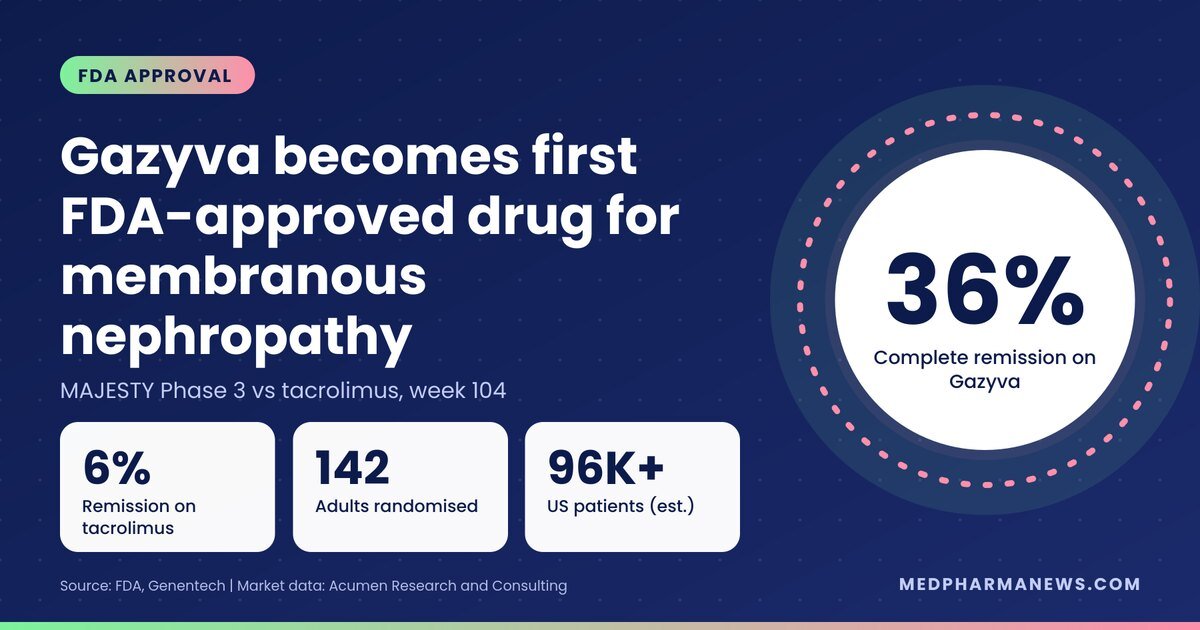
The FDA approved Gazyva for membranous nephropathy on 13 November 2026, making Roche’s obinutuzumab the first drug ever cleared specifically for adults with primary membranous nephropathy (PMN) who are at risk of disease progression. The approval rests on the Phase 3 MAJESTY trial, in which 36% of patients on Gazyva reached complete remission of proteinuria at two years compared with 6% on tacrolimus, an off-label standard.
Key takeaways on Gazyva membranous nephropathy
- Indication: adults with primary membranous nephropathy at risk of progression, to induce remission of proteinuria. It is the first FDA approval in this disease.
- Evidence: MAJESTY randomised 142 adults to Gazyva or tacrolimus for a 104-week main study period; complete remission was 36% vs 6% in the FDA’s analysis.
- Limit: Gazyva did not show a statistically significant effect on sustained loss of kidney function (eGFR decline of 30% or more), so later endpoints were not formally tested.
- Safety: the label carries boxed warnings for hepatitis B reactivation and progressive multifocal leukoencephalopathy (PML).
- Business angle: PMN is Gazyva’s fourth kidney or autoimmune use after lupus nephritis and childhood nephrotic syndrome, extending a drug first built for blood cancers.
Why a first approval in PMN matters
Primary membranous nephropathy is an autoimmune disease in which antibodies, most often against the PLA2R protein, damage the kidney’s filtering units. Protein leaks into the urine, causing swelling, high cholesterol and high blood pressure. Genentech estimates more than 96,000 people in the US live with PMN and says up to 30% develop kidney failure within 10 years. Until now, nephrologists have relied on off-label regimens: calcineurin inhibitors such as tacrolimus, older cytotoxic combinations, and the anti-CD20 antibody rituximab. A labelled option gives payers a clearer basis for coverage and gives Roche an exclusive promotional position in the indication.
MAJESTY results at a glance
| Endpoint (week 104) | Gazyva | Tacrolimus |
|---|---|---|
| Complete remission (FDA analysis) | 36% | 6% |
| Complete remission (NEJM, multiple imputation) | 37% | 6% |
| Grade 3 or higher adverse events | 22% | 19% |
| Serious adverse events | 17% | 14% |
| Sustained eGFR decline of 30% or more | No statistically significant difference | |
By our calculation, the 30-point gap means roughly one additional patient reaches complete remission for every three or four treated with Gazyva instead of tacrolimus. The NEJM paper put the adjusted difference at 31 percentage points (95% CI 18 to 44). That is a large effect for an open-label study against an active comparator, although open-label designs can carry some bias in how rescue therapy is used.
How obinutuzumab differs from rituximab
Both drugs target CD20 on B cells, the cells that mature into the plasma cells producing the anti-PLA2R antibodies behind PMN. Obinutuzumab is a glycoengineered, type II antibody designed for deeper B-cell depletion, including in tissue. Roche’s argument is that more complete depletion translates into more durable remission, which matters in a disease where relapse after rituximab is common. MAJESTY did not compare the two directly, so whether Gazyva outperforms cheaper rituximab biosimilars in practice is an open question that will shape uptake and payer policy.
Gazyva’s nephrology franchise strategy
Gazyva launched for chronic lymphocytic leukaemia and follicular lymphoma, and is approved in around 100 countries for blood cancers. Roche has since repositioned it as an immunology asset: the FDA has approved it for active lupus nephritis and childhood-onset idiopathic nephrotic syndrome, and on 13 November 2026 the EU’s CHMP backed it for systemic lupus erythematosus. Adding PMN gives Roche a cluster of kidney indications it can sell through the same nephrology call points, a useful hedge as its oncology portfolio faces biosimilar pressure. Our recent coverage of Roche’s Q3 2026 results sets out how the company is leaning on such lifecycle expansions. The designations it carried, Breakthrough Therapy, Orphan Drug and Priority Review, also mean seven years of US orphan exclusivity in PMN.
Market context for kidney autoimmune therapies
There is no dedicated Acumen report on membranous nephropathy, but the closest adjacent market is lupus nephritis, where Gazyva already competes. Acumen Research and Consulting projected the global lupus nephritis treatment market to reach around US$6.3 billion by 2027, growing at a CAGR of about 7.3% from 2020, with biologics expected to be the fastest-growing drug class. That report dates from February 2021, so treat the figures as indicative; they predate Gazyva’s kidney approvals. Kidney care economics are also under legal scrutiny, as our report on the DaVita and Fresenius lawsuit shows, and therapies that delay dialysis carry obvious value for payers.
Open questions
- Price and reimbursement for the PMN indication have not been disclosed.
- Whether remission at two years translates into fewer patients reaching kidney failure; MAJESTY did not prove this.
- Timing of an EU filing in PMN, which Roche has said will follow sharing of the data with the EMA.
- How nephrologists sequence Gazyva against rituximab, given infusion-related reactions and infection risk.
FAQ
Is Gazyva approved for membranous nephropathy?
Yes. The FDA approved Gazyva (obinutuzumab) on 13 November 2026 for adults with primary membranous nephropathy at risk of disease progression. It is the first drug approved specifically for this condition.
What is the remission rate with Gazyva in PMN?
In MAJESTY, 36% of patients on Gazyva achieved complete remission of proteinuria at week 104, versus 6% on tacrolimus.
What are the main side effects of Gazyva?
The most common were infusion-related reactions and upper respiratory tract infections. The label has boxed warnings for hepatitis B reactivation and PML.
Who makes Gazyva?
Gazyva is developed by Roche and marketed in the US by its Genentech unit.
Browse more pharmaceutical news.
Sources: FDA announcement (13 Nov 2026); Genentech MAJESTY release (Feb 2026); NEJM MAJESTY publication. Market data: Acumen Research and Consulting. Not medical or investment advice. Last updated 14 November 2026.