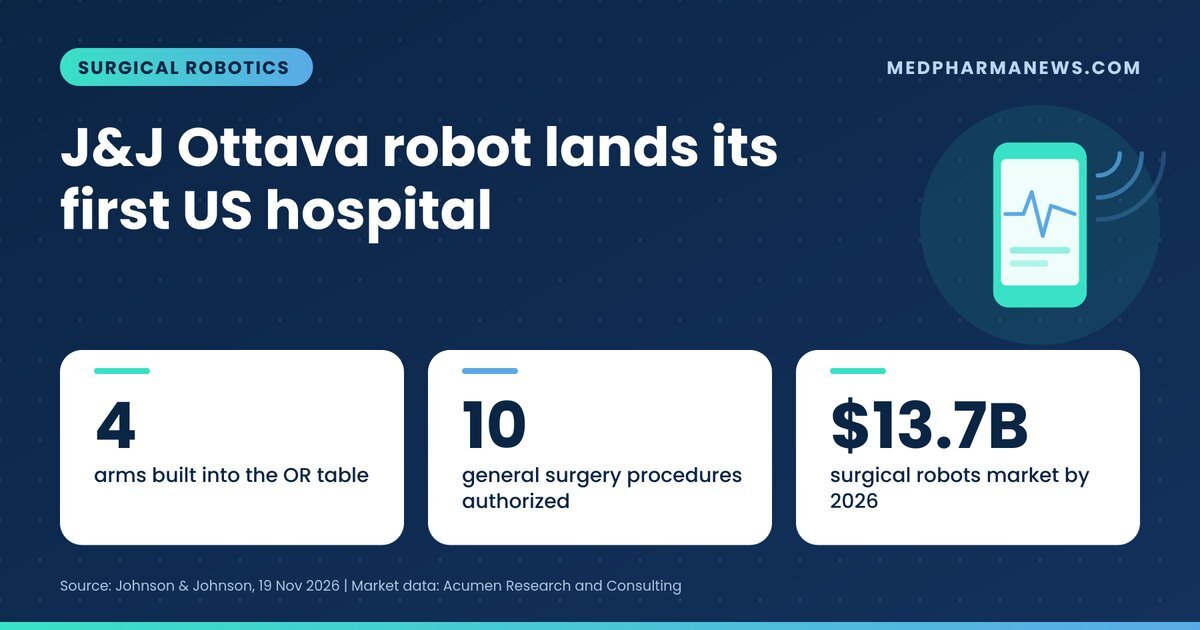
The J&J Ottava robot has its first paying customer. Johnson & Johnson said on 19 November 2026 that Memorial Hermann-Texas Medical Center in Houston will be the first US hospital to install and use the OTTAVA Robotic Surgical System under an early access commercial program, four months after the FDA granted the system De Novo authorization in July 2026 for ten general surgery procedures. The install marks the start of J&J’s long-awaited attempt to compete in soft-tissue robotic surgery, a market Intuitive has led for more than two decades.
Key takeaways on the J&J Ottava robot
- First commercial site: Memorial Hermann-Texas Medical Center, which was also a trial site in the program that supported FDA authorization.
- Regulatory status: FDA De Novo authorization in July 2026, which J&J describes as the first for a table-integrated soft-tissue surgical robot.
- Design: four robotic arms built into a standard-sized operating table rather than mounted on separate carts or a boom.
- Rollout: a controlled launch with select US customers, while J&J studies more indications in parallel.
- Not disclosed: pricing, how many systems J&J plans to place, and patient-level trial results.
What the FDA authorization covers
According to J&J, OTTAVA is authorized for ten general surgery procedures. The list leans heavily on bariatric and foregut work, which is where the company ran its pivotal studies.
| Procedure group | Authorized procedures |
|---|---|
| Bariatric | Roux-en-Y gastric bypass, gastric sleeve |
| Foregut and stomach | Gastrectomy, fundoplication, hiatal hernia repair |
| Gallbladder and spleen | Cholecystectomy, splenectomy |
| Bowel and other | Small bowel resection, appendectomy, lysis of adhesions |
Notably absent are urology, gynecology, colorectal and thoracic procedures, which together drive a large share of robotic case volume in US hospitals. Prostatectomy and hysterectomy were the procedures that built the robotic surgery business, so OTTAVA’s early value case will rest on general surgery departments, and on bariatric programs in particular.
Why a table-integrated design matters to hospitals
Most surgical robots arrive as large patient-side carts that must be wheeled in, positioned and docked, and then stored when not in use. OTTAVA puts its four arms inside the operating table itself. J&J pitches this as a way to free up floor space, cut setup time and let a single operating room switch more easily between robotic and conventional cases. The system also uses software-controlled automation, new robotic instruments and links into J&J’s Polyphonic digital ecosystem for video and data.
Whether those claims hold up will be measured in turnover times, case counts per room and staff learning curves. J&J has said it wants the first sites to generate real-world evidence, which suggests the company knows hospital buyers will want more than trial results before replacing or adding to an existing robot fleet. Tim Schmid, who leads J&J MedTech, called the install “a significant step” in commercializing the system.
The clinical evidence so far
Memorial Hermann took part in the investigational device exemption (IDE) program behind the De Novo decision. J&J also cites the FORTE clinical study of OTTAVA in Roux-en-Y gastric bypass, led by bariatric surgeon Erik Wilson of UTHealth Houston and Memorial Hermann, who is a paid consultant to J&J. The company’s announcement did not include patient numbers, complication rates or operating times, so independent assessment of performance will have to wait for peer-reviewed publications.
A crowded week for soft-tissue robots
The timing is not a coincidence. Medtronic won an expanded FDA clearance for its Hugo robot in upper abdominal general surgery days earlier, adding to its first US clearance in urology. Stryker has also moved into the space through its $400 million investment in CMR Surgical. All three are chasing Intuitive’s da Vinci platform, which has a vast installed base, an established training pipeline and a recurring instrument revenue model that new entrants must match.
| System | Company | US status (Nov 2026) | Distinguishing feature |
|---|---|---|---|
| OTTAVA | Johnson & Johnson | De Novo, July 2026; first commercial install Nov 2026 | Arms built into the OR table |
| Hugo | Medtronic | Cleared for urology; expanded to upper abdominal general surgery Nov 2026 | Modular, separate arm carts |
| da Vinci | Intuitive | Market leader across multiple specialties | Largest installed base and training network |
Market context
Acumen Research and Consulting estimates the global surgical robots market will reach around US$13.7 billion by 2026, growing at a CAGR of about 10.4% over 2019 to 2026, with North America holding the largest regional share. That growth rate explains why three of the largest device makers are spending heavily to enter a field one company has dominated. For J&J, OTTAVA is also a test of whether its MedTech unit can turn a long development program into a meaningful revenue line.
What investors and hospitals should watch
- Install pace: J&J has not given placement targets, so the number of sites announced in 2027 will be the first real signal.
- New indications: filings beyond general surgery, especially gynecology or urology, would widen the addressable case pool.
- Published data: peer-reviewed FORTE and IDE results on safety and operating time.
- Pricing model: whether J&J offers leasing or per-procedure deals to unseat incumbent robots.
FAQ
Is the J&J Ottava robot FDA approved?
It received FDA De Novo authorization in July 2026 for ten general surgery procedures, including gastric bypass, gastric sleeve and gallbladder removal.
Which hospital has the first Ottava robot?
Memorial Hermann-Texas Medical Center in Houston is the first US hospital to install OTTAVA under J&J’s early access commercial program.
How is Ottava different from da Vinci?
OTTAVA’s four arms are integrated into the operating table, while da Vinci uses a separate patient-side system. Da Vinci is cleared for far more specialties and has a much larger installed base.
More from our medical devices coverage.
Sources: Johnson & Johnson press release, 19 November 2026; MedTech Dive. Market data: Acumen Research and Consulting. Not medical or investment advice. Last updated 24 November 2026.