Companies in blood safety technology got a clinical milestone on 2 November 2026, when Cerus Corporation (Nasdaq: CERS) reported that its Phase 3 RedeS trial of INTERCEPT-treated red blood cells met its primary efficacy endpoint. For the business, the result is a necessary step, not a finished one: the product is investigational in the US, the FDA has not reviewed the final study report, and the company has not described a US submission timetable. This analysis looks at what the data support commercially and what is unknown. It is not investment advice.
Key takeaways for the blood safety technology business
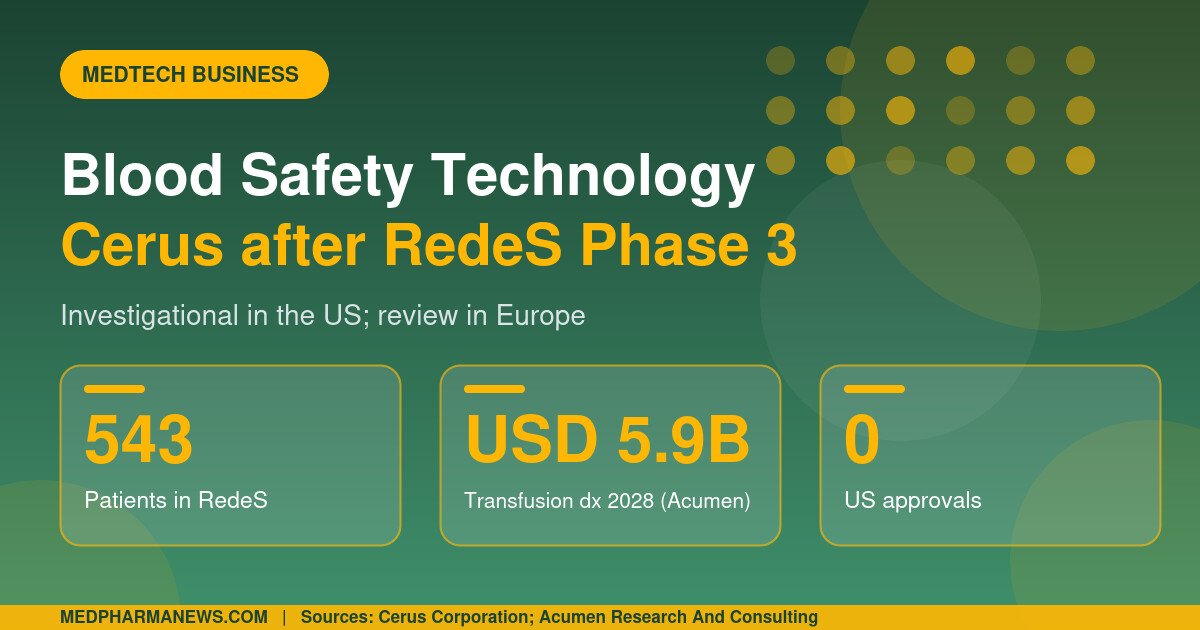
- Trial: Phase 3 RedeS, NCT03037164, with 543 patients across INTERCEPT and control arms.
- Efficacy: adjusted haemoglobin increment of 1.996 g/dL versus 2.050 g/dL; non-inferiority met against a margin of minus 0.32 g/dL.
- Safety: related adverse events 3.4% versus 2.5%; antibodies to INTERCEPT red cells in 2.2% versus none.
- Regulatory: investigational in the US; under regulatory review in Europe per company background.
- Not disclosed: US filing plans, pricing, reimbursement or revenue expectations.
Why red cells matter commercially
Cerus already sells the INTERCEPT system for platelets and plasma. Red blood cells are the most commonly transfused component, so a validated pathogen reduction process for them would extend the same technology to a larger transfusion volume. That is the strategic logic behind the RedeS programme. But a clinical win does not set a price, secure regulatory clearance or change hospital procurement on its own. Blood centres must see value against current screening, and regulators must accept the risk-benefit balance, including the antibody finding.
Who decides adoption
In transfusion, the buyer is usually a blood establishment or a national blood service rather than the individual clinician. Such organisations weigh safety gains against processing time, staffing, validation work, equipment and the cost of each unit, and they often adopt new technologies in stages, starting with the components where the evidence is strongest. Hospitals then follow what their suppliers provide. This structure tends to make adoption slower than for a drug, and it means that regulatory approval is necessary but not sufficient for commercial uptake.
The data at a glance
| Measure | INTERCEPT | Control |
|---|---|---|
| Safety population | 267 | 276 |
| mITT population | 195 | 199 |
| Haemoglobin increment (g/dL) | 1.996 | 2.050 |
| Related TEAEs | 3.4% | 2.5% |
| Antibodies to INTERCEPT red cells | 2.2% | 0% |
The difference of minus 0.054 g/dL had a 95% confidence interval from minus 0.210 to 0.103, inside the margin of minus 0.32 g/dL. The company said the antibodies were low-titre and transient with no haemolysis or clinical impact. Dr Richard Benjamin, Cerus’s chief medical officer, described the result as another important step toward extending pathogen reduction to red blood cells.
What the business still has to prove
There are several commercial hurdles that the release does not address. Regulators may weigh the antibody signal differently from the company. Blood establishments will want peer-reviewed data and operational evidence on processing time, storage and cost. Hospitals will ask whether the incremental safety justifies any added cost per unit. None of these has an answer in the available material, so any revenue forecast would be speculation, and we offer none.
Possible paths from here (our framing, not a forecast)
- Clean review path: publication supports the company’s reading of the antibody data and regulators proceed to review without major new requests.
- Extended review path: regulators ask for more antibody or subgroup data, lengthening the timeline.
- Slow adoption path: even with clearance, blood establishments phase in the technology gradually.
These are illustrations of how such programmes can unfold, not predictions, and the company has not given timelines for any of them.
Regulatory position
The company states that INTERCEPT red blood cells are investigational in the US and that the FDA has not reviewed the final study report, so its view of benefit and risk may differ. Trial information is on the ClinicalTrials.gov record, and the company website hosts its releases.
Timeline
- Earlier: ReCePI study reports antibody findings.
- 2 November 2026: RedeS topline results and investor call.
- Next: journal publication, meetings and antibody studies.
- Regulatory: European review ongoing; US plan not described.
Market context
According to Acumen Research And Consulting, the blood transfusion diagnostics market was USD 3,813.1 million in 2020 and is projected to reach USD 5,873.9 million by 2028, a compound annual growth rate of 6.7% for 2021 to 2028, with blood banks the largest end use and North America leading. This is an adjacent market, covering testing and not pathogen reduction, and does not size Cerus’s opportunity. By our calculation the endpoints imply about 5.6%, the FAQ repeats the 2028 value as the 2020 value, and the page was last updated in 2021.
Our analysis
In our assessment, RedeS removes a clinical uncertainty and leaves the regulatory and commercial ones. The data are consistent with treated cells performing like standard cells on haemoglobin recovery, which is what a non-inferiority design is meant to show. The next value-defining events are publication, the regulators’ response and any submission plan. We make no forecast of revenue or share price.
What is not disclosed
- US submission plans and timelines.
- Pricing, reimbursement and cost-per-unit data.
- Revenue or margin expectations from red cells.
- Detailed antibody titres and follow-up.
Risks and caveats
- Results are company-reported and not yet peer reviewed.
- The product is investigational in the US.
- Market data are adjacent and inconsistent.
- This article is not investment advice.
What to watch next
- Journal publication of full results.
- European regulatory decision.
- Any FDA submission statement.
- Blood-centre adoption signals.
General background
Related coverage: a UK health-service outage and the medical devices section.
Questions readers are asking about blood safety technology
Is INTERCEPT for red cells available in the US?
No. It is investigational.
Did RedeS meet its goal?
The company says the primary endpoint was met.
Is there a revenue forecast?
None was disclosed in the available material.
FAQ
What is Cerus?
A company developing the INTERCEPT Blood System for blood components.
What is non-inferiority?
A trial design showing a treatment is not worse than a comparator by more than a set margin.
What are the antibodies?
Antibodies directed at INTERCEPT-treated red cells, which the company calls transient and without clinical impact.
How we reported this: details come from the Cerus Corporation release of 2 November 2026; market figures are attributed to Acumen Research And Consulting; calculations marked as ours are our own. Last updated 4 November 2026. This is news reporting and not investment advice.