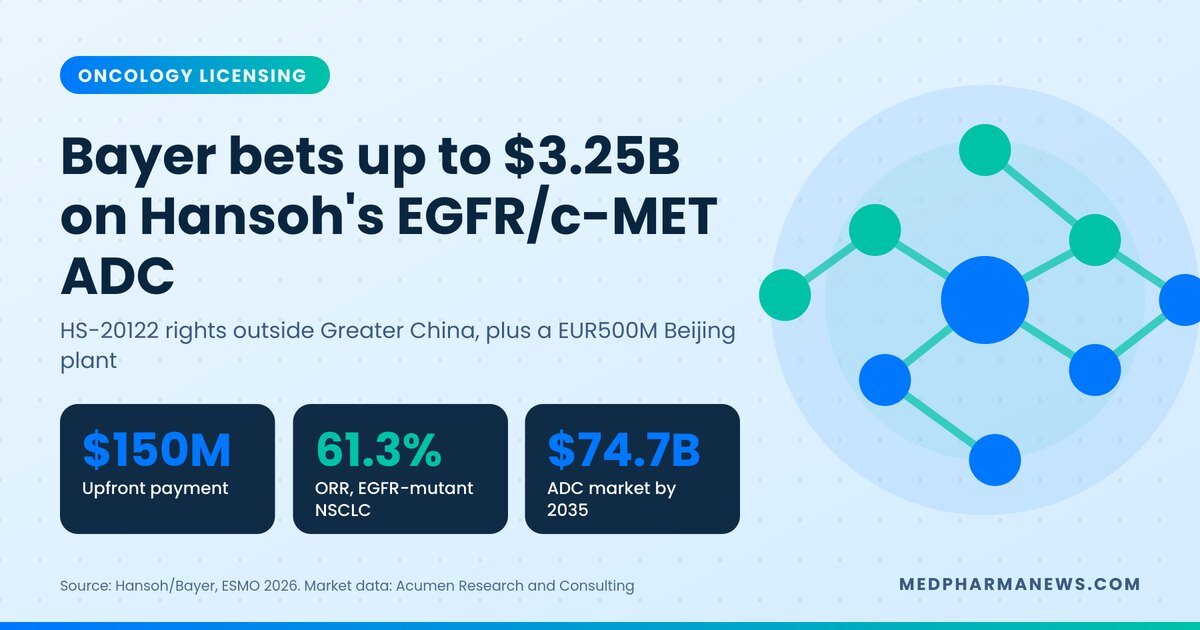
The Bayer Hansoh deal announced on 25 November 2026 gives Bayer exclusive rights outside Greater China to HS-20122, an EGFR and c-MET bispecific antibody-drug conjugate (ADC), for $150 million upfront and up to $3.1 billion in development, regulatory and commercial milestones, plus tiered royalties. Total potential value is up to $3.25 billion. A day later Bayer said it will invest up to €500 million to expand its Beijing manufacturing site, its largest single pharmaceutical investment in China. The two moves, made within 24 hours, say a lot about where the German group thinks its next oncology growth will come from.
Key takeaways on the Bayer Hansoh deal
- Terms: $150M upfront, up to $3.1B in milestones, tiered royalties; effective once antitrust clearance is received.
- Territory: worldwide except mainland China, Hong Kong, Macau and Taiwan, which Hansoh keeps.
- Asset: HS-20122, a Phase 1 bispecific ADC hitting EGFR and c-MET, aimed at solid tumours including non-small cell lung cancer (NSCLC).
- Early data: 44.1% overall response rate across 215 patients at ESMO 2026, and 61.3% in EGFR-mutant NSCLC after EGFR tyrosine kinase inhibitors.
- China bet: up to €500M for a Beijing plant expansion, part of roughly €1B Bayer plans to spend on China pharma operations through 2030.
Deal terms at a glance
| Item | Detail |
|---|---|
| Licensor | Hansoh Pharmaceutical (Hong Kong-listed; disclosed via HKEX filing, 25 Nov 2026) |
| Licensee | Bayer AG, Pharmaceuticals Division |
| Upfront | $150 million |
| Milestones | Up to $3.1 billion |
| Headline value | Up to $3.25 billion |
| Upfront as share of headline | About 4.6% (by our calculation) |
| Royalties | Tiered, on net sales outside Greater China |
| Conditions | Antitrust clearance |
The low upfront share is typical of China out-licensing deals for early-stage assets: most of the value is contingent on HS-20122 clearing later trials and reaching the market. Our coverage of Lilly’s Stipple Bio pact and AbbVie’s DISCO bispecific deal shows the same back-loaded pattern across oncology this month.
What HS-20122 is and what the early data show
HS-20122 combines an antibody that binds both EGFR and c-MET with a cytotoxic payload, which Hansoh has not publicly named. The antibody backbone was licensed from Biotheus. The dual-target idea is not new: EGFR and MET signalling together drive many lung cancers, and MET amplification is a common escape route after EGFR inhibitors such as osimertinib stop working. J&J’s amivantamab, a naked EGFR/MET bispecific, has already validated the targets, including in the recent head and neck cancer approval. HS-20122 adds a toxic payload on top.
First-in-human Phase 1 results (NCT06927570) were presented at ESMO 2026 with a 6 July 2026 data cutoff and 215 patients enrolled. Company-reported figures:
| Population | Objective response rate | Other |
|---|---|---|
| All evaluable patients | 44.1% | Disease control 91.0% |
| EGFR-mutant NSCLC after EGFR-TKI | 61.3% | 6-month PFS 75.3% |
| Squamous NSCLC, after immuno-chemo | 32.1% | n/a |
| Head and neck SCC, after immuno-chemo | 50.0% | n/a |
On safety, no dose-limiting toxicities were reported. Grade 3 or higher treatment-related adverse events occurred in 44.2% of patients, led by neutropenia (25.6%) and low white blood cell count (15.8%). Dose reductions were needed in 10.2% and discontinuations in 3.7%, and no grade 3 or higher rash was seen, which matters because skin toxicity is a known limitation of EGFR-directed drugs. A Phase 1b study (NCT07645222) is testing combinations with aumolertinib, adbrelimab and platinum chemotherapy in NSCLC.
These are single-arm, early-phase numbers from a mostly Chinese patient population. They are encouraging but are not comparable with randomised Phase 3 results, and the durability of responses is not yet known.
Why Bayer is buying, and why now
Bayer’s oncology business leans on prostate cancer drugs and radiopharmaceuticals, with HER2-directed therapy and now EGFR/c-MET as newer pillars. Juergen Eckhardt, head of business development and licensing for the Pharmaceuticals Division, said Bayer was “excited to further advance HS-20122” as part of its push into precision oncology, according to Pharmaceutical Technology. The company is also under pressure to rebuild revenue: it has faced litigation costs, including the $7.25B Roundup settlement, and pricing setbacks such as the planned Kerendia withdrawal in Germany.
The Beijing expansion, announced on 26 November by pharma chief Stefan Oelrich, covers about 18,000 square metres with three independently run manufacturing modules and up to 300 jobs. Production could start as early as 2032, initially for cardiovascular medicines, but the plant is designed for high-potency products including future cancer drugs, mainly for the Chinese market. Bayer has not said HS-20122 will be made there.
Market context: the ADC race tilts toward lung cancer and China
According to Acumen Research and Consulting, the global antibody-drug conjugate market was valued at $16.4 billion in 2025 and is projected to reach $74.7 billion by 2035, a compound annual growth rate of 16.3%. Acumen expects lung cancer to be the fastest-growing ADC indication, at a CAGR of about 31% from 2026 to 2035, while breast cancer remains the largest application with a 46.2% share in 2025. Asia-Pacific is projected to be the fastest-growing region at a 20.2% CAGR, and the firm notes that Chinese companies now originate a large share of new ADC candidates and license them globally through multi-billion-dollar deals. HS-20122 sits squarely at the intersection of those two trends.
Risks and open questions
- Competition: several EGFR/c-MET bispecifics and ADCs are in development, and Acumen notes new ADCs must show clear advantages over approved ones to win share.
- Payload and toxicity: the undisclosed payload and a 25.6% grade 3+ neutropenia rate will be scrutinised as dosing is refined.
- Global data: Bayer will need trials in Western populations before any US or EU filing; no timeline has been given.
- Regulatory and political: antitrust clearance is pending, and US scrutiny of China-sourced biotech assets remains a background risk.
FAQ
How much is Bayer paying Hansoh for HS-20122?
Bayer pays $150 million upfront and up to $3.1 billion in milestones, for a total potential value of up to $3.25 billion, plus tiered royalties on sales outside Greater China.
What does HS-20122 treat?
It is being studied in advanced solid tumours, with the strongest early signal in EGFR-mutant non-small cell lung cancer that has progressed on EGFR inhibitors. It is investigational and not approved anywhere.
What is a bispecific ADC?
It is an antibody that recognises two different targets on cancer cells, here EGFR and c-MET, and carries a chemotherapy-like payload that is released inside the cell after binding.
Is Bayer investing in China?
Yes. Bayer will spend up to €500 million expanding its Beijing plant, with production possibly starting in 2032, as part of about €1 billion planned for China pharma operations through 2030.
Sources: Hansoh HKEX announcement and Bayer statements (25-26 November 2026) as reported by Pharmaceutical Technology and OncoDaily; ESMO 2026 Phase 1 data (NCT06927570). Market data: Acumen Research and Consulting, Antibody Drug Conjugate Market report (updated November 2026). More in Industry Insights. Not medical or investment advice. Last updated 26 November 2026.