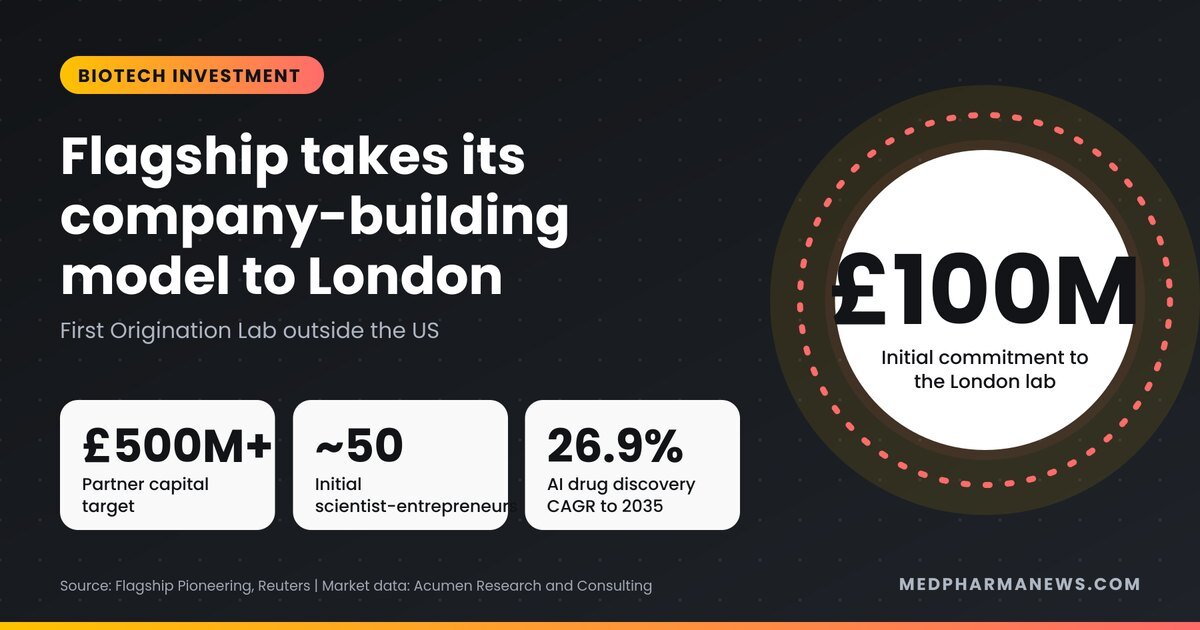
Moderna’s creator is taking its company-building model abroad for the first time. On November 16, 2026, Flagship Pioneering announced the Flagship Pioneering London lab, formally the Flagship Origination Lab, U.K., with an initial £100 million (about $132 million) commitment and a plan to recruit roughly 50 scientist-entrepreneurs who will invent AI-native biotech companies from scratch in Britain. Founder and CEO Noubar Afeyan hopes partners will add a further £500 million or more, which would make it one of the larger single bets on UK company creation in recent years.
Key takeaways on the Flagship Pioneering London lab
- £100 million initial commitment, with a target of £500 million or more in additional partner capital.
- It is Flagship’s first dedicated company-creation unit outside the US after more than 25 years of operating only from Cambridge, Massachusetts.
- About 50 scientist-entrepreneurs and operators will be hired initially in London.
- Flagship says it will create new companies rather than invest in existing UK start-ups, using AI from invention through to clinical trials.
- The NHS and its patient data were cited by Afeyan as the main draw.
The deal at a glance
| Item | Detail |
|---|---|
| Vehicle | Flagship Origination Lab, U.K., part of Flagship Labs |
| Location | London, building on an office opened in 2023 near the Francis Crick Institute |
| Initial capital | £100 million (about $132 million) |
| Target partner capital | £500 million or more |
| Initial headcount | About 50 scientist-entrepreneurs and operators |
| Focus | AI-native platform companies in human health and other science frontiers |
| Leadership named | Noubar Afeyan (CEO), Avak Kahvejian (President, Flagship Labs) |
| Government link | Memorandum of understanding with the UK government signed in 2023 |
Why Flagship is not just opening another office
Most venture firms that expand overseas do so to find deals. Flagship’s model is different: its own teams generate a scientific hypothesis, build a platform around it and spin it out as a company, a process that produced Moderna and, by Flagship’s count, more than 130 companies in total. Moving that origination step to London means the intellectual property, early hires and first clinical programmes of new companies will be rooted in the UK rather than imported from Boston.
Afeyan told Reuters the firm “concluded that this might well be the right next step in our evolution.” The groundwork has been laid over three years. Flagship signed an MOU with the UK government in 2023, and two of its companies already have British footprints: Generate:Biomedicines ran an early-stage trial of an AI-designed asthma antibody in Manchester, and Quotient Therapeutics was set up as the firm’s first transatlantic company. The lab will also draw on Flagship’s internal units Pioneering Intelligence and Pioneering Medicines.
The NHS data angle
The most telling part of the announcement is the rationale. Afeyan pointed to the NHS, and the longitudinal patient data it holds, as the UK’s main attraction, arguing that researchers can begin from real-world evidence when choosing disease targets instead of starting with animal models. He also framed AI’s first major contribution as illuminating disease mechanisms rather than simply speeding up chemistry. That is a notable position from an investor whose portfolio is heavy in AI-enabled design, and it suggests the London companies will lean on human biology and health records at the target-selection stage.
Whether that advantage materialises depends on access. NHS data are fragmented across trusts and governed by strict consent and research approval rules, and the announcement names its academic and data partners only in general terms. Investors will want to see which data environments the new companies can actually use, and on what terms.
What it signals for UK life sciences funding
UK science minister Chris McDonald welcomed the move, calling Britain “a natural home for AI and life sciences companies.” The timing is useful for a sector that has struggled to keep later-stage companies and capital at home. A £100 million start is modest next to US mega-rounds, but because Flagship creates rather than buys companies, the multiplier effect on jobs and follow-on funding could be larger than the headline suggests. By our calculation, the full £600 million ambition would equal roughly £12 million of capital for each of the 50 initial staff, an unusually deep pool for an early-stage origination team.
The launch lands in a busy week for biotech company formation. Seawolf Therapeutics debuted with $100 million and a Sanofi partnership the same day, as we reported in Seawolf Therapeutics Launches With $100M, underscoring that investors are still willing to fund platform science despite a tougher IPO window.
Market context: AI in drug discovery
The field Flagship is betting on is growing fast. Acumen Research and Consulting’s AI in drug discovery market report (updated September 2026) values the market at USD 2.8 billion in 2025 and projects USD 30.49 billion by 2035, a CAGR of 26.9%. Pharmaceutical companies accounted for 43% of 2025 spending and biotech companies 30%, while cloud deployment held a 52% share. The same report notes that UK investors directed about $20.7 billion of AI venture capital in 2025, second only to the US, which helps explain why London was Flagship’s first choice.
| AI in drug discovery metric | Value |
|---|---|
| Market size, 2025 | USD 2.8 billion |
| Forecast, 2035 | USD 30.49 billion |
| CAGR, 2026-2035 | 26.9% |
| Pharma end-user share, 2025 | 43% |
| Biotech end-user share, 2025 | 30% |
What to watch next
- Names of the first London-born companies and their therapeutic areas.
- Which corporate, sovereign or charitable partners commit toward the £500 million target.
- Concrete NHS or UK Biobank data agreements supporting target discovery.
- Whether other US company builders follow with UK origination units. For a look at how AI-first biotechs are being judged on clinical data, see our analysis of Recursion’s REC-4881 results.
FAQ
How much is Flagship Pioneering investing in the UK?
Flagship has committed an initial £100 million to its London Origination Lab and aims to attract £500 million or more from partners.
Will Flagship invest in existing UK biotech start-ups?
No. According to Reuters, Flagship plans to create new companies internally and partner with universities, corporations and funders, rather than buy stakes in existing firms.
Is this Flagship’s first lab outside the US?
Yes. It is the firm’s first dedicated company-creation unit outside the US, although it has run a London office since 2023.
More business analysis: Industry Insights.
Sources: Flagship Pioneering press release (November 16, 2026); Reuters. Market data: Acumen Research and Consulting. Not investment advice. Last updated: November 17, 2026.