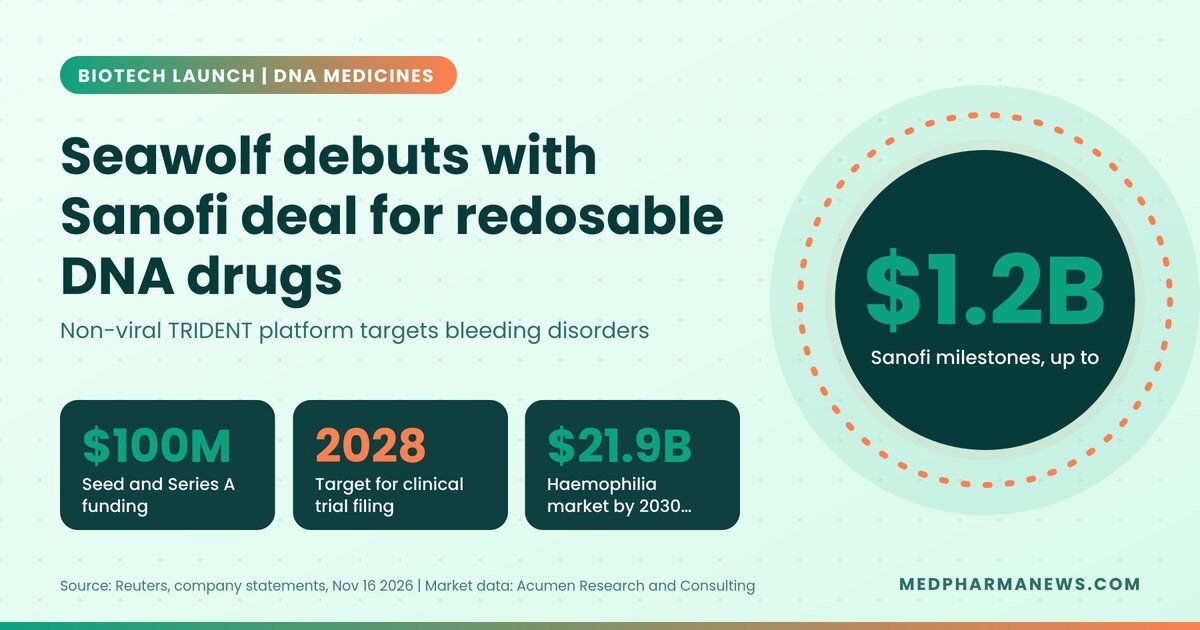
Seawolf Therapeutics came out of stealth on November 16, 2026 with $100 million in funding and a research deal with Sanofi worth up to $1.2 billion, betting that DNA delivered in lipid nanoparticles can do what RNA drugs and viral gene therapies cannot: produce a therapeutic protein for a long time and still be given more than once. The San Diego company’s first Sanofi programs target bleeding disorders, while its own lead project aims at obesity and muscle loss.
Key takeaways on Seawolf Therapeutics
- Seawolf raised $100 million across seed and Series A rounds co-led by Versant Ventures, MPM BioImpact and Novartis Venture Fund, with Eli Lilly and CRISPR Therapeutics also investing.
- Sanofi signed a multi-target collaboration and exclusive licence worth up to $1.2 billion in milestones plus tiered royalties; the upfront payment was not disclosed.
- The TRIDENT platform packages engineered DNA in a lipid nanoparticle with an undisclosed helper factor that carries it into the cell nucleus.
- All evidence so far is from animals. Seawolf expects to pick a clinical candidate in late 2027 and to file for human trials by the end of 2028.
- The CEO said the company will probably need to raise more money before reaching the clinic.
The deal in figures
| Item | Detail |
|---|---|
| Launch date | November 16, 2026 |
| Funding raised | $100 million (seed plus Series A; split not disclosed) |
| Lead investors | Versant Ventures, MPM BioImpact, Novartis Venture Fund |
| Strategic investors | Eli Lilly, CRISPR Therapeutics, among others |
| Sanofi milestones | Up to $1.2 billion, plus tiered royalties |
| Sanofi focus | Bleeding disorders and other undisclosed indications |
| Candidate selection | Late 2027 (company target) |
| Clinical trial filing | By end of 2028 (company target) |
Why DNA, and why now
Messenger RNA in lipid nanoparticles proved during the pandemic that fat bubbles can carry genetic instructions into cells safely and at scale. But mRNA breaks down within days, so protein production fades fast. Viral gene therapies built on adeno-associated virus (AAV) last much longer, yet the body makes antibodies against the virus after the first dose, which in practice limits most patients to a single treatment. In haemophilia, that has meant one-shot therapies whose factor levels can fall over time with no way to top them up.
DNA sits between the two. Inside the nucleus, a DNA instruction can keep making protein for weeks or months. Delivered without a virus, it should not trigger anti-vector antibodies, so a patient could be redosed. Seawolf says its version is “immune quiet”, a key claim because naked plasmid DNA in standard nanoparticles is known to set off the cGAS-STING alarm pathway, an inflammatory response that has caused serious toxicity in mouse studies published by academic groups. Seawolf has not yet released data showing how TRIDENT avoids this.
What Sanofi gets
Sanofi has been a major haemophilia player since its $11.6 billion purchase of Bioverativ in 2018, and today markets long-acting factor therapies and an RNA-based option. A redosable DNA medicine that keeps clotting factor at steady levels would fit that franchise and could answer the durability problem that has dogged AAV gene therapies. For Sanofi, the structure is milestone-heavy, which caps upfront risk on an unproven, preclinical platform.
For Seawolf, the partnership offers validation and non-dilutive cash while it builds its own metabolic program. Big pharma has been signing similar early bets this month; Eli Lilly, one of Seawolf’s investors, separately agreed a multi-target oncology deal with Stipple Bio, and Johnson & Johnson leaned on outside funding for late-stage work in the J&J Ollin acquisition.
The obesity and muscle angle
Seawolf’s in-house lead program is designed to build muscle and reduce fat, with possible use in obesity, age-related muscle loss and osteoporosis. That positions it next to the GLP-1 boom, where a major concern is that weight lost on drugs such as semaglutide and tirzepatide includes some lean muscle. A long-acting gene-based muscle builder could in theory be paired with those drugs. The company has disclosed no target or animal data for this program, so it is far too early to judge its prospects.
Market context
The bleeding-disorder opportunity Sanofi is targeting is sizeable. Acumen Research and Consulting valued the global haemophilia market at USD 12.2 billion in 2021 and projected it to reach USD 21.9 billion by 2030, a compound annual growth rate of 6.9%. Acumen reported that haemophilia A held more than 82% of the market in 2021 and cited estimates of more than 1.1 million people living with haemophilia worldwide. The report was last updated in November 2022, so these figures are indicative rather than current.
Open questions for investors and partners
- The helper factor. Seawolf has not said what carries its DNA into the nucleus or how it works.
- Inflammation data. Cytokine and STING-pathway readings after dosing will be the first test of the “immune quiet” claim.
- Repeat dosing. Expression curves across several doses in primates would show whether redosing works as promised.
- Integration. Regulators will want to know whether the DNA stays outside the chromosomes, which affects long-term follow-up requirements.
- Funding runway. With human trials roughly two years away and more capital needed, terms of any next round will signal investor confidence.
More pharma deal analysis is available in our Industry Insights section.
FAQ
What is Seawolf Therapeutics?
Seawolf Therapeutics is a San Diego biotech developing non-viral DNA medicines using its TRIDENT lipid nanoparticle platform. It launched publicly in November 2026 with $100 million and is led by CEO Elizabeth Alcamo.
How much is the Sanofi Seawolf deal worth?
Up to $1.2 billion in research, development and commercial milestones, plus tiered royalties on sales. The upfront payment was not disclosed.
How is a DNA medicine different from mRNA?
mRNA is translated into protein in the cell’s cytoplasm and degrades within days. DNA must reach the nucleus but can keep producing protein for much longer, potentially reducing how often a patient needs dosing.
When will Seawolf start human trials?
The company aims to select a drug candidate in late 2027 and to file to start human studies by the end of 2028.
Sources: Reuters (November 16, 2026); company statements reported by Tech Times and BioPharma Dive. Market data: Acumen Research and Consulting, Hemophilia Market report. This article is for information only and is not medical or investment advice. Last updated November 17, 2026.