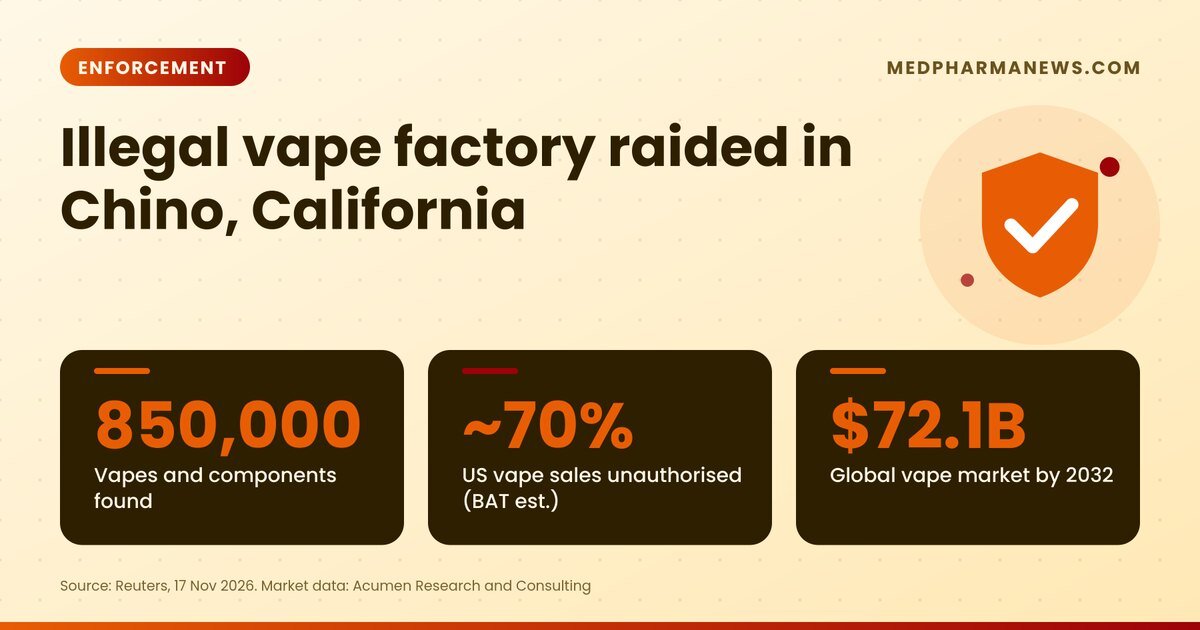
An illegal vape factory operating inside a warehouse complex in Chino, California, was raided on 30 October 2026, with officers recovering about 850,000 vapes or vape components, including Geek Bar and Foger products, according to a Reuters exclusive published on 17 November. Homeland Security Investigations, the Ontario Police Department and several other state and federal agencies took part, and the equipment found on site suggests Chinese-brand disposables were being assembled, branded and shrink-wrapped on US soil.
The case matters to regulators and the legal nicotine industry alike because it hints that suppliers of unauthorised disposables may be shifting some production inside the United States after a long run of import seizures.
Key takeaways on the illegal vape factory raid
- Raid date: 30 October 2026, at warehousing units in Chino, east of Los Angeles; first reported by Reuters on 17 November.
- Roughly 850,000 vapes or components were found, plus packaging and branding and shrink-wrap machinery.
- Both genuine and counterfeit Geek Bar and Foger items were present; a worker said the site began operating in 2026.
- The FDA has not authorised any Chinese-owned vapes and has named Geek Bar and Foger among brands that are illegal to import or sell.
- No arrests were reported in the Reuters account.
Inside the Chino warehouse
Photos reviewed by Reuters showed spools of authenticity labels carrying QR codes, the kind brands print to help buyers spot fakes. When reporters scanned one code on a Geek Bar box, it led to a Geek Bar web page that verified the product as genuine. That detail cuts two ways: it may indicate authentic devices or parts were being finished locally, or that genuine verification labels were available to whoever ran the operation. Neither Geek Bar’s maker, Guangdong Qisitech, nor Foger responded to Reuters.
An Ontario police spokesperson told Reuters that “the significance of this investigation goes well beyond the number of illegal vaping products seized.” Investigators have not publicly said who owned the site, how long product had been shipping or where it was going.
How enforcement got here: a short timeline
| Period | Development |
|---|---|
| Early 2025 | New US tariffs on Chinese goods squeeze supplies of imported disposables |
| 2025 | FDA and customs carry out large seizures of unauthorised vapes; states step up their own crackdowns |
| Later 2025 to 2026 | Imports rebound, according to FDA data cited by Reuters |
| 2026 | Worker says the Chino factory starts operating |
| 30 Oct 2026 | Multi-agency raid in Chino recovers about 850,000 vapes and components |
| 17 Nov 2026 | Reuters reports the previously undisclosed raid |
Why onshore assembly is a problem for regulators
US enforcement against flavoured disposables has leaned heavily on the border: customs holds, import alerts and seizures at ports. Every new tobacco product sold in the US needs FDA marketing authorisation, and products without it are illegal to import or sell. A domestic finishing operation sidesteps the point where most interdiction happens. Components can arrive in smaller, less obvious shipments, and branded, sealed boxes then enter distribution from inside the country, which makes them harder to tell apart from legitimately imported stock.
The quality question is just as pressing from a public health view. Unauthorised disposables have never been reviewed for things like nicotine content accuracy, battery safety or the chemistry of their flavourings. A warehouse that mixes authentic and counterfeit stock adds another unknown: buyers cannot be sure what they are inhaling even when the label looks right.
What it means for the legal vape business
Tobacco companies with authorised products have been lobbying hard for tougher action against illicit disposables. British American Tobacco estimates that unauthorised devices make up about 70% of US vape sales, in a market it values at around $9.25 billion a year. Both BAT and Altria said this year that stronger enforcement was starting to shift share, and BAT reported higher sales as a result. A credible sign that illicit supply is moving onshore is likely to become an argument for more domestic inspections, retail penalties and distributor liability, not just border work.
Market context from Acumen Research and Consulting
The scale of the prize explains why illicit supply is so persistent. Acumen Research and Consulting sized the global e-cigarette and vape market at USD 28.5 billion in 2023 and projects it will reach USD 72.1 billion by 2032, growing at a CAGR of 11.1% from 2024. Acumen identifies North America as the dominant region and fruit as the leading flavour category, which is the segment where unauthorised disposables are concentrated.
By our calculation, if BAT’s 70% estimate holds, unauthorised products would account for roughly $6.5 billion of annual US vape sales, money that funds both import networks and, apparently, local assembly. For more on how the FDA is pressing Chinese suppliers in other product areas, see our report on FDA warning letters to Chinese compounding API makers, and browse more analysis in Industry Insights.
Open questions
- Who operated the Chino site, and will charges follow?
- Were the devices made from imported kits, or were some components sourced in the US?
- How did genuine verification labels end up at the facility?
- Are similar operations running elsewhere? Investigators have not said.
FAQ
Are Geek Bar vapes illegal in the US?
Geek Bar products have no FDA marketing authorisation, and the FDA has named the brand among those that are illegal to import or sell in the United States.
Where was the illegal vape factory?
In warehousing units in Chino, California, east of Los Angeles. The Ontario Police Department, which covers the area, took part in the raid alongside Homeland Security Investigations.
How many vapes were seized in the Chino raid?
About 850,000 vapes or vape components, along with packaging, label spools and machinery for branding and shrink-wrapping.
Can a QR code prove a vape is legal?
No. A brand’s QR code can at most indicate a product is not counterfeit; it says nothing about FDA authorisation. A genuine Geek Bar is still an unauthorised product in the US.
Sources: Reuters exclusive report (17 November 2026); FDA statements on unauthorised e-cigarettes as cited by Reuters. Market data: Acumen Research and Consulting, E-cigarette and Vape Market report. Not legal, medical or investment advice. Last updated 17 November 2026.