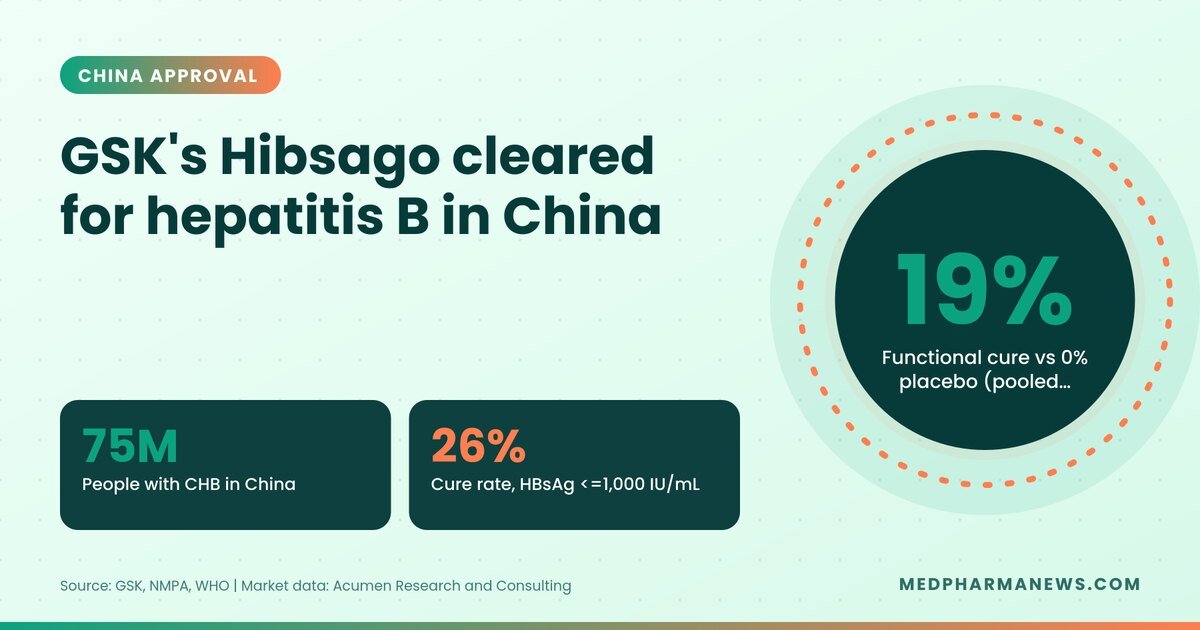
The Hibsago China approval gives GSK’s bepirovirsen access to the world’s largest hepatitis B population: on 26 November 2026 the company said China’s National Medical Products Administration (NMPA) had cleared the six-month antisense course, used with existing antiviral therapy, for a defined group of adults with chronic hepatitis B. China is home to an estimated 75 million people with the infection, and the approval follows US clearance on 20 October and Japanese approval in August, making China the third major market for a drug GSK positions as a functional cure.
Key takeaways on the Hibsago China approval
- NMPA approved Hibsago (bepirovirsen) for non-cirrhotic adults on nucleos(t)ide analogue therapy for at least six months, with HBV DNA below 90 IU/mL and HBsAg at or below 3,000 IU/mL.
- In the pooled B-Well 1 and B-Well 2 Phase 3 trials, 19% of patients achieved functional cure versus 0% on placebo; in those with HBsAg at or below 1,000 IU/mL the rate was 26%.
- China had granted Breakthrough Therapy designation in 2021 and priority review after accepting the filing in March 2026.
- Sino Biopharmaceutical, through its subsidiary CTTQ, will handle importation, distribution and hospital access across more than 5,000 medical centres; GSK holds the marketing authorisation.
- The drug was licensed from Ionis; EU review is ongoing.
Who qualifies under the Chinese label
The approved population mirrors the patients studied in Phase 3 and closely tracks the US label. Patients must already be on long-term antiviral tablets such as entecavir or tenofovir, have their virus suppressed, show no cirrhosis and have a relatively low level of hepatitis B surface antigen (HBsAg), the viral protein whose disappearance defines a functional cure. In practice that means bepirovirsen is an add-on that aims to let some people eventually stop treatment, not a first-line option for newly diagnosed or advanced disease.
Functional cure in the trials meant undetectable HBsAg and HBV DNA sustained for 24 weeks after all treatment, including antivirals, had stopped. That is a far higher bar than viral suppression, which current tablets achieve but which usually requires lifelong dosing.
The B-Well data behind the decision
| Group (baseline HBsAg) | Bepirovirsen | Placebo |
|---|---|---|
| Pooled, at or below 3,000 IU/mL | 19% (233/1,220) | 0% (0/614) |
| B-Well 1, at or below 3,000 IU/mL | 20% (127/650) | 0% (0/328) |
| B-Well 2, at or below 3,000 IU/mL | 19% (106/570) | 0% (0/286) |
| Pooled, at or below 1,000 IU/mL | 26% (200/768) | 0% (0/393) |
Both trials were randomised, double-blind and run across 29 countries, with p<0.001 for the primary and key secondary endpoints in each. By our calculation, roughly five patients in the broader eligible group would need to be treated for one to reach functional cure, falling to about four in the lower-HBsAg group. GSK chief scientific officer Tony Wood said in May that bepirovirsen “offers the possibility of significantly better functional cure rates than the current standard of care.”
Safety signals prescribers will watch
GSK described the trial safety profile as acceptable, with injection site redness, local pain and a temporary rise in a liver enzyme the most common adverse events. Liver enzyme flares can be expected with immune-mediated clearance of infected cells, but they need monitoring. The US label carries a boxed warning for serious liver reactions and low platelet counts, along with warnings on kidney function and inflammatory reactions such as vasculitis. Chinese labelling details were not included in the material we reviewed.
Commercial angle: why China is the key market
China accounts for close to a third of the roughly 240 to 250 million people living with chronic hepatitis B globally, and about 450,000 deaths a year there are linked to the disease, according to WHO figures cited by GSK. That scale is why GSK signed its May 2026 agreement with Sino Biopharmaceutical: CTTQ’s hospital network gives an imported, injectable specialty drug a route into provincial hospitals, with an initial supply term of five and a half years. GSK shares closed up 1.33% at 1,945p on the announcement day, according to FinChannel.
Questions remain over price and National Reimbursement Drug List inclusion, which usually determine uptake in China far more than approval alone. Our earlier analysis of the bepirovirsen FDA approval and the Ionis economics covers the royalty structure and the US launch.
Market context
Bepirovirsen is an antisense oligonucleotide, a class that is moving from rare diseases into large infectious and cardiometabolic indications. Acumen Research and Consulting estimates the antisense and RNAi therapeutics market at USD 4.9 billion in 2023, projected to reach USD 22.1 billion by 2032 at an 18.4% CAGR. The report’s listed update date is older, so treat these figures as indicative.
Global regulatory status
- Japan: approved August 2026.
- United States: approved 20 October 2026, with Breakthrough, Fast Track and priority review.
- China: approved, announced 26 November 2026.
- European Union: under EMA review since March 2026.
FAQ
Is Hibsago approved in China?
Yes. GSK announced on 26 November 2026 that the NMPA approved Hibsago (bepirovirsen) with nucleos(t)ide analogue therapy for eligible non-cirrhotic adults with chronic hepatitis B.
Does bepirovirsen cure hepatitis B?
It produced a functional cure, meaning sustained loss of HBsAg and HBV DNA after stopping treatment, in about 19% of eligible trial patients, versus none on placebo. It does not eliminate the virus from the liver entirely.
Who will distribute Hibsago in China?
Sino Biopharmaceutical’s subsidiary CTTQ handles importation, distribution and hospital access, while GSK remains the marketing authorisation holder.
See also: GSK’s depemokimab Phase 3 result in EGPA, and more in Pharmaceuticals.
Sources: GSK B-Well results release; GSK China filing release; FinChannel. Market data: Acumen Research and Consulting. This article is for information only and is not medical or investment advice. Last updated 28 November 2026.