The Oxbryta withdrawal is now becoming permanent in law: the US Food and Drug Administration filed a Federal Register notice for public inspection on 27 November 2026 withdrawing approval of both voxelotor applications held by Pfizer’s Global Blood Therapeutics unit. The move formally closes the book on a sickle cell disease drug that Pfizer pulled from every market in September 2024 after data suggested more pain crises and deaths among patients taking it.
Nothing changes at the pharmacy counter, because Oxbryta has not been sold for more than two years. What changes is the regulatory record. Once the notice is published, the approvals cease to exist, generic makers can no longer reference them, and the case becomes one of the clearest examples of an accelerated approval being reversed after confirmatory evidence failed to support it.
Key takeaways on the Oxbryta withdrawal
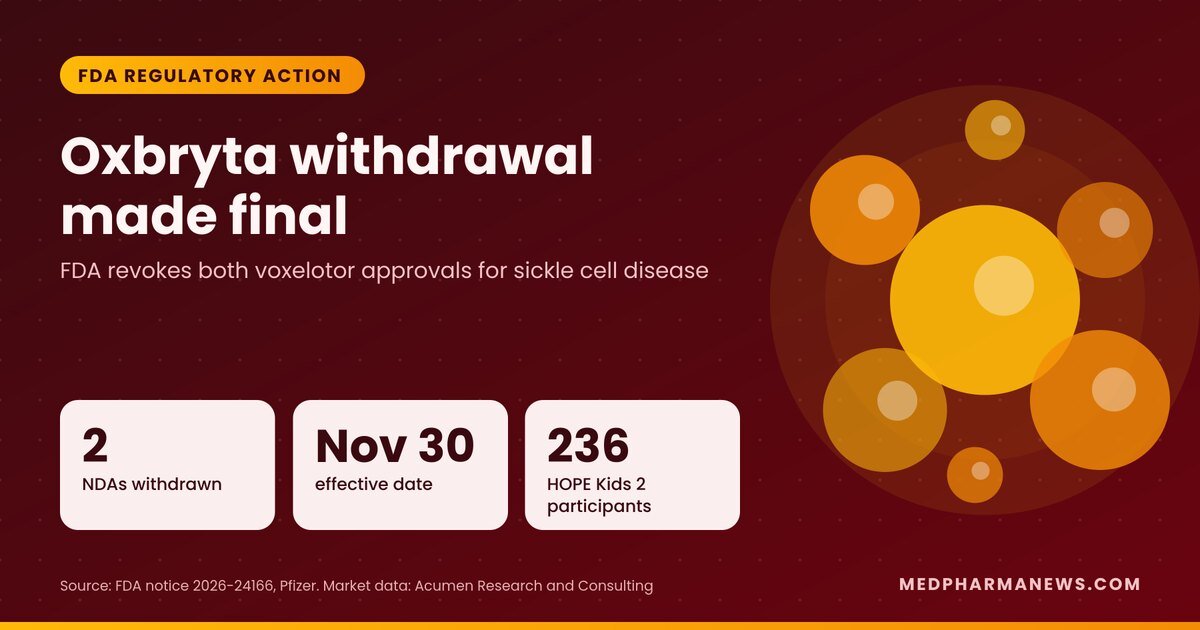
- FDA is withdrawing approval of NDA 213137 (300 mg and 500 mg tablets) and NDA 216157 (300 mg tablets for oral suspension).
- The notice, document 2026-24166, was filed for public inspection on 27 November and is scheduled for publication on 30 November 2026, when the withdrawal takes effect.
- The company itself requested withdrawal on 31 July 2026 and waived a hearing, according to reporting on the notice.
- Pfizer withdrew all Oxbryta lots worldwide on 25 September 2024, citing an imbalance in vaso-occlusive crises and fatal events.
- Patients who once took voxelotor should already have moved to other therapies; anyone unsure should speak with their haematologist.
From breakthrough to withdrawal: the Oxbryta timeline
| Date | Event |
|---|---|
| November 2019 | FDA grants accelerated approval for patients aged 12 and older, based on haemoglobin response |
| December 2021 | US label expanded to children aged 4 and older, including a dispersible tablet |
| February 2022 | European Commission authorises Oxbryta for haemolytic anaemia in sickle cell disease |
| October 2022 | Pfizer completes its roughly $5.4 billion acquisition of Global Blood Therapeutics |
| 25 September 2024 | Pfizer withdraws all lots worldwide and halts all voxelotor trials and access programmes |
| 31 July 2026 | Company requests that FDA withdraw both applications (as reported) |
| 27 November 2026 | FDA withdrawal notice filed for public inspection |
| 30 November 2026 | Scheduled Federal Register publication; withdrawal effective |
Why the drug failed its confirmatory test
Voxelotor was designed to stop sickling at its source. It binds to haemoglobin and increases its affinity for oxygen, which keeps the protein from polymerising and distorting red blood cells. That mechanism reliably raised haemoglobin levels, the surrogate endpoint FDA accepted in 2019. The open question was whether higher haemoglobin would translate into fewer pain crises, less organ damage and longer lives.
The confirmatory evidence pointed the other way. Pfizer said in 2024 that clinical trial and registry data suggested an imbalance in vaso-occlusive crises and fatal events, and that the drug’s benefit “no longer outweighs the risk” in the approved population. According to reporting on the new notice, the evidence base included the global phase 3 HOPE Kids 2 study, which enrolled 236 participants and has been terminated, and the RESOLVE leg-ulcer study. FDA concluded it could not identify any patient group in which benefits outweighed risks.
One hypothesis researchers have raised is that pushing haemoglobin to hold oxygen more tightly may reduce oxygen delivery to tissues, offsetting the gain from fewer sickled cells. That explanation has not been confirmed as the cause of the safety signal and should be treated as unproven.
What it means for accelerated approvals
Oxbryta sits alongside a short list of accelerated approvals that ended in full withdrawal. The pathway lets FDA clear drugs for serious diseases on a surrogate marker, on condition that later trials confirm clinical benefit. Critics have long argued that withdrawals take too long once confirmatory studies disappoint. Here, the commercial exit came quickly, within days of Pfizer’s review, but the formal legal withdrawal took more than two years.
For investors, the episode is also a costly footnote to Pfizer’s acquisition of Global Blood Therapeutics, which brought Oxbryta and the pipeline candidate inclacumab and osivelotor. It also raises the evidentiary bar for the next wave of sickle cell drugs, such as the pyruvate kinase activator covered in our report on Novo Nordisk’s etavopivat filing. Regulators are likely to look harder at clinical outcomes, not just haemoglobin gains.
Market context: sickle cell drugs
Acumen Research and Consulting valued the global sickle cell anemia drug market at USD 1.2 billion in 2022 and expects it to reach USD 1.8 billion by 2032, a 4% compound annual growth rate. Acumen says hydroxyurea held the largest share by drug type and North America led by region, with Asia-Pacific growing fastest. The report was last updated in April 2023, before Oxbryta’s withdrawal, so its forecast likely includes voxelotor sales that will not materialise; treat it as an indicative baseline.
Treatment options that remain
Patients and clinicians still have several approaches, each with its own trade-offs. Hydroxyurea remains the backbone oral therapy. L-glutamine and crizanlizumab are additional US options, and two one-time gene therapies, Casgevy and Lyfgenia, were approved in December 2023 for eligible patients aged 12 and older, though they require hospital-based conditioning and cost millions per patient. Choice depends on age, crisis frequency and access, and should be made with a sickle cell specialist. Pfizer’s medical information line remains available for questions about past Oxbryta use, and side effects can be reported to FDA MedWatch.
Questions people are asking
Why was Oxbryta taken off the market?
Pfizer withdrew it in September 2024 after data suggested more vaso-occlusive pain crises and deaths in patients taking voxelotor, leading the company to conclude the risks outweighed the benefits.
Is Oxbryta coming back?
No. The FDA notice withdraws both approved applications, so the drug cannot legally be marketed in the US without a completely new application.
When does the Oxbryta approval withdrawal take effect?
The notice is scheduled to publish in the Federal Register on 30 November 2026, which is the effective date reported for the withdrawal.
What should former Oxbryta patients do?
Pfizer advised patients to talk with their physicians about alternative treatment. Anyone who still has leftover tablets should not take them and should ask a pharmacist about safe disposal.
Read more in our Pharmaceuticals section.
Sources: Federal Register public inspection, document 2026-24166; Pfizer (25 September 2024). Market data: Acumen Research and Consulting. Not medical or investment advice. Last updated 28 November 2026.