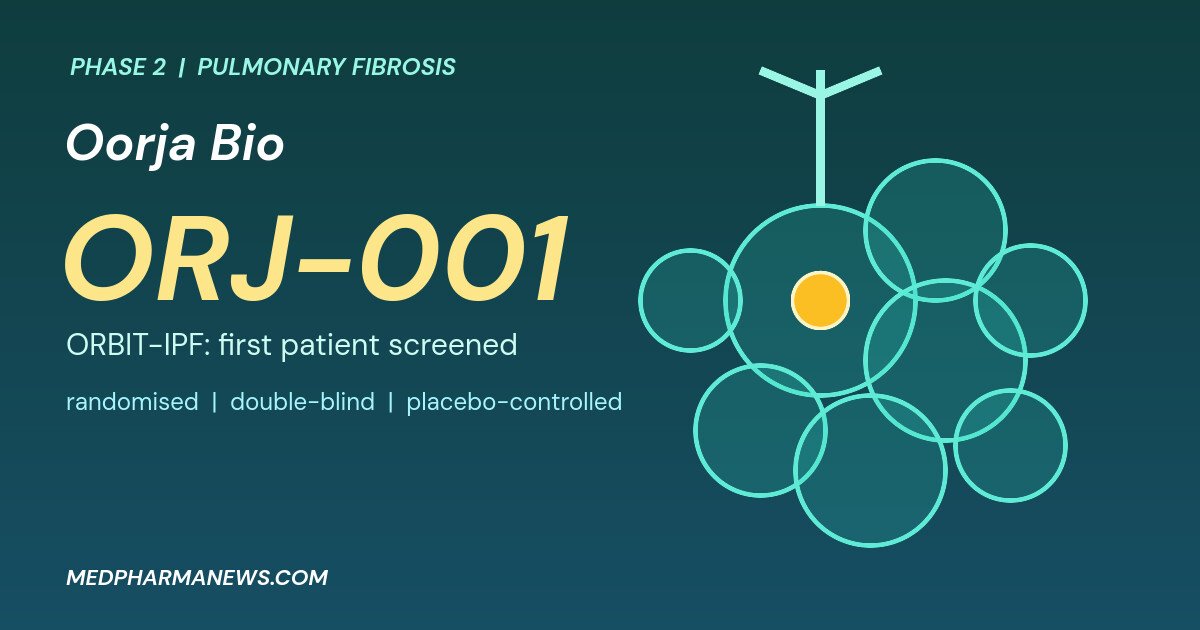
The ORJ-001 pulmonary fibrosis trial has opened its doors. On 13 October 2026, Houston-based Oorja Bio announced the start of the ORBIT-IPF study, a Phase 2 study of ORJ-001, an experimental peptide for idiopathic pulmonary fibrosis (IPF), and said the first patient has been screened. Screening is the step before enrolment, so the company is not yet reporting that anyone has been dosed.
The headline matters less than the question behind it. Existing IPF medicines slow the loss of lung function but do not reverse scarring, and ORJ-001 is built on a different idea: helping the lung’s own repair cells work again. Nothing in the announcement shows that it does. The trial has begun; the evidence has not.
Key takeaways
- Oorja Bio says the first patient has been screened in ORBIT-IPF, a Phase 2 study of ORJ-001.
- The study is randomised, double-blind, placebo-controlled and adaptive, with two parts.
- ORJ-001 is a twice-weekly injection under the skin; Part A runs for 12 weeks at two dose levels against placebo.
- The main efficacy measure in Part B is change in forced vital capacity (FVC) against placebo.
- No human efficacy results exist yet, and the release gives no timeline for data.
What the ORJ-001 pulmonary fibrosis trial is testing
IPF is a long-term lung disease in which tissue around the air sacs thickens and stiffens for reasons that are not known. The National Heart, Lung, and Blood Institute says it causes permanent scarring that makes breathing progressively harder and that there is currently no cure. Risk rises with age, smoking and family history.
ORJ-001 is described by the company as a first-in-class peptide that acts as an agonist of beta-1 integrin, a protein on the surface of alveolar epithelial type 2 (AEC2) cells. These cells help maintain and repair the lining of the air sacs. In the company’s account, nudging that pathway could restore AEC2 function, dampen inflammatory and fibrotic signalling and let damaged tissue repair. This is the sponsor’s hypothesis, supported so far by animal studies the company reports, not by data in patients with IPF.
How the ORJ-001 pulmonary fibrosis trial is designed
According to the company and the ClinicalTrials.gov record NCT07869147, ORBIT-IPF is a multicentre, multi-country trial with currently active sites in the United States. It will enrol adults with moderate IPF who either remain on standard care or have stopped it because of tolerability problems or an inadequate response.
- Part A: 12 weeks of ORJ-001 at two dose levels versus placebo, injected twice weekly. It looks at safety, tolerability, how the drug moves through the body (pharmacokinetics), its biological effects (pharmacodynamics) and a first read on efficacy.
- Part B: the primary efficacy endpoint is the change from baseline in FVC, the amount of air a person can forcefully exhale, compared with placebo. Details of Part B dosing and length were not given.
- Biomarkers: tenascin-C, linked to fibrosis, and surfactant protein D, linked to epithelial damage, are being tracked. The company says they belong to a panel under review by the US Food and Drug Administration as a possible scoring approach for IPF.
The total enrolment target, number of sites and data timelines are not stated in the release. An adaptive design means findings from the first part can shape the second, so the final study may look different from today’s outline.
What is known before the ORJ-001 pulmonary fibrosis trial reports results
In an earlier announcement, Oorja reported results from two Phase 1 studies in 64 healthy volunteers. It said no systemic toxicities were seen and that injection-site reactions were the most common side effects, mostly mild. Those are the company’s statements on healthy people, not IPF patients, and they say nothing about benefit.
In preclinical models the company reports that the drug reversed established fibrosis and compared favourably with the two approved IPF medicines, nintedanib and pirfenidone. Animal results often fail to carry over to patients, so we treat that comparison as a claim to be tested.
The NHLBI treatment guidance says nintedanib and pirfenidone are intended to support lung function and may slow progression, while oxygen therapy and lung transplant are options in advanced disease. That is the standard against which any new drug will be judged.
Our assessment of the ORJ-001 pulmonary fibrosis trial
In our assessment, the ORJ-001 pulmonary fibrosis trial is a meaningful step because it moves a repair-focused idea from animals into patients, and because it measures FVC, a standard lung-function test in IPF. It is also early. A 12-week safety and signal-finding phase can hint at benefit but rarely proves it, and many drugs that looked promising in preclinical work have not held up in patients.
Funding is another factor to note: the release cites a 34 million dollar Series A from Westlake BioPartners and Andreessen Horowitz, while the company’s launch announcement in May described 30 million dollars; we use the figure in the latest release. For another example of a young biotech moving a platform toward people, see our report on Soufflé Therapeutics’ $135 million funding for RNA treatments, or browse more pharmaceutical news.
Risks and caveats of the ORJ-001 pulmonary fibrosis trial
- Screening one patient is not enrolment, dosing or evidence of benefit.
- Safety data so far come from healthy volunteers, not people with IPF.
- Preclinical comparisons with approved drugs may not hold in patients.
- Enrolment size, sites and readout timing have not been disclosed.
What to watch after the ORJ-001 pulmonary fibrosis trial begins
- Updates to the ClinicalTrials.gov record, including enrolment numbers and sites.
- Any safety signal or dose decision at the end of Part A.
- FVC and biomarker data from the study.
- Regulatory feedback on the biomarker panel.
Frequently asked questions about the ORJ-001 pulmonary fibrosis trial
What is ORJ-001?
An experimental peptide given by injection under the skin, designed to restore the function of AEC2 cells in the lungs of people with idiopathic pulmonary fibrosis.
What has happened in the trial so far?
The company says the first patient has been screened. It has not said that any patient has been enrolled or dosed.
What is the trial design?
A randomised, double-blind, placebo-controlled, adaptive study in two parts, with twice-weekly injections at two dose levels in Part A over 12 weeks.
Does ORJ-001 work?
That is not known. No efficacy results in people with IPF have been reported.
Who can join the ORJ-001 pulmonary fibrosis trial?
Adults with moderate IPF who are on standard care or have stopped it for tolerability or inadequate response. Check the trial record for current criteria and sites.
How we reported this: we relied on Oorja Bio’s 13 October 2026 announcement, its earlier company announcements and the ClinicalTrials.gov record. These are company statements. Last updated: 14 October 2026. This article is news reporting and not medical advice.