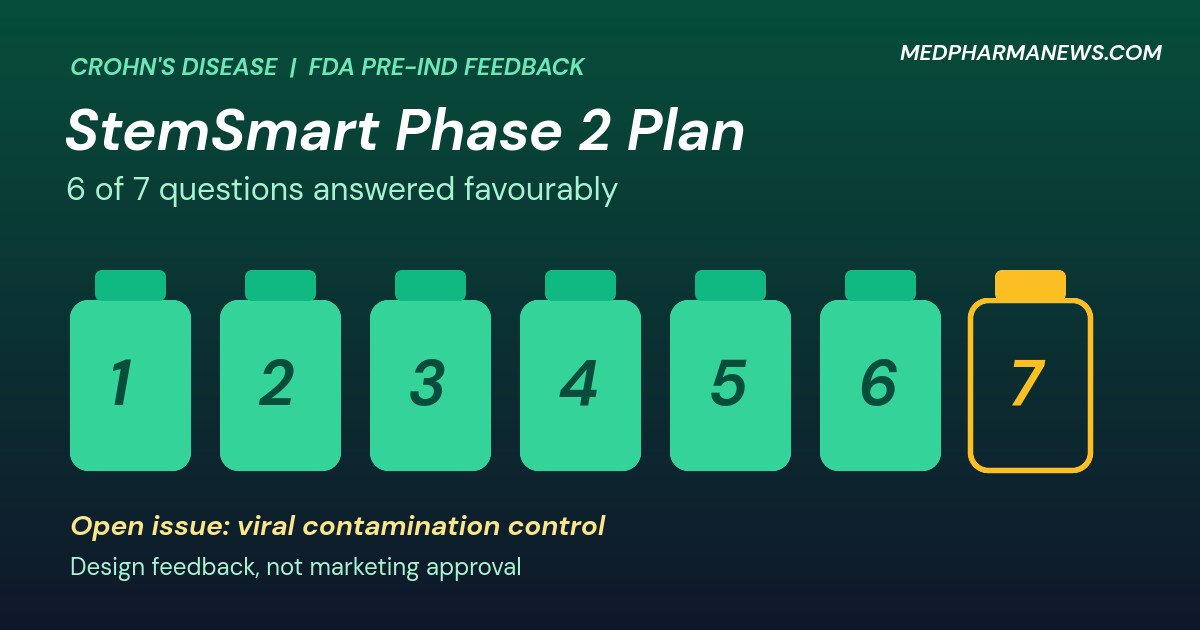
The StemSmart Crohn’s disease clinical trial has taken a regulatory step forward. NeuroScientific Biopharmaceuticals (ASX: NSB) said in an announcement dated 13 October 2026 that the US Food and Drug Administration (FDA) responded favourably to six of the seven questions it submitted about a planned Phase 2 study of StemSmart, an experimental stem cell therapy, in treatment-resistant Crohn’s disease. The company says the regulator agreed with the proposed trial but wants more work on one manufacturing issue.
This is feedback on a plan, not an approval. StemSmart is not authorised for sale in the United States, the Phase 2 study has not started, and the open question is a safety-related manufacturing control: how the product is shown to be free from viral contamination. Everything below about the FDA feedback comes from the company, and we have not seen the FDA’s written response.
StemSmart Crohn’s disease clinical trial: what the FDA said
- Questions answered favourably: six of seven, according to the company.
- Trial design: the company says the FDA agreed with the proposed study in treatment-resistant Crohn’s disease.
- Existing human evidence: reported as accepted by the regulator.
- Release-testing strategy: the plan for testing each batch of StemSmart before it is used was reported as accepted.
- Further laboratory studies: the company says no additional non-clinical studies were required.
- Open issue: the control strategy to ensure StemSmart is free from viral contamination.
The company says it agrees with the FDA’s feedback, is putting the required testing in place and expects only a minimal effect on timelines. That is an expectation, not a commitment from the regulator.
What the FDA pre-IND meeting means for the StemSmart Crohn’s disease clinical trial
Before a company can test an experimental drug in people in the United States, it normally files an Investigational New Drug (IND) application. A pre-IND meeting comes earlier. It lets a company put specific questions to the agency about its manufacturing, animal and laboratory data, and trial design, so that gaps are found before the formal filing. The process is described in FDA’s overview of the IND process.
Two points matter for readers. First, pre-IND advice is not binding approval; the agency reviews the actual application when it arrives. Second, once an IND is submitted, a study can generally begin 30 days later unless the FDA places it on clinical hold, which is why the manufacturing issue matters. The company had earlier said the face-to-face meeting was set for 31 August 2026, and the outcome has now been announced.
What StemSmart is
According to the company, StemSmart is made from mesenchymal stem cells (MSCs) taken from the bone marrow of adult donors, using a patented manufacturing process developed at Royal Perth Hospital in Western Australia, which the company says is designed to improve therapeutic activity and clinical response. Because the cells come from donors, not from the patient receiving them, the product is described as allogeneic. MSCs have been studied for their ability to influence immune responses, which is the reason they are tested in inflammatory diseases.
In the United States, products of this kind are regulated as cellular therapies, a category the FDA oversees under its cellular and gene therapy products programme. The company’s announcement, as we saw it, gave no detailed mechanism for StemSmart in Crohn’s disease.
Why treatment-resistant Crohn’s disease needs new options
Crohn’s disease is a chronic inflammatory bowel disease that can affect any part of the digestive tract, causing pain, diarrhoea, weight loss and fatigue, as explained by the US National Institute of Diabetes and Digestive and Kidney Diseases. Treatment-resistant, or refractory, disease means patients have not responded adequately to standard therapies. A related form is fistulising Crohn’s disease, in which abnormal tunnels form between the bowel and the skin or other organs; these can be hard to heal.
That unmet need is the company’s case for the programme. It is also why regulators tend to look carefully at claims in this area: patients with long-standing disease may be willing to try an unproven treatment, so trial design and safety standards need to be strong.
What is still unknown about the StemSmart Crohn’s disease clinical trial
- Size and design: the announcement did not give patient numbers, the number of treatment groups, whether there will be a placebo group, the dose or the length of treatment.
- Endpoints: one version of the announcement says the trial will assess safety and preliminary efficacy; the main measures are not stated.
- Population: the company describes the target as refractory Crohn’s disease, and one version adds “and/or fistulising” disease, so the exact enrolment criteria are unclear.
- Sites and start date: the study is planned for Australia and the United States, with a target of starting by the end of 2026, subject to regulatory, manufacturing and operational requirements.
- Registration: we found no public trial registration. Registered studies appear on ClinicalTrials.gov.
- Prior human data: the company says the FDA accepted the existing human evidence, but the release does not describe it. An earlier summary reported an Australian special-access approval covering the first three patients with fistulising disease; we could not tie this to the original announcement, so treat it as unverified.
Our assessment of the StemSmart Crohn’s disease clinical trial
In our assessment, the StemSmart Crohn’s disease clinical trial is at an early and uncertain stage. A favourable response to six of seven questions is a good sign for the trial design, and agreement on the plan for testing each batch suggests the basic manufacturing approach is not in dispute. But the viral contamination control is the kind of issue that can take months to settle, and the target of starting by the end of 2026 depends on finishing that testing, filing the IND and having it take effect. By our reading, that schedule leaves little margin, though the company says the effect on timelines will be minimal.
The bigger scientific question is whether donor stem cells help patients at all, which only a controlled study can show. For other recent clinical-stage cell therapy news, see our report on the experimental eye treatment CSB-001, or browse our pharmaceuticals coverage.
What to watch next in the StemSmart Crohn’s disease clinical trial
- Completion of the viral contamination testing the FDA asked for.
- Submission of the IND application and any FDA response.
- Publication of the protocol: size, control group and endpoints.
- Registration of the study and recruitment of the first patient in Australia or the United States.
- Company updates through the Australian Securities Exchange announcements platform.
Frequently asked questions
What is the StemSmart Crohn’s disease clinical trial?
A planned Phase 2 study of StemSmart, a donor bone-marrow stem cell therapy, in treatment-resistant Crohn’s disease, to be run in Australia and the United States.
What did the FDA say about the StemSmart Crohn’s disease clinical trial?
According to NeuroScientific, the FDA responded favourably to six of seven questions, accepted the proposed design, and asked for more control over viral contamination.
Is StemSmart approved in the United States?
No. Feedback on a trial plan is not marketing approval.
When will the StemSmart Crohn’s disease clinical trial start?
The company is targeting the end of 2026, subject to regulatory, manufacturing and operational requirements.
Does news about the StemSmart Crohn’s disease clinical trial show that StemSmart works?
No. It concerns the design of a future study, not results.
How we reported this: we relied on the company’s 13 October 2026 announcement as published in full or summarised by distribution services, and on public regulatory information from the FDA. We did not see the FDA’s letter or the trial protocol. Last updated: 13 October 2026. This article is news reporting and not medical advice.