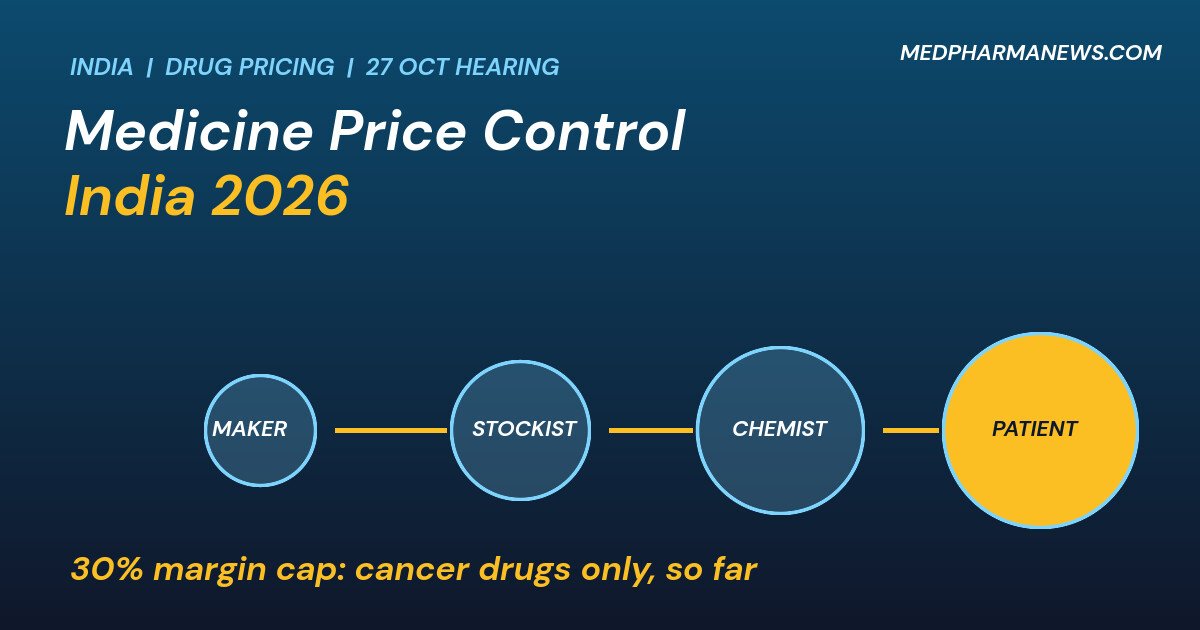
Drugmakers, distributors, hospitals and patients all have a reason to watch 27 October. That is the date the Supreme Court has fixed to hear the government’s plan again after judges questioned why a new 30% trade-margin cap applies only to certain cancer medicines. The debate over medicine price control India 2026 is not settled, and nothing on 12 October created a universal cap, but the bench has made clear it wants the government to explain why one category of drugs is treated differently from the rest.
Instead of retelling the hearing line by line, this article looks at what the exchange could mean for each part of the supply chain, where the facts are firm and where they are not, and the questions to ask when the court sits again.
Medicine price control India 2026: the short version
- On 12 October 2026, a bench of Justices Vikram Nath and Sandeep Mehta heard petitions on medicine pricing, generics and device costs.
- The Centre said it would cap trade margins on anti-cancer drugs at 30% of the maximum retail price (MRP), a step it values at around ₹2,500 crore a year in patient savings.
- The judges said the response offered “hardly anything to be happy about” and asked why other medicines could not be treated alike.
- The government replied that margins help medicines reach remote areas and that it does not want to control the entire drug ecosystem.
- The matter returns on 27 October. No wider cap has been ordered or announced.
The legal backdrop to medicine price control India 2026
Context helps here. Under the Drugs (Prices Control) Order, 2013, medicines on the National List of Essential Medicines, called scheduled drugs, have ceiling prices. According to the Centre’s affidavit as reported, the 2022 list contains 388 drugs and more than 900 formulations, and ceiling prices exist for 935 formulations. Those ceilings are built from the average retail price of leading brands and generics, plus a 16% margin.
Everything outside the list is non-scheduled. For those products the price regulator, the National Pharmaceutical Pricing Authority, mainly watches that MRPs do not climb more than 10% in a twelve-month period. That is a limit on increases, not on the starting price, which is exactly the gap the judges keep returning to. More background on the regulator is on NPPA’s website.
Why the bench is not satisfied with medicine price control India 2026
The judges did not argue in the abstract. They quoted examples: a saline drip with an MRP of ₹270 against a cost of ₹11, a cardiac stent costing about ₹5,000 sold for more than ₹25,000, and an antibiotic priced at over ₹70 against a cost near ₹28. The Solicitor General answered that stents already have price caps. We have not independently verified any of these numbers, and they should be read as claims made in court.
The court’s earlier hearings set the tone. In late September, the bench used strong language about a tenfold gap between the retail and MRP price of an essential cancer medicine, and asked why one margin could not fit all medicines. It also asked the government to look at hospitals that tell patients to buy only from in-house pharmacies. In our assessment, the 30% cancer cap looks, to the bench, like a partial answer to a general problem.
Medicine price control India 2026: what changes for each group
Manufacturers
A margin cap does not directly set a company’s MRP, but it changes the arithmetic of how the MRP is built. If the retail and wholesale share is capped, a company that wants to keep the same trade incentive must either lower the MRP or accept a thinner channel. Any broader rule would be felt first by firms selling branded products with large channel margins. Industry bodies have not commented in the reports we reviewed.
Distributors and chemists
These businesses earn through the margin the government now wants to cap. The Centre’s lawyers stressed that thin margins could discourage supply to remote areas, and in our view that argument will be tested hard if the court asks for evidence.
Hospitals
The bench’s remarks on device pricing and in-house pharmacies suggest hospitals are part of the conversation even though the 30% cap itself addresses cancer drugs. We have seen no direction to hospitals yet, but healthcare providers should expect questions about billing. Readers following healthcare finance can compare the issue with our report on prescription subscription plans and drug affordability in the US.
Patients
For cancer patients, price relief depends on which drugs are on the notified list, when it takes effect, and whether the lower MRP actually appears on packs. None of that was clear in the reports we reviewed. Patients should not stop or switch treatment because of a pricing change and should ask the treating oncologist for guidance.
Three ways medicine price control India 2026 could move on 27 October
These scenarios are our own framing, not forecasts, and the court may do something else entirely.
- The Centre comes back with a wider plan. That could mean extending margin limits to more medicines or clarifying how devices are handled.
- The Centre defends a narrow cap. It could present evidence on remote-area supply and ask for time, leading to another hearing.
- The court issues directions. Judges could order specific steps, though they have so far asked questions rather than set rules.
What we do not know about medicine price control India 2026
- The date and legal instrument for the cancer drug cap. One account refers to Paragraph 19 of the DPCO and an 8 October pricing authority meeting; others do not.
- How many cancer drugs are covered, and which.
- Whether the Solicitor General’s “modalities” will reach beyond cancer medicines.
- Any estimate of what a wider cap would cost or save.
Related industry coverage is in our pharmaceuticals section, including the Sahajanand Medical Technologies IPO price band for readers tracking Indian medtech valuations. Official updates appear on the Supreme Court’s website and the Department of Pharmaceuticals; policy statements may also come from the Ministry of Health and Family Welfare.
Frequently asked questions
Is medicine price control India 2026 a cap on all medicines?
No. The court asked the question, but the government has not announced a universal cap.
What did the government announce for cancer medicines?
A 30% limit on trade margins, measured against MRP, for anti-cancer drugs.
How does medicine price control India 2026 affect hospitals?
Not directly yet. The judges have raised hospital billing and pharmacy practices, but no direction has been issued.
When is the next hearing on medicine price control India 2026?
27 October 2026.
How we reported this: we relied on reports of the 12 October 2026 hearing and earlier hearings. We did not read the court record. Scenarios and interpretations are labelled as ours. Last updated: 13 October 2026. This article is news reporting and not legal, financial or medical advice.