Good headline numbers do not always survive a closer look, and the new obuprazine schizophrenia clinical trial is a useful test case. On 12 October 2026, Tortugas Neuroscience of Massachusetts announced that its experimental antipsychotic obuprazine (TRTL-107) met its main goal in a Phase 2b study run by Chinese partner Hansoh Pharma. This article sets each claim from the announcement beside the evidence offered for it, so readers can see what is established, what is suggested and what is missing.
The drug is investigational. Nothing here means it has been approved or will be, and the data have not been peer reviewed.
Obuprazine schizophrenia clinical trial claim 1: “All three doses beat placebo”
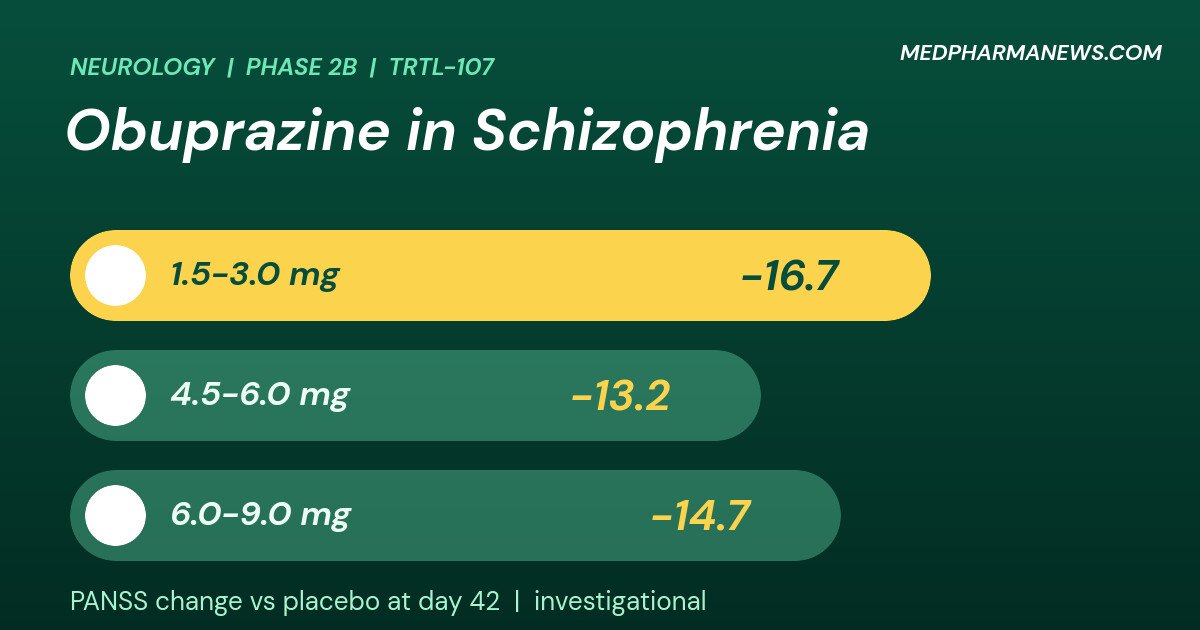
What the evidence shows: true, as reported. The study enrolled 363 hospitalised adults with acute schizophrenia at 24 centres in China and randomised them to one of three obuprazine dose ranges (1.5 to 3.0 mg, 4.5 to 6.0 mg or 6.0 to 9.0 mg), the older drug aripiprazole, or placebo. After 42 days, the placebo-adjusted fall in the PANSS total score was 16.7, 13.2 and 14.7 points respectively. Every comparison was reported at p below 0.0001, and one summary lists 95% confidence intervals that stay clear of zero, such as 10.9 to 22.5 points for the lowest range.
What remains uncertain: the effect in the obuprazine schizophrenia clinical trial is not neatly dose-related. The lowest range did best, which can happen in a trial of this size but makes it harder to know which dose to take forward. The announcement did not say how many patients were in each arm. Dividing 363 by five gives roughly 73, though that is our rough estimate only.
Obuprazine schizophrenia clinical trial claim 2: “The strongest dose improved symptoms by 16.7 points”
What the evidence shows: the arithmetic holds. Patients on the lowest range improved by an average of 28.6 PANSS points, while placebo patients improved by 11.9, leaving 16.7. The scale runs from 30 to 210, so these are sizeable moves.
What remains uncertain: the placebo group also improved markedly. In our calculation, placebo captured about two-fifths of the improvement seen on the lowest range. That is not unusual in short inpatient studies, but it means the adjusted gap, not the raw fall, is the number to trust. And the 16.7 figure applies to one dose range, not to the drug as a whole.
Claim 3: “Broad symptom improvement and rapid onset”
What the evidence shows: at day 42, all dose ranges improved positive symptoms, negative symptoms and the Marder cognitive factor against placebo. For the lowest range, positive and negative subscales improved by 5.3 and 4.4 points over placebo. Responder rates (a drop of 50% or more) were higher than placebo and aripiprazole in the two lower dose groups by day 14.
What remains uncertain: no responder percentages were published in the summaries we reviewed, and early response was not reported for the highest dose. “Rapid” is a fair description only if the missing numbers support it.
Obuprazine schizophrenia clinical trial claim 4: “Numerically better than aripiprazole”
What the evidence shows: the company says obuprazine was numerically ahead of aripiprazole on several measures. One summary gives the aripiprazole placebo-adjusted effect as 12.1 points.
What remains uncertain: numerically better is not the same as better. The announcement does not claim a statistically significant difference, the reported confidence intervals overlap, and the trial was not described as designed to prove superiority. Readers should not treat this as a head-to-head win. A study built to compare the two drugs directly would need more patients and a pre-specified comparison, which is something later trials may provide.
Obuprazine schizophrenia clinical trial claim 5: “Generally well tolerated”
What the evidence shows: about 2.1% of obuprazine patients and 2.5% of placebo patients stopped because of adverse events, and Hansoh reports mostly mild to moderate events with no new significant concerns.
What remains uncertain: a lot. Weight gain, akathisia, movement disorders, sedation and prolactin elevation, the problems that most often shape antipsychotic choice, were not disclosed. Six weeks is also too short to judge long-term safety, and schizophrenia is a lifelong condition for many people, so questions about weight, metabolic effects and staying on treatment for years cannot be answered by a study this short.
The obuprazine schizophrenia clinical trial in context
Obuprazine is described as a dopamine D2/D3 partial agonist, a 5-HT1A partial agonist and a 5-HT2A antagonist. Tortugas has global commercial development rights outside Greater China, with Hansoh keeping those in China; financial terms were not disclosed. The results were presented at the 2026 ECNP Congress, and the company has promised a peer-reviewed publication. Its chief executive, Jeff Jonas, called the results among the most compelling efficacy datasets in schizophrenia in recent years, which is a company statement and should be read that way. Details of the programme may appear on Tortugas’ news page and Hansoh’s website.
What happens next after the obuprazine schizophrenia clinical trial
- US IND filing: Tortugas plans to submit an application, which, as explained on FDA’s explanation of the IND process, is permission to begin human trials in the US, not an approval.
- Full publication: the peer-reviewed paper should show per-arm numbers, safety tables and responder rates.
- Larger studies: Hansoh says the results support moving towards Phase 3. No timelines were given.
Existing treatment options are also changing. See our report on the FDA approval of Teva’s monthly schizophrenia injection Weltruza and our wider pharmaceuticals news.
Verdict on the obuprazine schizophrenia clinical trial, in one paragraph
In our assessment, the Phase 2b result is a credible early signal: consistent separation from placebo across doses, with effects on symptom domains beyond hallucinations and delusions. The caveats, namely a single country, six weeks, a heavy placebo response and absent safety detail, are the usual ones for this stage. The real test comes when the data are published and a Western trial begins. Until then, the sensible reading is cautious optimism: the drug appears to work in this population over six weeks, but how it compares with established treatments, and what it costs patients in side effects, is still open.
Frequently asked questions
What is obuprazine?
An investigational antipsychotic, also known as TRTL-107, with D2/D3 and 5-HT1A partial agonist and 5-HT2A antagonist activity.
How big was the obuprazine schizophrenia clinical trial?
It enrolled 363 adults with acute schizophrenia at 24 centres in China.
Is obuprazine approved by the FDA?
No. Tortugas plans to submit an IND application, the first regulatory step towards US trials.
How long did the obuprazine schizophrenia clinical trial last?
Six weeks, with the main endpoint measured at day 42.
How we reported this: we relied on the company announcement of 12 October 2026 and on summaries of the trial data, and did not read the full study. Interpretations are labelled as ours. Last updated: 13 October 2026. This article is news reporting and not medical advice.