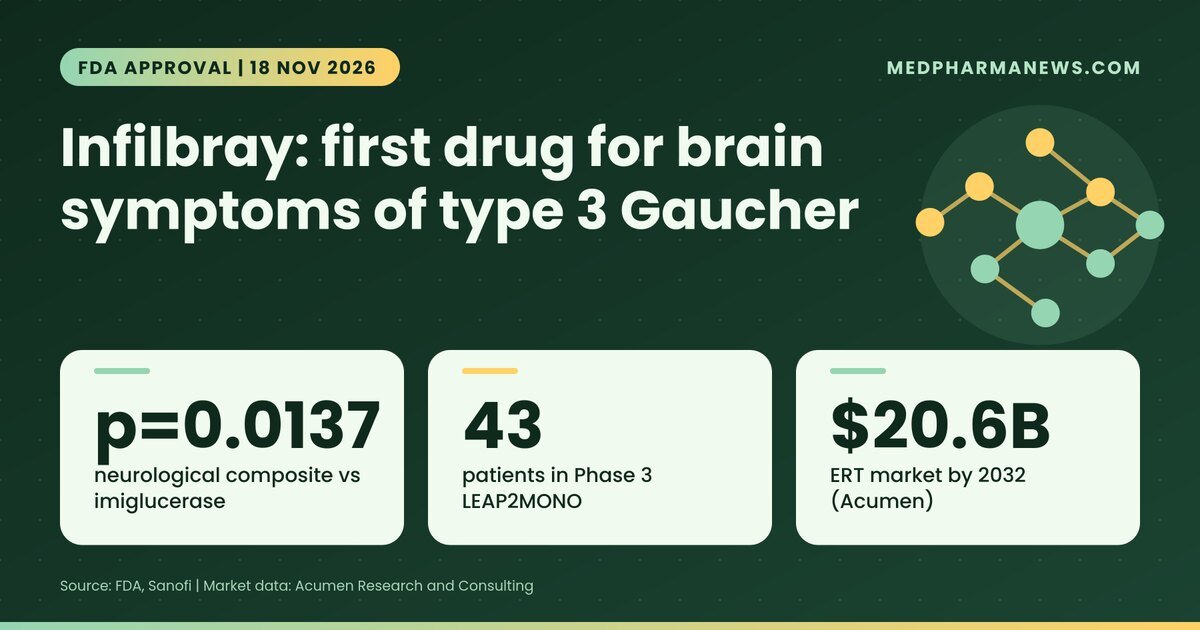
The Infilbray FDA approval, announced on 18 November 2026, makes Sanofi’s once-daily venglustat tablet the first medicine cleared in the US to treat the neurological manifestations of type 3 Gaucher disease (GD3), in adults and children weighing at least 15 kg. The decision rests on LEAP2MONO, a 43-patient Phase 3 trial in which switching to the oral drug beat continued intravenous enzyme replacement therapy on a combined test of movement and cognition (p=0.0137) at 52 weeks.
Key takeaways on the Infilbray FDA approval
- First approved therapy aimed at the brain-related symptoms of GD3, such as ataxia and cognitive decline.
- Venglustat is a brain-penetrant glucosylceramide synthase inhibitor taken by mouth once a day.
- In LEAP2MONO, Infilbray was superior to IV imiglucerase on a prespecified global test of mSARA motor scores and RBANS cognition scores.
- Label warnings cover suicidal ideation and behaviour, lens clouding in children and harm to a developing fetus.
- Sanofi now sells both the new pill and Cerezyme, the enzyme therapy it was tested against.
Why GD3 needed a different kind of drug
Gaucher disease is an inherited shortage of the enzyme glucocerebrosidase, which lets fatty substances called glycosphingolipids pile up in cells. For three decades, intravenous enzyme replacement therapy (ERT) has controlled the body-wide problems: enlarged spleen and liver, anaemia, low platelets and bone disease. The enzyme is a large protein, however, and does not cross the blood-brain barrier. People with type 3, the chronic neuronopathic form, can therefore have well-controlled blood counts and organ size while their coordination, eye movements and thinking still deteriorate. Acting FDA Commissioner Kyle Diamantas summed up the problem as harmful substances building up in the brain “without a way to stop them”.
Venglustat attacks the problem from the supply side. Instead of replacing the missing enzyme, it slows production of glucosylceramide, the substrate that accumulates, and because it is a small molecule it reaches the central nervous system. The FDA describes this as reducing fatty-substance buildup in both the body and the brain.
Inside the LEAP2MONO trial
| Design element | Detail |
|---|---|
| Trial | LEAP2MONO, Phase 3, NCT05222906 |
| Design | Randomized 1:1, double-blind, double-dummy, active comparator |
| Patients | 43 aged 12+, on ERT for at least 3 years with systemic disease at goal |
| Arms | Oral venglustat daily (n=21) vs IV imiglucerase every 2 weeks (n=22) |
| Primary endpoint | Global O’Brien OLS test combining 4-item mSARA (motor) and RBANS total index (cognition) at week 52 |
| Result | Superiority for venglustat, p=0.0137 |
| Other endpoints | Spleen and liver volume, haemoglobin, platelets; CSF and plasma GL-1 and lyso-GL-1 |
Two points stand out. The comparator was the standard of care rather than placebo, which makes the win commercially meaningful: patients did not simply avoid getting worse, they did better on the neurological composite than those who stayed on infusions. On the other hand, neither Sanofi nor the FDA has published the size of the improvement on each scale, nor whether systemic control (spleen, blood counts) held up after patients stopped ERT. Those numbers will shape how neurologists use the drug, and they should appear in the prescribing information and a peer-reviewed paper.
Safety profile and label warnings
| Adverse reaction | Infilbray (n=21) | Imiglucerase (n=22) |
|---|---|---|
| Diarrhoea | 14% | 0% |
| Splenomegaly | 14% | 0% |
| Nausea | 14% | 5% |
| Depression | 10% | 0% |
| Gastroenteritis | 10% | 0% |
| Vomiting | 10% | 5% |
With about 21 patients per arm, each percentage point here represents a fraction of one person, so 14% means three patients. Even so, the splenomegaly signal deserves attention, because spleen control is exactly what ERT provides and what doctors will monitor after a switch. The psychiatric warning, covering suicidal ideation and behaviour, and the depression rate mean mood monitoring is likely to become part of routine follow-up. Animal findings also prompted warnings on lens opacification in younger patients and embryofetal toxicity.
The business angle: Sanofi competing with itself
Sanofi, through Genzyme, built the Gaucher market with Ceredase and then Cerezyme, and it also sells the oral substrate-reduction pill Cerdelga for type 1 disease. Infilbray lets the company defend that franchise as competitors and biosimilar-style pressure grow, while shifting the most complex patients onto a convenient tablet. Venglustat had a rocky path elsewhere: Sanofi halted earlier programmes in GBA-associated Parkinson’s disease and polycystic kidney disease. GD3 is a narrow but high-need niche where the brain-penetrant design finally paid off. The drug carried Breakthrough Therapy, Fast Track, Rare Pediatric Disease and orphan designations and received priority review. Reviews are under way in the EU and Japan, with more filings planned through 2027.
The approval lands a day after the FDA cleared a first survival-extending drug for infantile Niemann-Pick type C, another lysosomal storage disorder, underscoring a busy month for rare neurological disease. For related deal flow, see our coverage of Sanofi’s Seawolf partnership.
Market context
According to Acumen Research and Consulting, the global enzyme replacement therapy market was worth US$10.1 billion in 2022 and is projected to reach US$20.6 billion by 2032, a compound annual growth rate of 7.6%. Acumen identifies Gaucher disease as the indication with the largest share of ERT revenue in 2022. Oral substrate-reduction drugs such as Infilbray are the main structural threat to infusion-based revenue in that segment, especially where the pill addresses a need ERT cannot.
FAQ
What is Infilbray used for?
Infilbray (venglustat) is approved in the US to treat neurological manifestations of type 3 Gaucher disease in adults and in children who weigh at least 15 kg.
Does Infilbray replace enzyme replacement therapy?
In LEAP2MONO, patients stable on ERT switched to venglustat alone and did better on neurological measures. Whether an individual patient stops infusions is a decision for their specialist, who will also monitor spleen size and blood counts.
How is Infilbray taken?
It is an oral tablet taken once a day, compared with intravenous ERT infusions every two weeks.
Is Infilbray approved in Europe?
Not yet. Sanofi says applications for GD3 are under review in the EU and Japan, where the drug already holds orphan designation.
Sources: FDA press announcement and Sanofi press release, 18 November 2026. Market data: Acumen Research and Consulting. More in Pharmaceuticals. Not medical or investment advice. Last updated 19 November 2026.