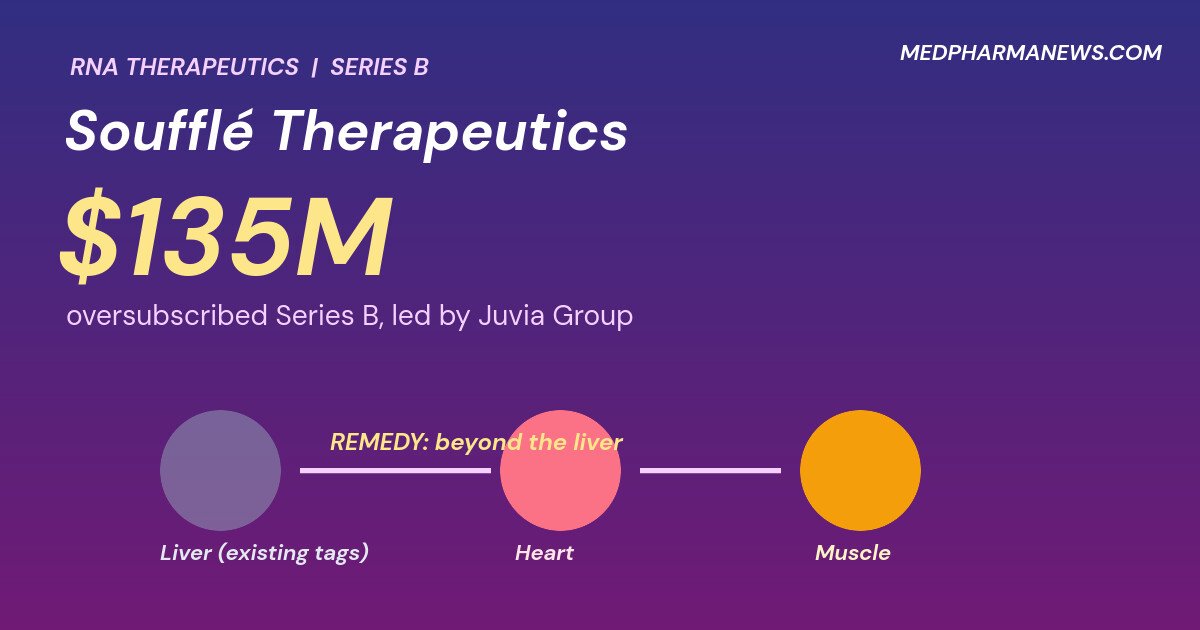
The Soufflé Therapeutics $135 million funding round is a bet that RNA medicines can be steered to muscle and heart cells, not only to the liver, where nearly all of today’s approved RNA interference drugs work. On 13 October 2026, Soufflé Therapeutics announced an oversubscribed $135 million Series B financing, led by Juvia Group, to move three lead programmes into clinical studies and to continue preclinical work in other cell types and tissues. The programmes target facioscapulohumeral muscular dystrophy (FSHD), heart failure and a muscle or metabolic disorder.
The treatments are experimental. The announcement reports no new human efficacy results, so the money is a vote of confidence in a delivery technology and not evidence that any drug works. Below is what was announced, what the REMEDY platform is meant to do and what to be careful about.
Key takeaways
- Soufflé raised $135 million in an oversubscribed Series B led by Juvia Group.
- Funds go to three lead programmes, FSHD, heart failure with reduced ejection fraction and a muscle or metabolic disorder, and to earlier work.
- Soufflé’s REMEDY platform is designed to deliver oligonucleotide drugs, such as siRNA, to specific cells outside the liver.
- No new clinical efficacy data were reported; the drugs are investigational.
Who backed the Soufflé Therapeutics $135 million funding round
Juvia Group, which says it was founded in 2026, led the round. New investors named are TCG Crossover, BB Biotech, Fidelity Management & Research Company, Balyasny Asset Management and an unnamed sovereign wealth fund. Existing investors that took part include Amgen Ventures, ARCH Venture Partners, Bessemer Venture Partners, Breyer Capital, The Invus Group, Janus Henderson, Leaps by Bayer, Polaris Partners, Safar Partners, TAS Partners, Temasek and Vida Ventures. The release does not state earlier funding totals or a valuation.
Amir Nashat, Soufflé’s chief executive, said the investors’ confidence supports the company’s belief in REMEDY. Stefan Vitorovic of Juvia Group said cell-selective delivery could change what medicines can achieve across many diseases. These are statements from the company and its investors.
The delivery problem behind the Soufflé Therapeutics $135 million funding
RNA interference drugs, which silence specific genes, have worked best in the liver because a sugar-based tag attached to the drug is taken up efficiently by liver cells. Other tissues are harder. Muscle and heart cells are protected by membranes and have different uptake pathways, so drugs given by injection or infusion often fail to reach them in useful amounts. Companies have been trying to attach RNA drugs to antibodies or other binding molecules that latch on to receptors on the target cell and carry the cargo inside.
Soufflé says its REMEDY (Receptor Mediated Delivery) platform identifies receptors that move into cells, makes proprietary binders such as antibodies or other ligands for them, and uses these to deliver oligonucleotide therapies to chosen tissues. Its website describes the same capabilities, receptor identification, ligand optimisation and siRNA engineering, without using the REMEDY name. Whether the approach works safely in people remains to be shown.
The three programmes the Soufflé Therapeutics $135 million funding supports
- FSHD: the most advanced programme, aimed at striated muscle. The company says no disease-modifying therapies are approved for FSHD. MedlinePlus describes FSHD as an inherited muscle disease that causes progressive weakness, often starting in the face, shoulders and upper arms.
- Heart failure with reduced ejection fraction: targets the phospholamban (PLN) gene in heart muscle cells. The National Heart, Lung, and Blood Institute explains that heart failure means the heart cannot pump enough blood for the body’s needs.
- Muscle and metabolic disorders: a third programme whose target has not been disclosed.
The company’s website also lists a strategic collaboration with Bayer, announced on 8 January 2026, on a heart-targeted siRNA therapy. The release does not give terms. For comparison with another RNA-focused company at an earlier financing stage, see our report on City Therapeutics eyeing a valuation of up to $956.3 million in a US IPO.
Clinical stage behind the Soufflé Therapeutics $135 million funding
The financing release says the first clinical study in FSHD is planned. The company’s website says the company has begun enrolling clinical trials in 2026. These descriptions do not clearly match, and neither gives trial phases, doses, endpoints or timelines, so we cannot say whether a study has started. We treat the stage as early and unconfirmed until a trial registry entry or company update says otherwise.
Our assessment of the Soufflé Therapeutics $135 million funding
In our assessment, the Soufflé Therapeutics $135 million funding is notable for its investor mix, which includes crossover funds and several pharma-linked venture arms, a pattern that often precedes later-stage financing or an IPO. The scientific risk is high. Extrahepatic delivery of RNA has proved hard, and hitting two very different tissues, muscle and heart, with one platform is an ambitious claim. Success will depend on whether the first human studies show that enough drug reaches the target cells, that it silences the gene as intended and that it is safe on repeated dosing. For related coverage, see our report on a home study of Lasix ONYU in heart failure, or browse more industry insights.
Risks and caveats of the Soufflé Therapeutics $135 million funding
- No human efficacy data accompany the announcement.
- Delivery to heart and muscle is technically difficult, and earlier attempts have struggled.
- Financing size does not predict clinical success.
- The target for the third programme and the timing of trials are undisclosed.
What to watch after the Soufflé Therapeutics $135 million funding
- Trial registry entries for the FSHD and heart failure studies.
- First safety and target-engagement data.
- Disclosure of the third programme’s target.
- Progress of the Bayer collaboration.
Frequently asked questions about the Soufflé Therapeutics $135 million funding
How much did Soufflé Therapeutics raise?
$135 million in an oversubscribed Series B financing, announced on 13 October 2026 and led by Juvia Group.
What will the money be used for?
To advance three lead programmes into clinical studies and to continue preclinical work in other cell types and tissues.
What is REMEDY?
Soufflé’s Receptor Mediated Delivery platform, designed to deliver oligonucleotide drugs to specific cells outside the liver.
Are the treatments approved?
No. They are experimental, and no new human efficacy data were reported.
Which diseases are targeted?
FSHD, heart failure with reduced ejection fraction and an undisclosed muscle or metabolic disorder.
How we reported this: we relied on Soufflé Therapeutics’ 13 October 2026 announcement and its website. These are company statements. Last updated: 14 October 2026. This article is news reporting and not medical or investment advice.